


 459 / 912

Chapter 13 451
Copyright © 2017 Pearson Education, Inc.
65.
Dividing 116 by 13 gives 8 with 12 left over, giving a base value of C
8
H
20
. Because the compound contains
two oxygens, two Os must be added to the base value and two Cs and eight Hs must be subtracted. There-
fore, the molecular formula is C
6
H
12
O
2
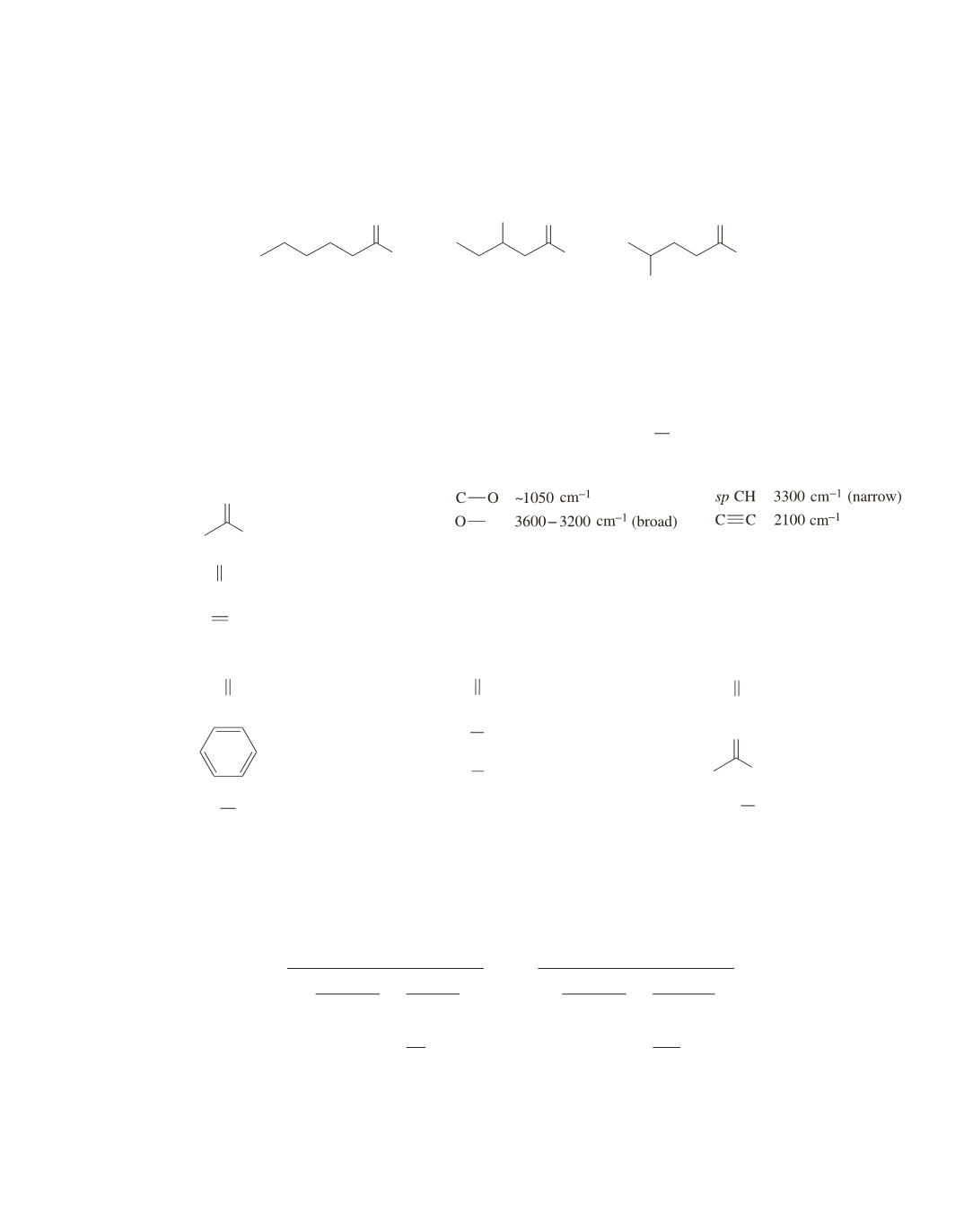
. Some possible structures are:
O
OH
O
OH
O
OH
66.
The concentration of benzene can be determined using the Beer–Lambert law, because only benzene
absorbs light of 260 nm and the length of the light path of the cell (1.0 cm) and the molar absorptivity of
benzene at 260 nm (
e
) are known.
Beer–Lambert law: A
=
c
l
e
Therefore, the concentration of benzene
=
A
l
e
67.
a.
2700 cm
−
1
C
O
1700 cm
−
1
C C 1600 cm
−
1
H
O
b.
1700 cm
−
1
1500 cm
−
1
, 1600 cm
−
1
C O ~1250 cm
−
1
, ~1050 cm
−
1
C
O
c.
H
d.
1700 cm
−
1
N H 3500–3300 cm
−
1
C
O
~1030 cm
−
1
C N
e.
f.
OH
O
1700 cm
−
1
C O ~1250 cm
−
1
C
O
~3000 cm
−
1
(broad)
68.
Calculating the term in Hooke’s law that depends on the masses of the atoms joined by a bond for a
C
¬
H bond and for a C
¬
C bond shows why stretching vibrations for smaller atoms occur at larger
wavenumbers.
for a carbon–hydrogen bond
for a carbon–hydrogen bond
m
1
+
m
2
m
1
*
m
2
=
12
+
1
12
*
1
=
13
12
=
1.08
m
1
+
m
2
m
1
*
m
2
=
12
+
12
12
*
12
=
24
144
=
0.17