



 456 / 912

448 Chapter 13
Copyright © 2017 Pearson Education, Inc.
The first compound has the
C O
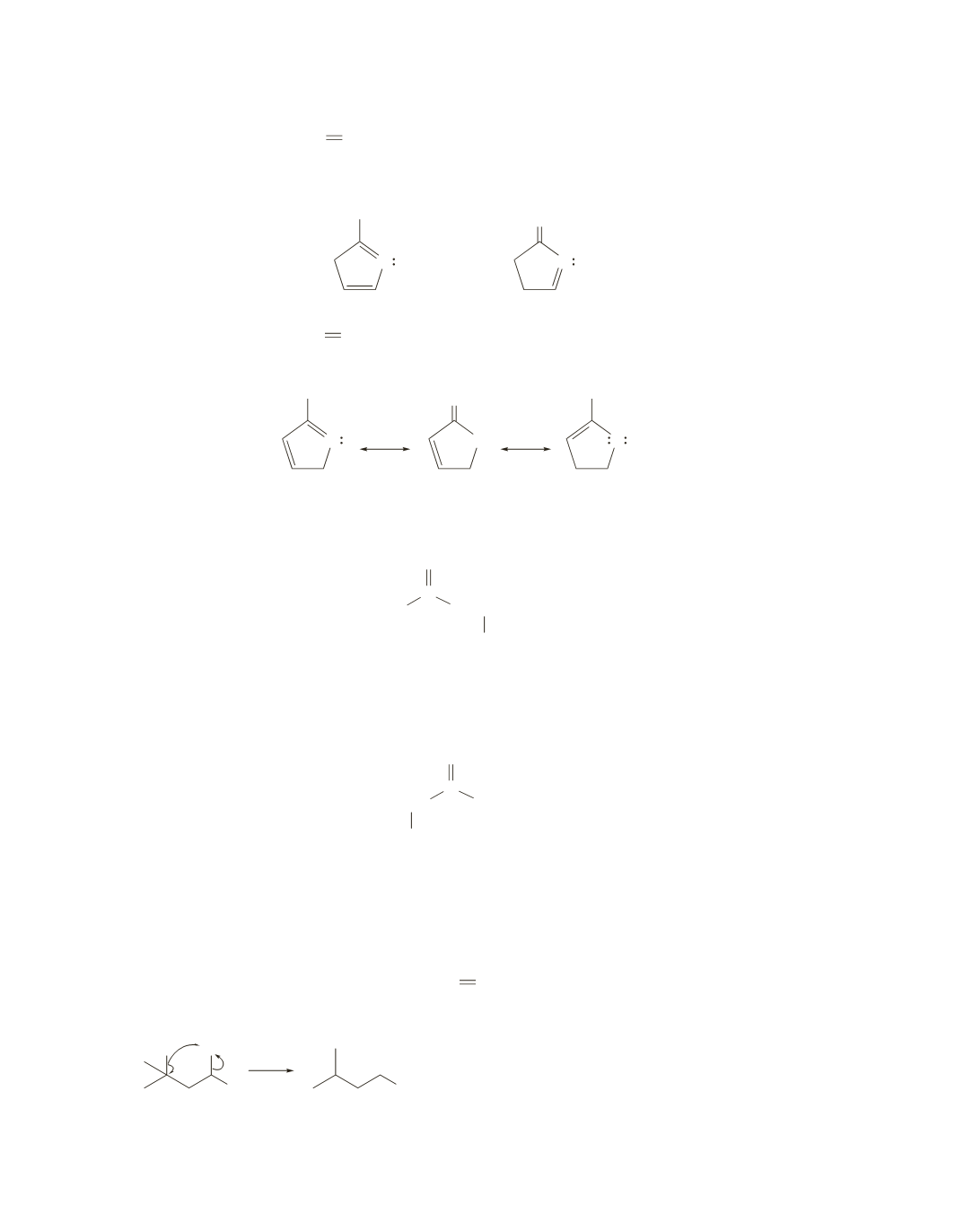
absorption band at the largest wavenumber because a lone pair on the
ring oxygen can be delocalized onto two different atoms; therefore, it is less apt than the lone pair in the
other compounds to be delocalized onto the carbonyl oxygen atom.
O
O
O
+
−
or
−
O
+
The third compound has the
C O
absorption band at the smallest wavenumber because its carbonyl group
has more single-bond character due to contributions from two other resonance contributors.
O
O
O
O
+
+
−
−
O
O
57.
The ketone shown below will show peaks at
m
>
z
=
85 (loss of a methyl group) and at
m
>
z
=
43 (loss of
an isobutyl group) and a peak at
m
>
z
=
58 due to a McLafferty rearrangement.
O
C
CH
3
CH
2
CHCH
3
CH
3
The ketone shown below will show peaks at
m
>
z
=
71 (loss of an ethyl group) and at
m
>
z
=
57 (loss of
an isopropyl group). Because it does not have a
g
-hydrogen, it cannot undergo a McLafferty rearragement.
Therefore, it will not have a peak at
m
>
z
=
58.
O
C
CH
3
CH CH
2
CH
3
CH
3
58.
a.
The tiny molecular ion peak at 102 and the broad absorption at 3600 cm
-
1
indicate that the compound
is an alcohol. The base peak at
m
>
z
=
45 indicates that the OH group is on the second carbon. The
absence of significant peaks an
m
>
z
=
29 and 27 indicates that the compound does not have an ethyl
group that can be cleaved from the molecule. The compound is 4-methyl-2-pentanol.
CH CH OH
+
3
=
45
m
/
z
b.
OH H
H O
•
•
•
•
+
+
+
=
2
m
/
z
102
=
84
m
/
z