



 463 / 912

Chapter 13 455
Copyright © 2017 Pearson Education, Inc.
Chapter 13
Practice Test
1.
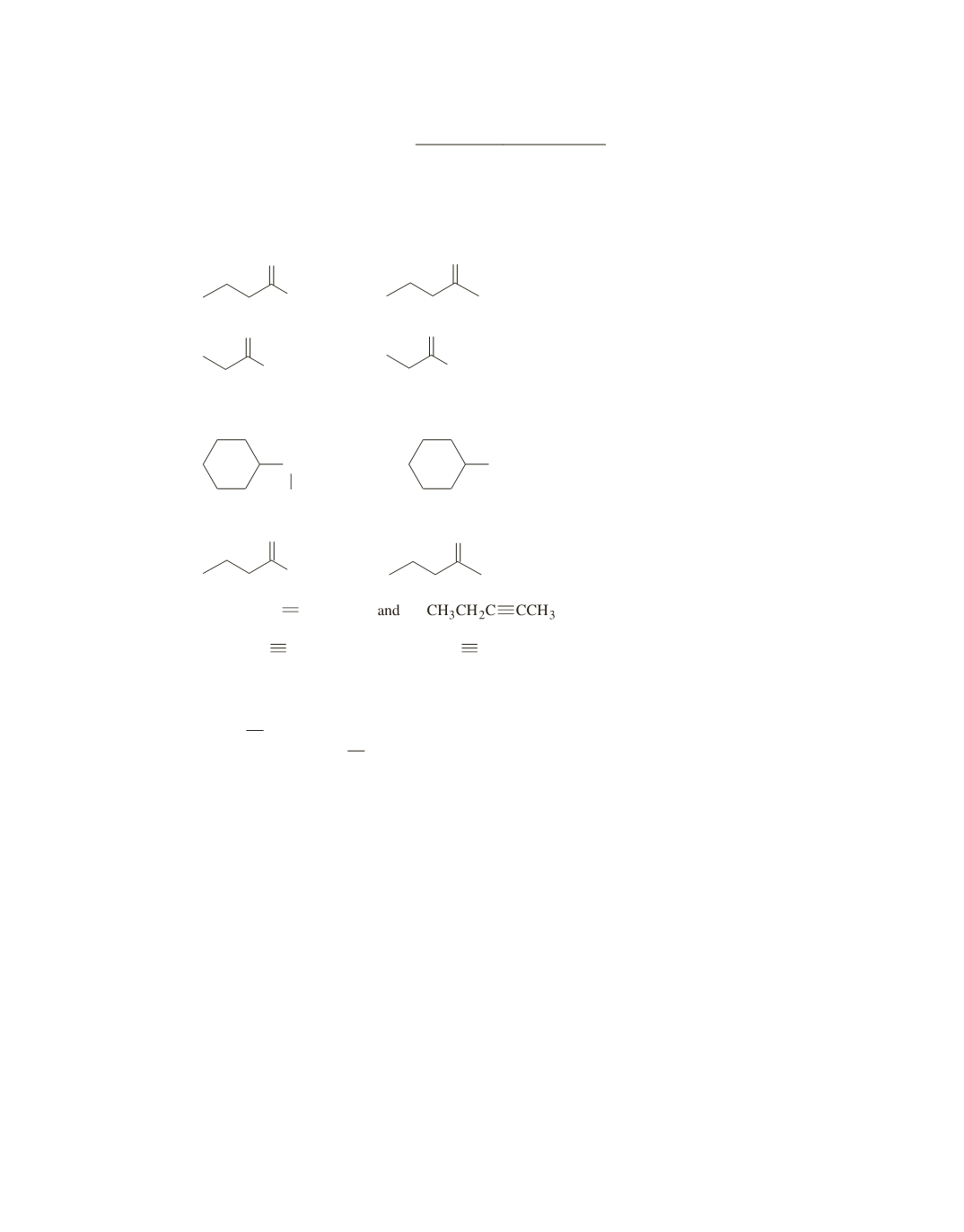
Give one IR absorption band that can be used to distinguish the following pairs of compounds. Indicate the
compound for which the band would be present.
a.
H
O
O
and
b.
NH
2
O
OCH
3
O
and
c.
CH
3
CH
2
CH
2
CH
2
OH
and
CH
3
CH
2
CH
2
OCH
3
d.
and
CHCH
3
OH
CH
2
CH
2
OH
e.
O
and
OCH
3
O
f.
CH
3
CH
2
CH CHCH
3
g.
CH
3
CH
2
C
CH
3
CH
2
C CCH
3
CH and
2.
Indicate whether each of the following statements is true or false:
a.
The
O H
stretch of a concentrated solution of an alcohol occurs at a higher
frequency than the
O H
stretch of a dilute solution.
T F
b.
Light of 280 nm is of higher energy than light of 320 nm
T F
c.
It takes more energy for a bending vibration than for a stretching vibration.
T F
d.
Propyne will not have an absorption band at 3100 cm
-
1
because there is
no change in the dipole moment.
T F
e.
The M
+
2 peak of an alkyl chloride is half the height of the M peak.
T F
3.
The major peaks shown in the mass spectrum of a tertiary alcohol are at
m
>
z
=
73, 87, 98, and 101. Iden-
tify the alcohol.
4.
A 3.8
*
10
-
4
M solution of cyclohexanone shows an absorbance of 0.75 at 280 nm in a 1.00 cm cell.
What is the molar absorptivity of cyclohexanone at 280 nm?