


 352 / 912

344 Chapter 9
Copyright © 2017 Pearson Education, Inc.
107.
The equilbrium contstant is given by the relative stabilities of the products and reactants. Therefore, any
factor that stabilizes the products increases the equilibrium constant.
K
eq
=
3
products
4
3
reactants
4
Ethanol will stabilize the charged products more than will diethyl ether because ethanol is a more polar
solvent. Therefore, the equilibrium will lie farther to the right (toward products) in ethanol.
108.
a.
The reaction with quinuclidine had the larger rate constant because quinuclidine is less sterically hin-
dered as a result of the substituents on the nitrogen being pulled back into a ring structure.
b.
The reaction with quinuclidine had the larger rate constant for the same reason given in part
a
.
c.
Isopropyl iodide exhibits the larger difference in rate constants and, therefore, the larger
k
quinuclidine
>
k
triethylamine
ratio. Because it is more sterically hindered than methyl iodide, it is more
affected by differences in the amount of steric hindrance in the nucleophile.
109.
Because methanol is a poor nucleophile, it is an
S
N
1
reaction. The bromine that departs is the one that forms
a secondary benzylic cation and not the one that would form a secondary carbocation. The nucleophile
can approach from the top or bottom of the planar carbocation.
+
OCH
3
Br
OCH
3
Br
110.
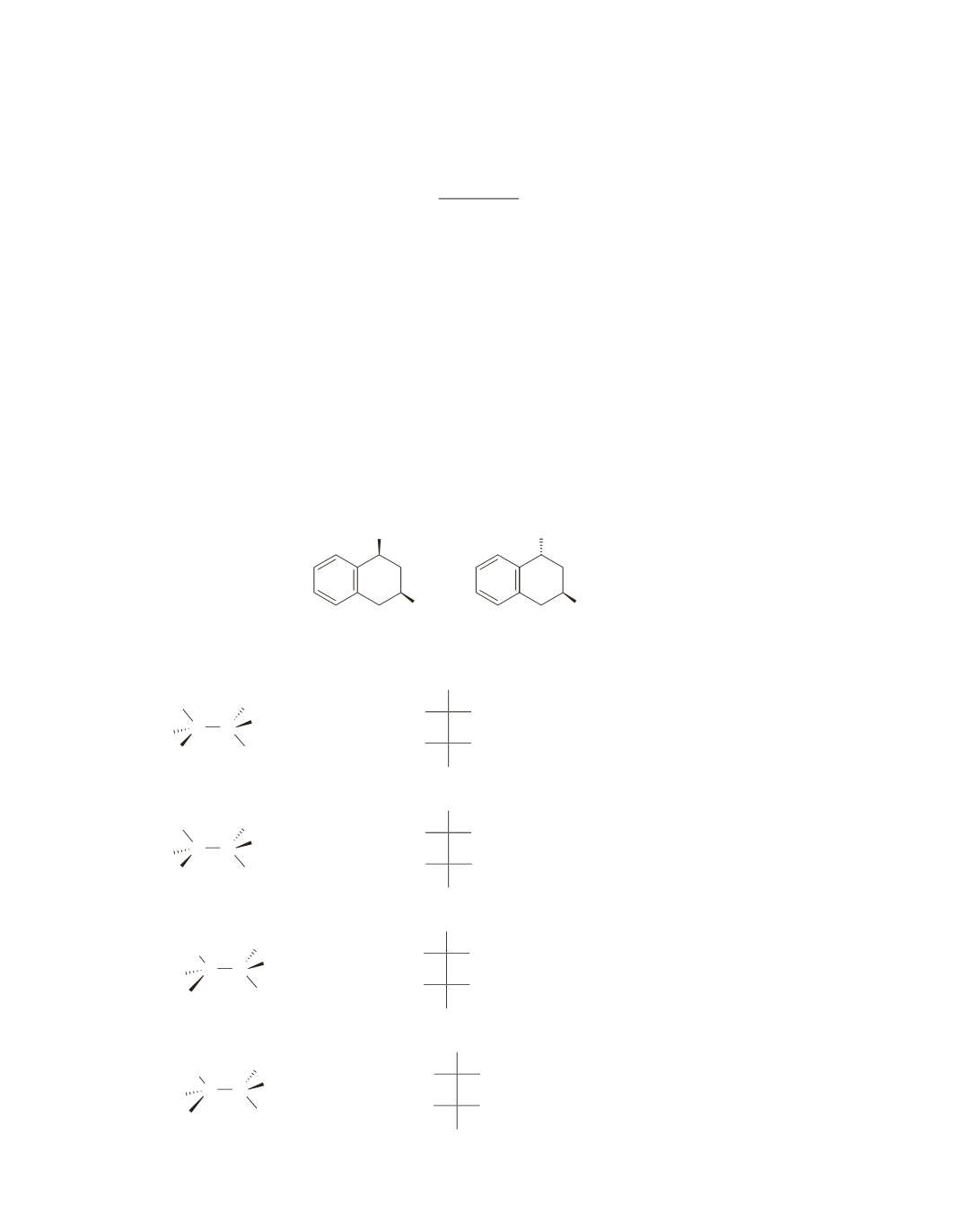
Because all the reactions are
S
N
2
reactions, the configuration of the asymmetric center attached to the Br in
the reactant is inverted in the product.
a.
C C CH
3
CH
2
CH
3
H
CH
3
O
CH
3
CH
2
H
CH
2
CH
3
CH
3
O H
CH
2
CH
3
H
or
(3
R
,4
S
)
CH
3
b.
C C CH
2
CH
3
CH
3
H
CH
3
O
CH
3
CH
2
H
CH
2
CH
3
CH
3
O H
CH
2
CH
3
H CH
3
or
(3
R
,4
R
)
c.
C C CH
2
CH
3
CH
3
H
CH
3
CH
2
CH
3
O
H
CH
2
CH
3
H OCH
3
CH
2
CH
3
H CH
3
or
(3
S
,4
R
)
d.
C C CH
3
CH
2
CH
3
H
CH
3
CH
2
CH
3
O
H
CH
2
CH
3
H OCH
3
CH
2
CH
3
H
or
(3
S
,4
S
)
CH
3