


 349 / 912

Chapter 9 341
Copyright © 2017 Pearson Education, Inc.
100.
a.
These are
S
N
2
>
E2
reactions, because the alkyl halide is secondary.
(CH
3
)
2
CH
+
CH(CH
3
)
2
+
CH
3
O
−
CH
3
OH
Cl
(CH
3
)
2
CH
CH
3
O
−
CH
3
OH
CH(CH
3
)
2
CH(CH
3
)
2
CH
3
O
Cl
OCH
3
(CH
3
)
2
CH
b.
Only the substitution products are optically active; the elimination product does not have an asymmetric
center.
c.
CH(CH
3
)
2
(CH
3
)
2
CH
CH
3
O
−
CH
3
OH
(CH
3
)
2
CH
CH
3
O
−
CH
3
OH
CH(CH
3
)
2
CH
3
O CH(CH
3
)
2
Cl
OCH
3
(CH
3
)
2
CH
+
+
Cl
All the products are optically active.
d.
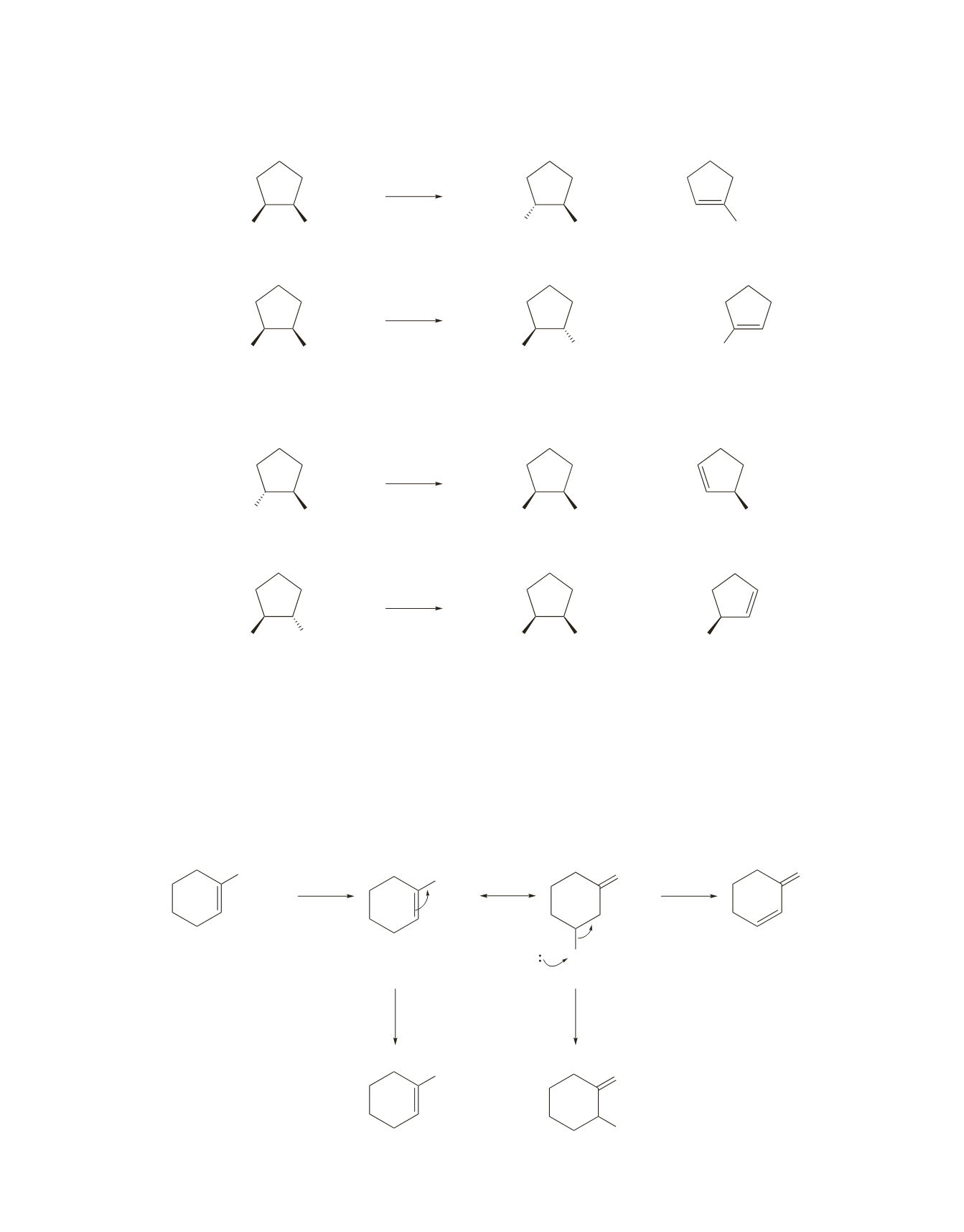
The cis enantiomers form the substitution products more rapidly, because there is less steric hindrance
from the adjacent substituent to back-side attack by the nucleophile.
e.
The cis enantiomers form the elimination products more rapidly, because the alkenes formed from the
cis enantiomers are more substituted and, therefore, more stable. The more stable the alkene, the lower
the energy of the transition state leading to its formation and the more rapidly it is formed.
101.
CH
2
Br
CH
2
CH
2
CH
2
H B
CH
2
OCH
2
CH
3
+
+
CH
2
OCH
2
CH
3
CH
2
CH
2
OH
CH
2
CH
2
OH