



 277 / 912

Chapter 8 269
Copyright © 2017 Pearson Education, Inc.
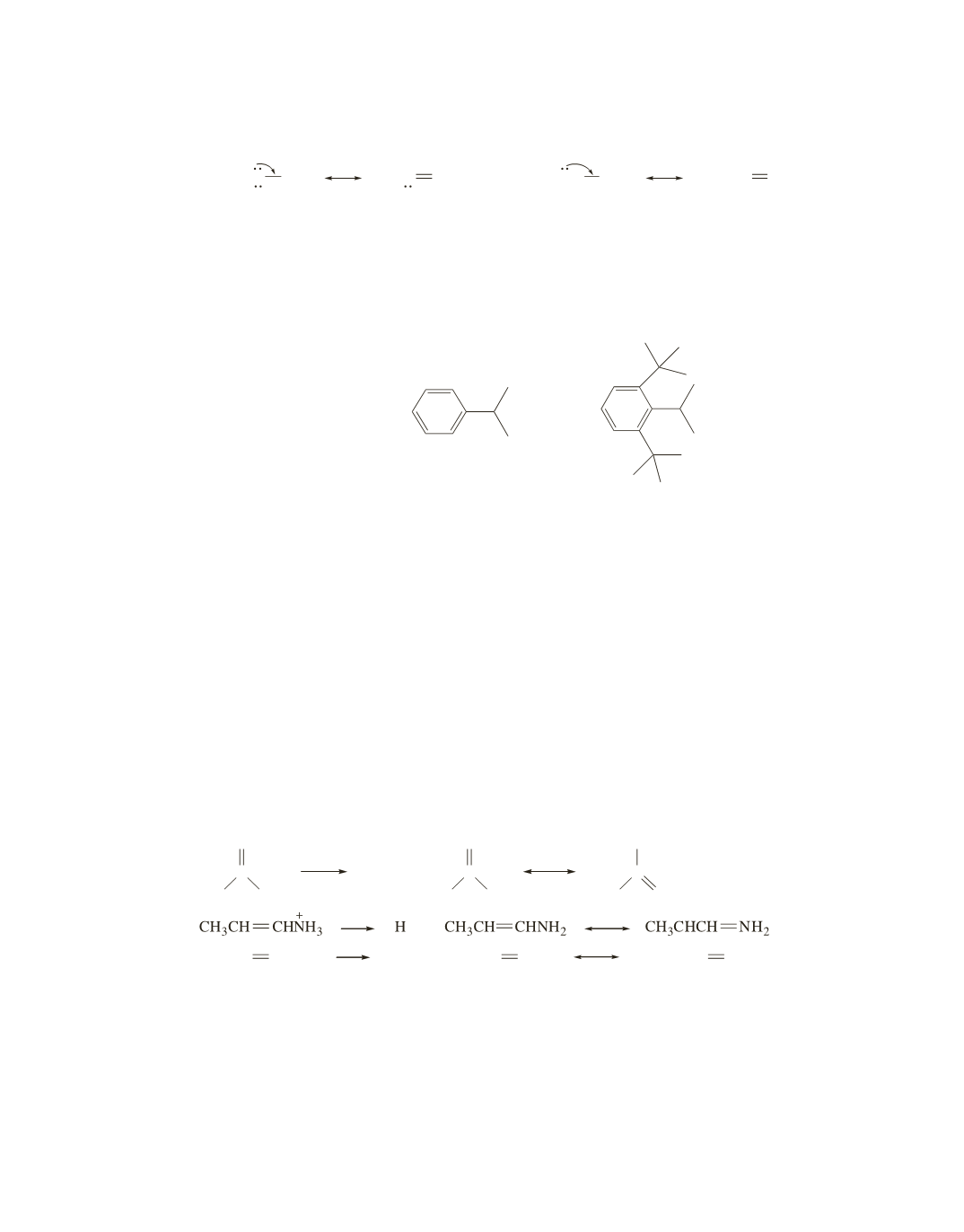
b.
Because nitrogen is less electronegative than oxygen, it shares the positive charge better.
CH
3
O CH
2
+
CH
3
O CH
2
+
CH
3
NH CH
2
+
CH
3
NH CH
2
+
more stable
c.
In order for electron delocalization to occur, the atoms that share the
p
electrons must be in the same
plane so that their
p
orbitals can overlap. The two bulky
tert
-butyl groups do not allow enough room
for the group with the positively charged carbon to be in the same plane as the benzene ring. Therefore,
the carbocation cannot be stabilized by electron delocalization because the
p
orbital of the positively
charged carbon cannot overlap the
p
orbitals of the benzene ring since they are not in the same plane.
+
+
more stable
14.
The
c
3
molecular orbital of 1,3-butadiene has three nodes (two vertical and one horizontal).
The
c
4
molecular orbital of 1,3-butadiene has four nodes (three vertical and one horizontal).
15.
a.
c
1
and
c
2
are bonding molecular orbitals, and
c
3
and
c
4
are antibonding molecular orbitals.
b.
c
1
and
c
3
are symmetric molecular orbitals, and
c
2
and
c
4
are antisymmetric molecular orbitals.
c.
c
2
is the HOMO and
c
3
is the LUMO in the ground state.
d.
c
3
is the HOMO and
c
4
is the LUMO in the excited state.
e.
If the HOMO is symmetric, the LUMO is antisymmetric and vice versa.
16.
The MO of benzene is more stable because it has six bonding interactions, whereas the MO of 1,3,5-hexatriene
has five bonding interactions.
17.
In each case, the compound shown is the stronger acid because the negative charge that results when it loses
a proton can be delocalized. Electron delocalization stabilizes the base, and the more stable the base, the
more acidic its conjugate acid. Electron delocalization is not possible for the other compound in each pair.
a.
CH
3
C
O
OH
H
+
+
CH
3
C
O
O
−
CH
3
C
O
O
−
b.
+
+
+
−
c.
+
−
CH
3
CH CHOH
H
+
CHO
–
CH
3
CHCH O
CH
3
CH