



 275 / 912

Chapter 8 267
Copyright © 2017 Pearson Education, Inc.
b.
CH
3
NH CH CHCH
3
CHCH
3
CH
3
NH CH
+
B
A
−
A
is more stable than
B
because
B
has separated charges and a positive
charge on a nitrogen.
c.
O
−
O
−
A
is more stable than
B
because the
negative charge in
A
is on an oxygen,
whereas the negative in
B
is on
carbon, which is less electronegative
than oxygen.
O
δ −
δ −
d.
O
A
O
−
B
+
A
is more stable than
B
because
A
does not have separated charges and
B
has an atom with an incomplete octet.
O
δ +
δ −
e.
CH
3
CH CH CHCH
3
+
CH
3
CH CH CHCH
3
+
A
B
CH
3
C
OH
NHCH
3
CH
B
A
3
C
OH
NHCH
3
+
+
A
is more stable than
B
because the
positive charge in
A
is on a less
electronegative atom. (N is less
electronegative than O.)
CH
3
C
OH
NHCH
3
δ +
δ +
f.
CH
3
CH CH CHCH
3
+
CH
3
CH CH CHCH
3
+
A
B
CH
3
C
OH
NHCH
3
CH
B
A
3
C
OH
NHCH
3
+
+
A
and
B
are equally stable.
CH
3
CH CH CHCH
3
δ +
δ +
7.
a.
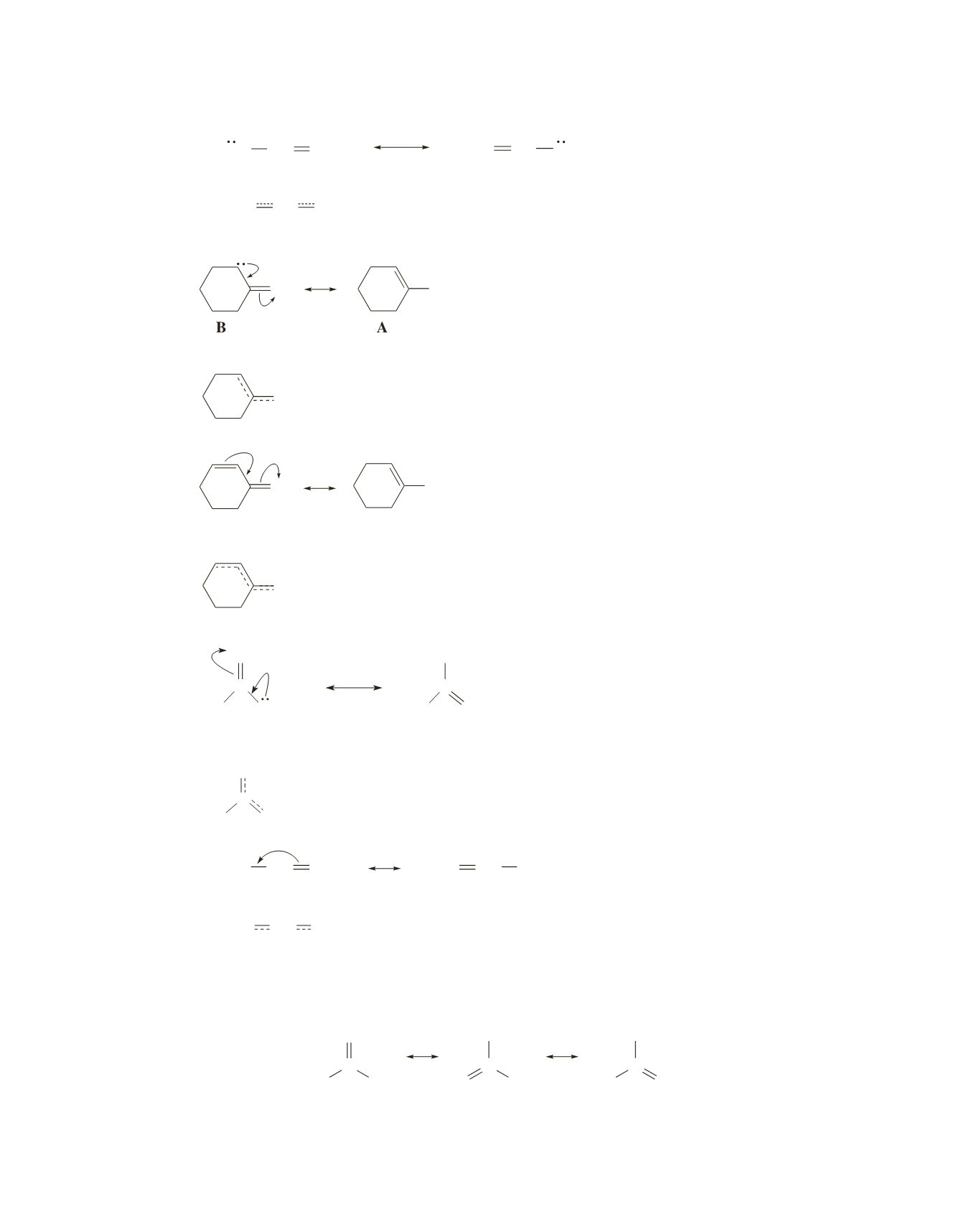
All the carbon–oxygen bonds in the carbonate ion are the same length, because each carbon–oxygen
bond is represented in one resonance contributor by a double bond and in two resonance contributors
by a single bond.
−
O O
−
C
O
O O
−
C
O
−
−
O O
C
O
−
b.
Because the two negative charges are shared equally by three oxygens, each oxygen has two-thirds of a
negative charge.
CH NH
3
HC CHCH
3
δ +
δ −