


 224 / 912

216 Chapter 6
Copyright © 2017 Pearson Education, Inc.
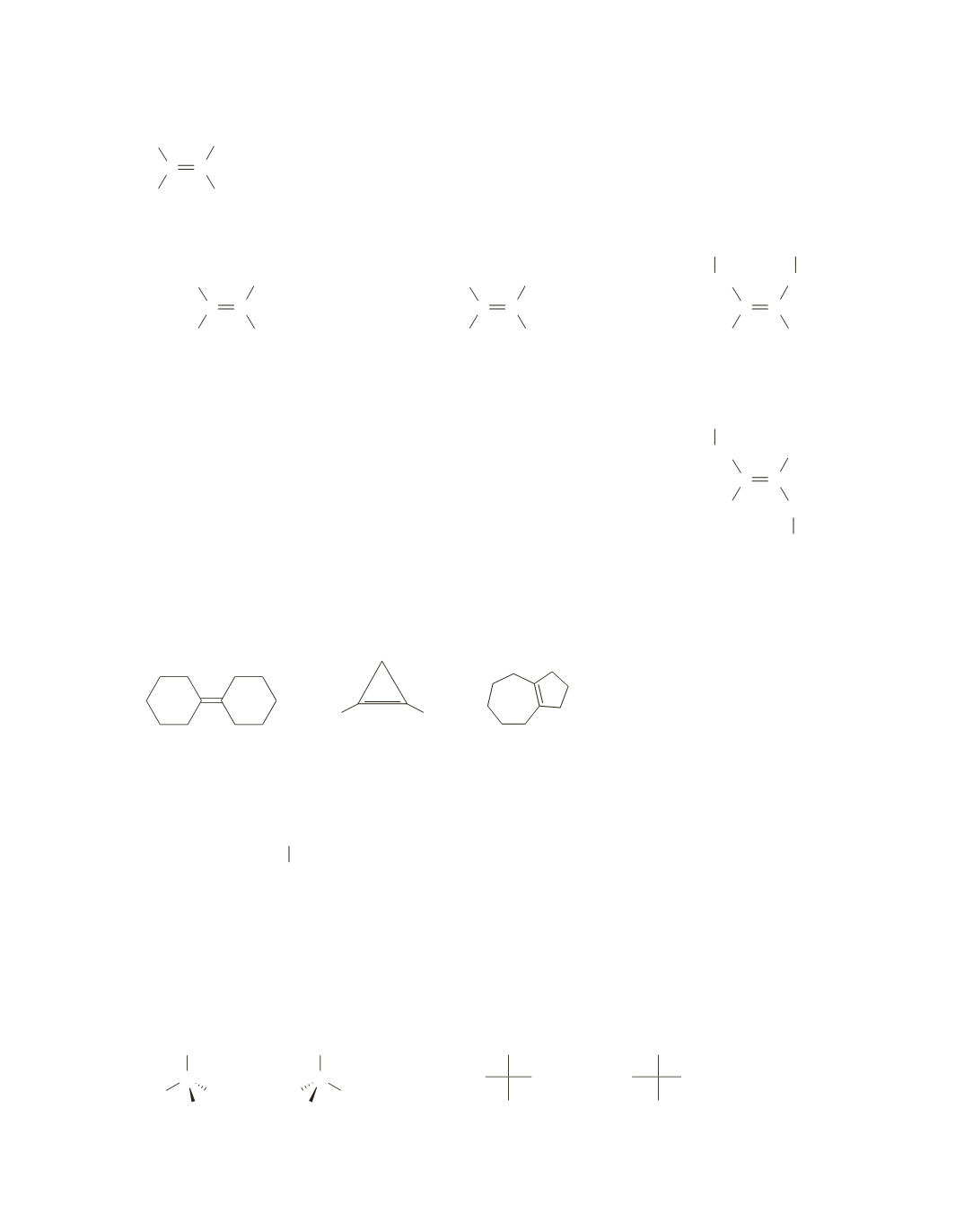
31.
a.
2,3-dimethyl-2-butene
CH
3
C C
CH
3
CH
3
CH
3
b.
cis
-4-octene
or
CH
3
CH
2
CH
2
C C
H
CH
2
CH
2
CH
3
H
trans
-4-octene
CH
3
CH
2
CH
2
C C
CH
2
CH
2
CH
3
H
H
or
or
cis
-2,5-dimethyl-3-hexene
CH
3
CH
CHCH
3
CH
3
CH
3
C C
H H
trans
-2,5-dimethyl-3-hexene
CH
3
CH
3
CH
H
CH
3
C C
CHCH
3
H
32.
It does not tell you whether the double bond has the
E
or
Z
configuration.
33.
Solved in the text.
34.
a.
b.
c.
35.
The reactant must have
E,Z
stereoisomers or
R,S
stereoisomers.
36.
a.
No, because only one constitutional isomer can be formed as a product since 2-butene is a symmetrical
alkene.
CH
3
CH
2
CHCH
3
Br
b.
No, because it forms a racemic mixture.
c.
No, because
cis
-butene and
trans
-butene form the same product.
d.
Yes, because two constitutional isomers are possible but only one is formed.
e.
No, because it forms a racemic mixture.
f.
No, because 1-butene does not have stereoisomers.
37.
Only the stereoisomers of the major product of each reaction are shown.
a.
CH
2
CH
2
CH
3
C
H
CH
2
CH
2
CH
3
C
CH
3
H
Cl
Cl
CH
3
Cl
CH
2
CH
2
CH
3
H
or
CH
3
H
CH
2
CH
2
CH
3
Cl
S
R
S
R
racemic
mixture
H
3
C