



 222 / 912

214 Chapter 6
Copyright © 2017 Pearson Education, Inc.
19.
Either BH
3
or R
2
BH can be used for the hydroboration reactions in this chapter.
a.
CH
3
CH
3
OH
CH
3
C CHCH
3
CH
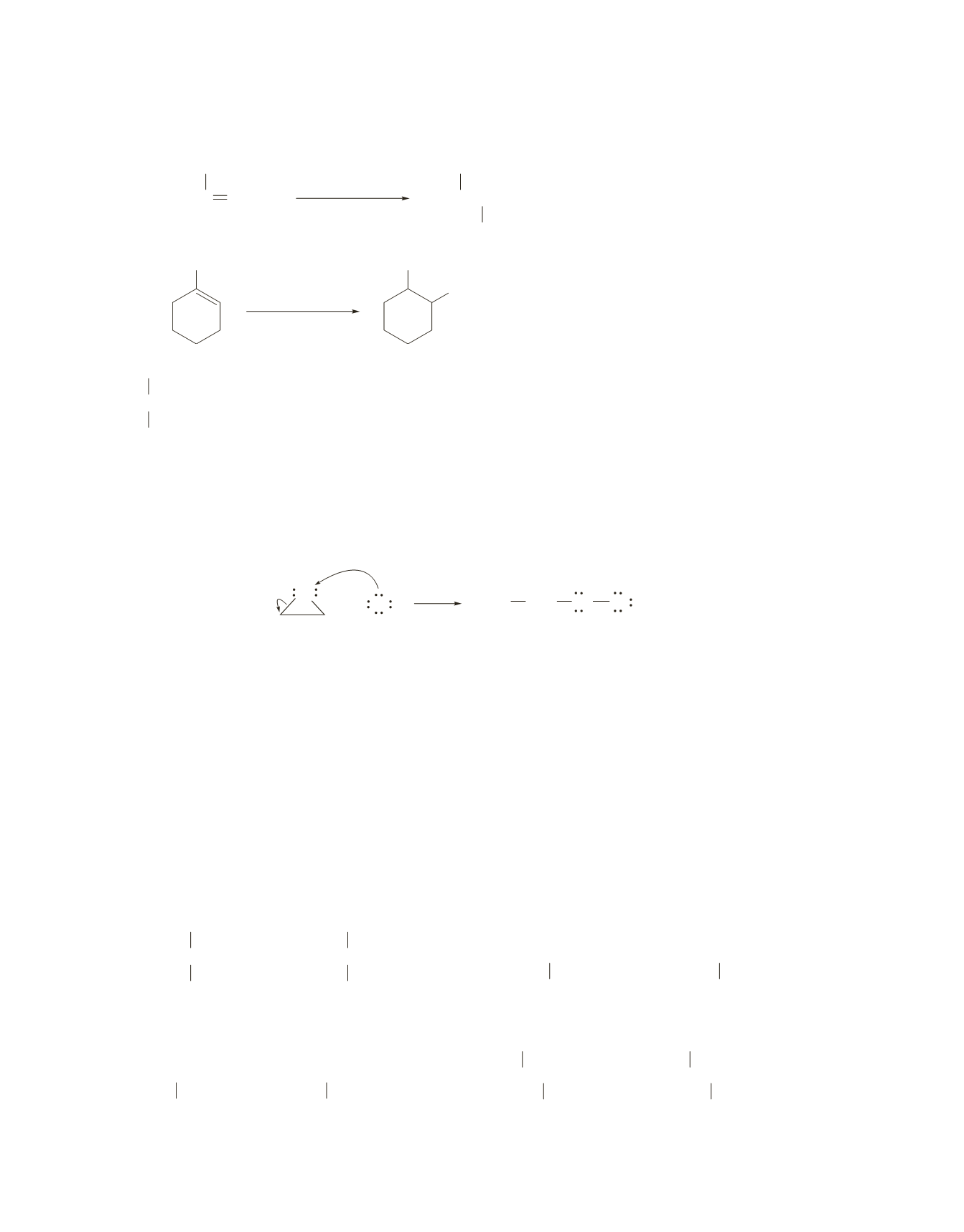
3
CHCHCH
3
1. BH
3
/THF
2. HO
–
, H
2
O
2
, H
2
O
b.
CH
3
CH
3
OH
1. BH
3
/THF
2. HO
–
, H
2
O
2
, H
2
O
20.
CH
3
CCH
2
CH
3
CH
3
Br
Addition of H
+
forms a carbocation that rearranges.
Addition of Br
+
forms a cyclic bromonium ion rather than a carbocation, so there is no
carbocation rearrangement.
21.
a.
The first step in the reaction of propene with Br
2
forms a cyclic bromonium ion, whereas the first step
in the reaction of propene with HBr forms a carbocation.
b.
If the bromide ion were to attack the positively charged bromine, a highly unstable compound (with a
negative charge on carbon and a positive charge on bromine) would be formed.
+
Br
−
+
CH
2
CH
2
Br Br
−
+
Br
Notice that the electrostatic potential map of the cyclic bromonium ion on page 254 of the text shows
that the ring carbons are the least electron dense (most blue) atoms in the intermediate and, therefore,
are the ones most susceptible to nucleophilic attack.
22.
Sodium and potassium achieve an outer shell of eight electrons by losing the single electron they have in
the 3
s
1
in the case of Na
2
or 4
s
(in the case of K) orbital, thereby becoming Na
+
and K
+
.
In order to form a covalent bond, they would have to regain electrons in these orbitals, thereby losing the
stability associated with having an outer shell of eight electrons and no extra electrons.
23.
The nucleophile that is present in greater concentration is more apt to collide with the intermediate. For
example, in part
a
the concentration of CH
3
OH (the solvent) is much greater than the concentration of Cl
-
;
in part
b
, the nucleophile is most likely to be I
-
because there are two equivalents of NaI and one equiva-
lent of HBr.
a.
ClCH
2
CCH
3
CH
3
Cl
ClCH
2
CCH
3
CH
3
OCH
3
and
major
c.
CH
3
CH
2
CHCH
3
OH
and
major
CH
3
CH
2
CHCH
3
Cl
b.
CH
3
CHCH
3
Br
CH
3
CHCH
3
I
and
major
d.
OCH
3
and
major
CH
3
CHCHCH
3
Br
Br
Br
CH
3
CHCHCH
3