


 223 / 912

Chapter 6 215
Copyright © 2017 Pearson Education, Inc.
24.
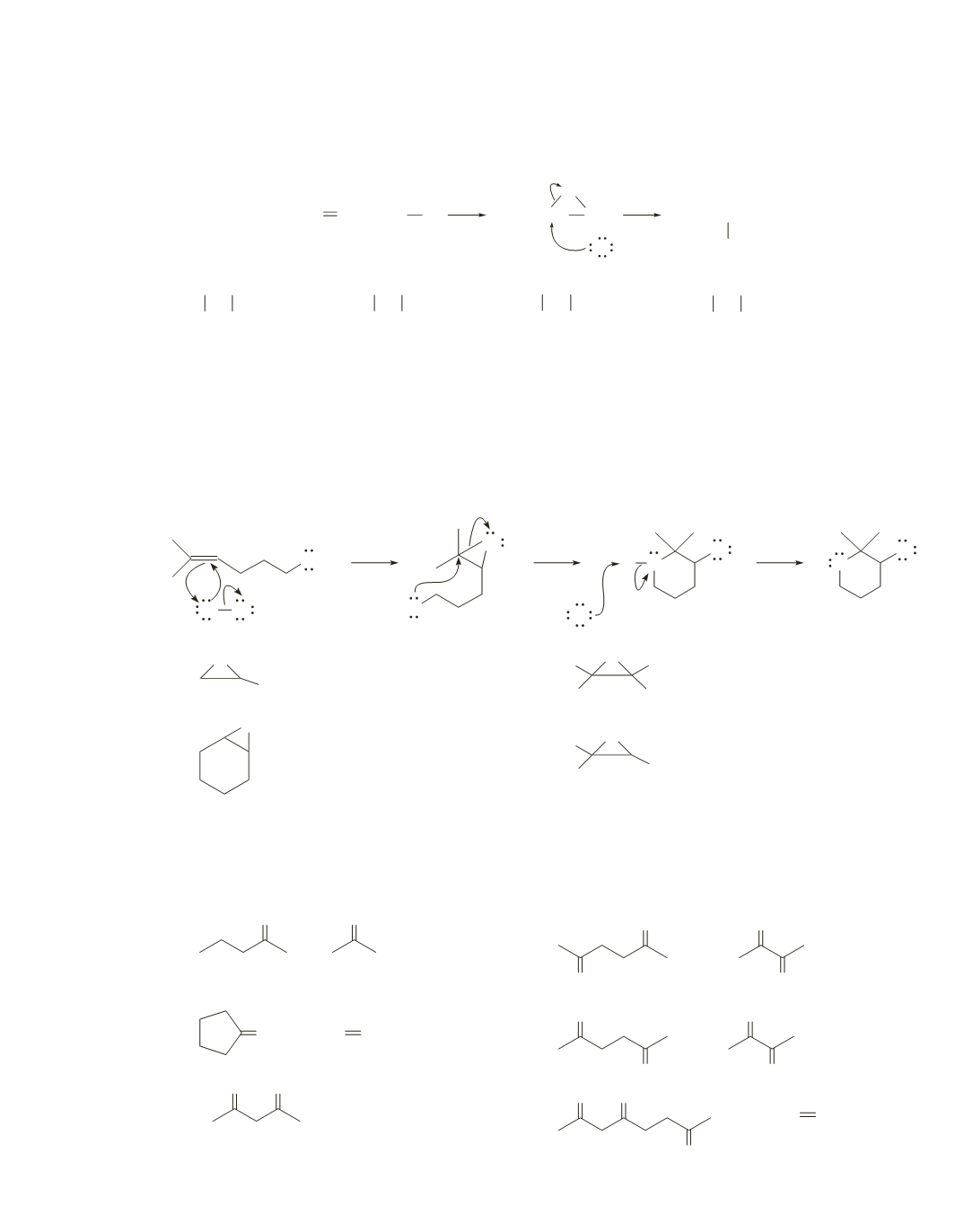
Because chlorine is more electronegative than iodine, iodine is the electrophile. Therefore, it ends up
attached to the
sp
2
carbon that is bonded to the most hydrogens.
CH
3
CH
2
CH CH
2
I Cl
+
I
+
CH
3
CH
2
CH CH
2
Cl
−
CH
3
CH
2
CHCH
2
I
Cl
δ+ δ−
25.
a.
CH
2
CHCH
2
CH
3
Br
Br
b.
CH
2
CHCH
2
CH
3
OH Br
c.
CH
2
CHCH
2
CH
3
OCH
2
CH
3
Br
d.
CH
2
CHCH
2
CH
3
OCH
3
Br
26.
Look at the reagent
1
Cl
2
2
and remember what that reagent does when it reacts with an alkene (do not let
the rest of the molecule confuse you): when Cl
2
adds to an alkene, it forms a cyclic chloronium ion inter-
mediate. You know that the intermediate then reacts with a nucleophile.
There are two nucleophiles in the solution that can react with the intermediate, a Cl
-
and the OH group at
the end of the molecule. There is a greater probability that the OH group is the nucleophile that attacks the
chloronium ion because, since it is attached to the reactant, it does not have to wander through the solution
to find the chloronium ion as the Cl
-
has to. Loss of a proton forms the six-membered ring ether.
+
O
Cl
H
_
OH
Cl Cl
HO
Cl
+
Cl
O
Cl
27.
a.
O
CH
2
CH
2
CH
3
c.
O
CH
3
H
3
C
H
3
C
CH
3
b.
O
d.
O
CH
2
CH
3
H
3
C
H
3
C
28.
a.
1-pentene
b.
cyclohexene
c.
2,3-dimethyl-2-butene
d.
2-methyl-2-pentene
29.
Solved in the text.
30.
a.
+
O
O
d.
H
+
O
H
O
O
O
H
b.
H
2
C O
O
+
e.
+
H
O
O
O
H
O
H
c.
H
H
O O
f.
H
2
C O
H
H
+
O O
O