


 229 / 912

Chapter 6 221
Copyright © 2017 Pearson Education, Inc.
d.
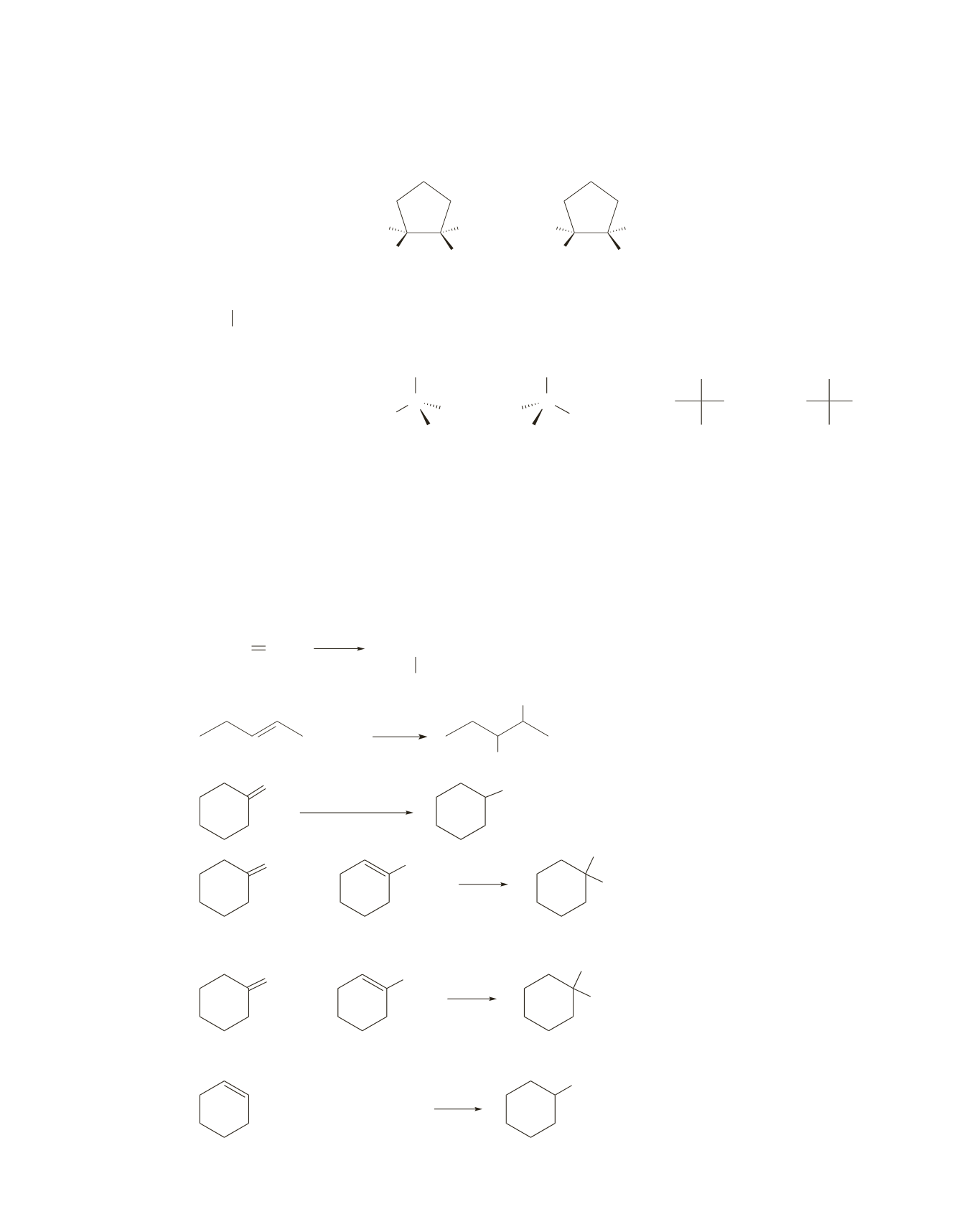
Only syn addition occurs. Because the reactant is cis, the product is the pair of enantiomers with the
hydrogens on the same side of the ring.
CH
3
CH
2
CH
3
CH
3
CH
2
CH
3
H
H
H
H
50.
a.
CH
3
CHCH
2
Br
Cl
b.
Equal amounts of the
R
and
S
enantiomers are formed (a racemic mixture)
because a reactant without an asymmetric center forms a product with one
asymmetric center.
CH
2
Br
C
H
Cl
+
CH
2
Br
C
CH
3
H
Cl
or
CH
2
Br
Cl
CH
3
H
+
CH
2
Br
H
CH
3
Cl
S
R
S
R
CH
3
51.
a.
A racemic mixture of
1
R
2
-malate and
1
S
2
-malate. (A product with one asymmetric center is formed
from a reactant with no asymmetric centers.)
b.
A racemic mixture of
1
R
)-malate and
1
S
2
-malate. In the absence of an enzyme, the reactions are nei-
ther stereoselective (part
a
) nor stereospecific (part
b
).
52.
Solved in the text.
53.
a.
CH
3
CH CH
2
CH
3
CHCH
3
H
2
SO
4
CH
3
OH
OCH
3
b.
Br
Br
Br
+
c.
1. R
2
BH/THF
2. HO
−
, H
2
O
2
, H
2
O
CH
2
CH
2
OH
d.
CH
2
or
CH
3
CH
3
OH
H
2
SO
4
OCH
3
CH
3
This is the better option because the reaction is more highly regioselective.
e.
or
HBr
CH
2
CH
3
Br
CH
3
This is the better option because the reaction is more highly regioselective.
f.
H
2
SO
4
+
CH
3
CH
2
CH
2
OH
OCH
2
CH
2
CH
3