


 219 / 912

Chapter 6 211
Copyright © 2017 Pearson Education, Inc.
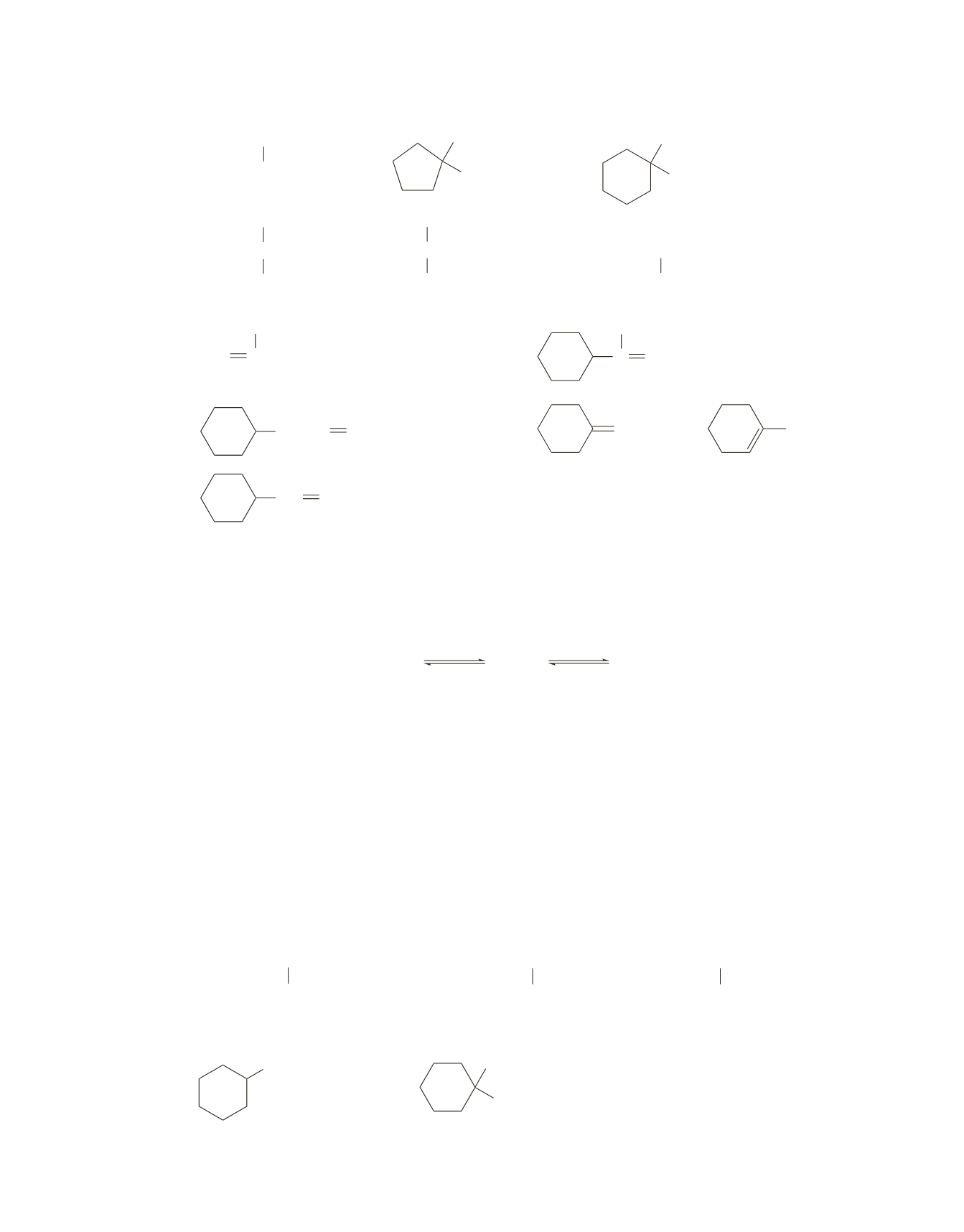
7.
a.
CH
3
CH
2
CHCH
3
Br
c.
Br
CH
3
e.
Br
CH
3
b.
CH
3
CH
2
CCH
3
Br
CH
3
d.
CH
3
CCH
2
CH
2
CH
3
CH
3
Br
f.
CH
3
CH
2
CHCH
3
Br
8.
a.
CH
2
CCH
3
CH
3
b.
CH
2
CH CH
2
CH CHCH
3
c.
C
CH
3
CH
2
d.
CHCH
3
CH
2
CH
3
or
This is not a good choice, because it
forms equal amounts of two products.
9.
As long as the pH is greater than about
-
2.5 and less than about 15, more than 50% of 2-propanol will be
in its neutral, nonprotonated form.
ROH
2
ROH
RO
−
+
p
K
a
p
K
a
= −
2.5
= ∼
15
Recall that when the pH
=
p
K
a
, half the compound is in its acidic form and half is in its basic form.
Therefore, at a pH less than about
-
2.5, more than half of the compound is in its positively charged pro-
tonated form. At a pH greater than about 15, more than half of the compound exists as the negatively
charged anion.
Therefore, at a pH between
-
2.5 and 15, more than half of the compound exists in the neutral nonpro-
tonated form.
10.
a.
three transition states
b.
two intermediates
c.
The first step is the
slowest step
, so it has the
smallest rate constant
; the second step is fast because no
bonds are being broken; the third step is fast because transfer of a proton from or to an O or an N is
always a fast reaction.
11.
a.
CH
3
CH
2
CH
2
CHCH
3
OH
c.
CH
3
CH
2
CH
2
CH
2
CHCH
3
OH
CH
3
CH
2
CH
2
CHCH
2
CH
3
and
OH
equal amounts are formed
b.
OH
d.
OH
CH
3