



 91 / 912

Chapter 1
83
Copyright © 2017 Pearson Education, Inc.
c. H
2
CO
The double-bonded carbon and the double-bonded oxygen in H
2
CO each uses
sp
2
orbitals; thus, the
bonds around the double-bonded carbon are all
120
°
.
Each carbon–hydrogen bond is formed by the
overlap of an
sp
2
orbital of carbon with the
s
orbital of hydrogen.
O
C
H H
sp –
2
s
overlap
the bond is formed by
sp
2
–
sp
2
overlap
the bond is formed by
p
–
p
overlap
sp –
2
s
overlap
all bond angles are 120
°
d.
N
2
The triple bond consists of one
s
bond and two
p
bonds. Each nitrogen has two
sp
orbitals; one is used to
form the
s
bond, and the other contains the lone pair. Each nitrogen has two
p
orbitals that are used to form
the two
p
bonds. A bond angle is the angle formed by three atoms. Therefore, there are no bond angles in
this two-atom containing compound.
N N the bond is formed by
sp
–
sp
overlap
each bond is formed by
p
–
p
overlap
s
p
e.
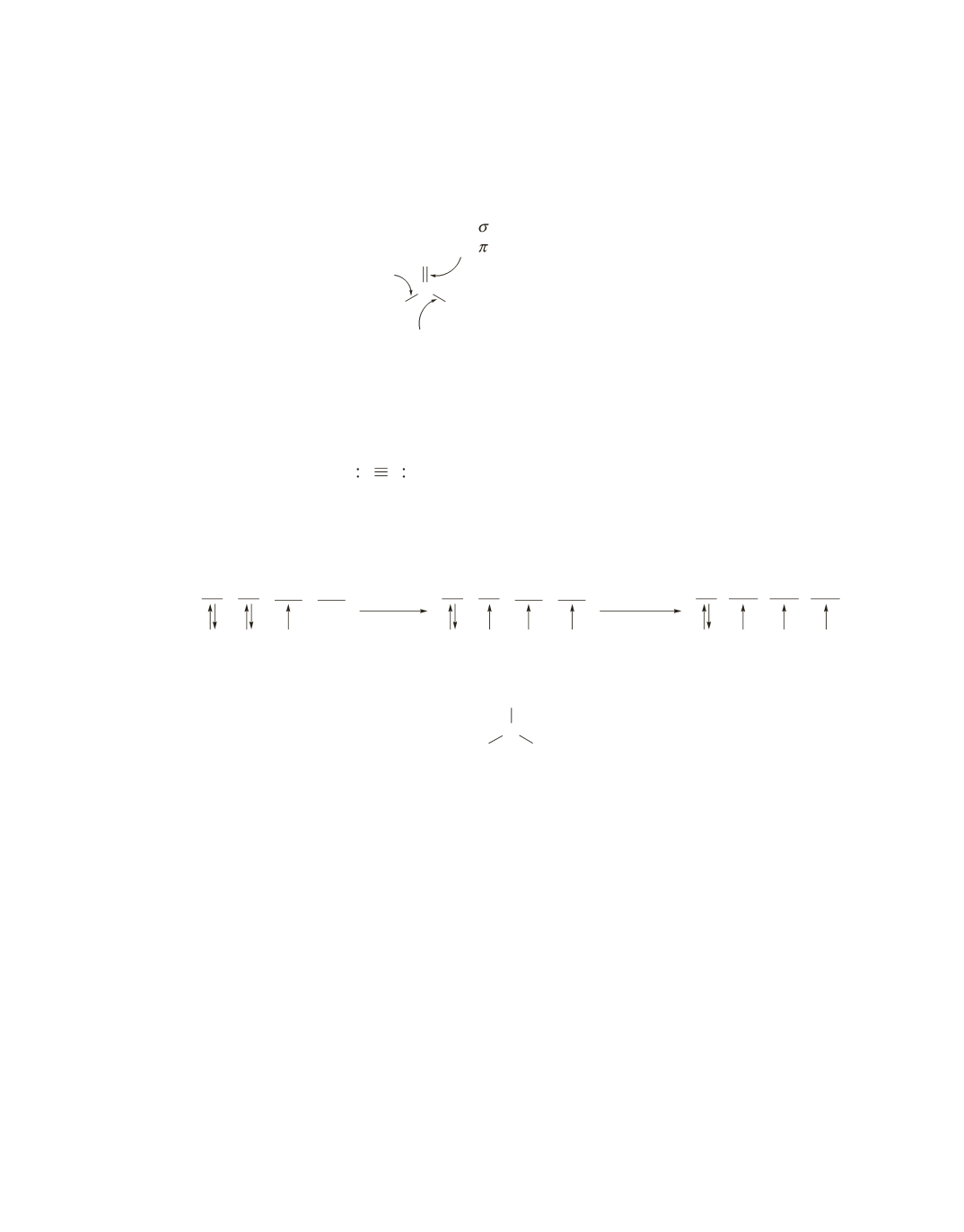
BF
3
Promotion gives boron three unpaired electrons, and hybridization gives it three
sp
2
orbitals.
1
s
2
s
2
p
x
promotion
hybridization
2
p
y
1
s
2
s
2
p
x
2
p
y
1
s
2
sp
2
2
sp
2
2
sp
2
Each
sp
2
orbital of boron overlaps an
sp
3
orbital of fluorine. The three
sp
2
orbitals orient themselves to
get as far away from each other as possible, resulting in bond angles of
120
°
.
F
B
F
F
bond angles
=
120
°
40.
Solved in the text.
41.
We know that the
s
bond is stronger than the
p
bond, because the
s
bond in ethane has a bond dissociation
energy of 90.2 kcal
>
mol, whereas the bond dissociation energy of the double bond
(
s
+
p
)
in ethene is
174.5 kcal
>
mol, which is less than twice as strong.
Because the
s
bond is stronger, we know that it has more effective orbital–orbital overlap.
42.
Because electrons in an
s
orbital are closer on average to the nucleus than those in a
p
orbital, the greater
the
s
character in the interacting orbitals, the stronger (and shorter) the bond. Therefore, the carbon–
carbon
s
bond formed by
sp
2
9
sp
2
overlap is stronger (and shorter) than the carbon–carbon bond formed by
sp
3
9
sp
3
overlap, because an
sp
2
orbital has 33.3%
s
character, whereas an
sp
3
orbital has 25%
s
character.