



 92 / 912

84
Chapter 1
Copyright © 2017 Pearson Education, Inc.
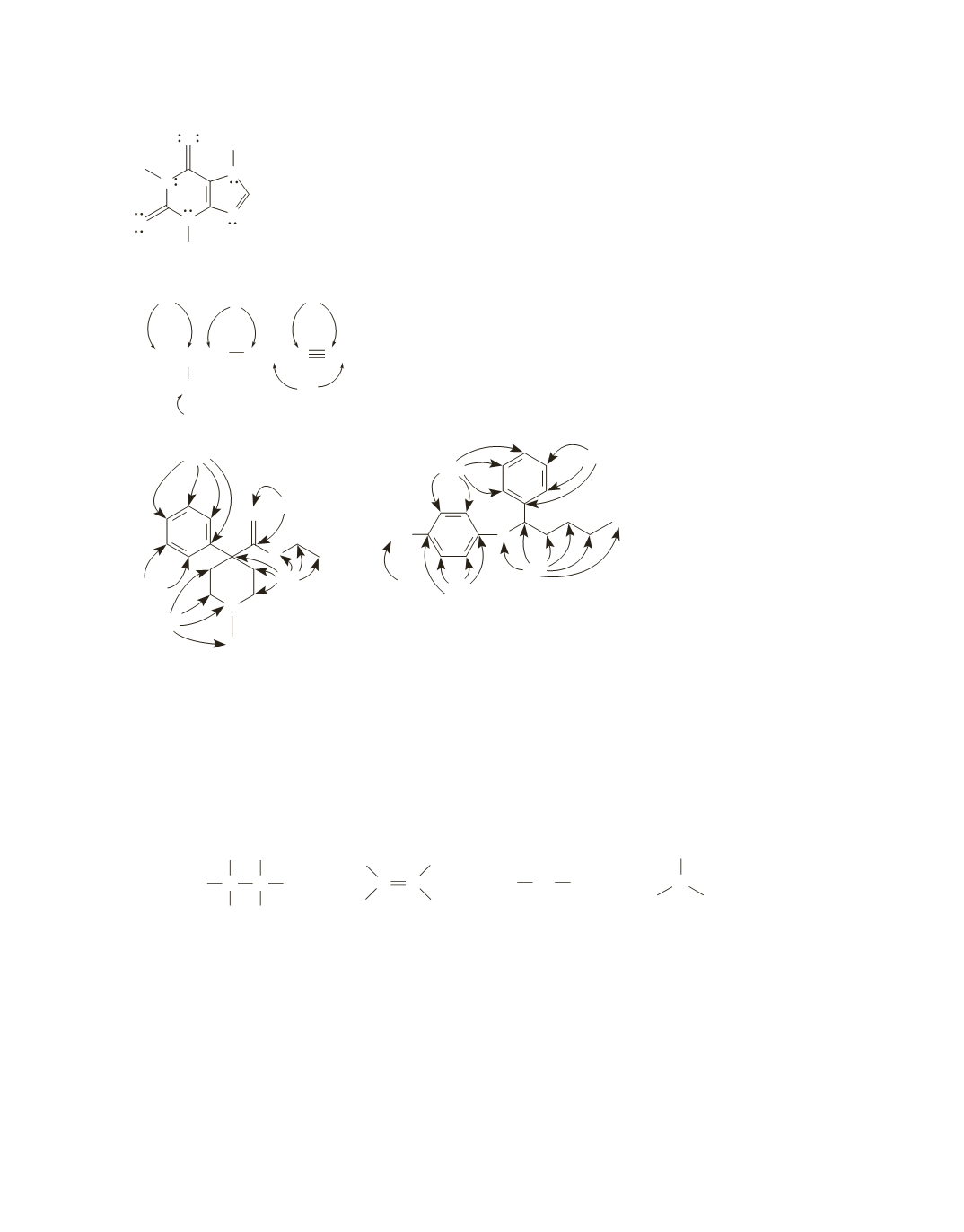
43.
O
O
CH
3
CH
3
CH
3
N
N
N
N
44.
a.
CH
3
CHCH CHCH
2
C CCH
3
CH
3
sp
3
sp
3
sp
3
sp
2
sp
b.
O
sp
2
sp
2
sp
2
sp
2
sp
2
sp
2
sp
3
sp
3
sp
3
sp
3
O
N
CH
3
NH Cl
3
CF
3
O
+
−
c.
the nitrogen and chlorine atoms
45.
The bond angle depends on the central atom.
a.
sp
3
nitrogen with no lone pair:
109.5
°
b.
sp
3
nitrogen with one lone pair:
107.3
°
c.
sp
3
carbon with no lone pair:
109.5
°
d.
sp
3
carbon with no lone pair:
109.5
°
46.
a
,
e
,
g,
and
h
have a dipole moment of zero because they are symmetrical molecules.
Be Cl
Cl
F
B
F
F
C C
H
H
H
H
C C H
H
H
H
H
H
47.
The electrostatic potential map of ammonia is not symmetrical in the distribution of the charge—the
nitrogen is more electron rich and, therefore, more red than the three hydrogens. Therefore, its shape,
which indicates charge distribution, is not symmetrical.
The electrostatic potential map of the ammonium ion is symmetrical in the distribution of the charge, so its
shape is symmetrical. Its symmetry results from the fact that nitrogen forms a bond with each of the four
hydrogens and the four bonds point to the corners of a regular tetrahedron. The nitrogen in the ammonium
ion has significantly lower electron density than the nitrogen in ammonia as a result of the lone pair having
formed a bond to hydrogen.