


 89 / 912

Chapter 1
81
Copyright © 2017 Pearson Education, Inc.
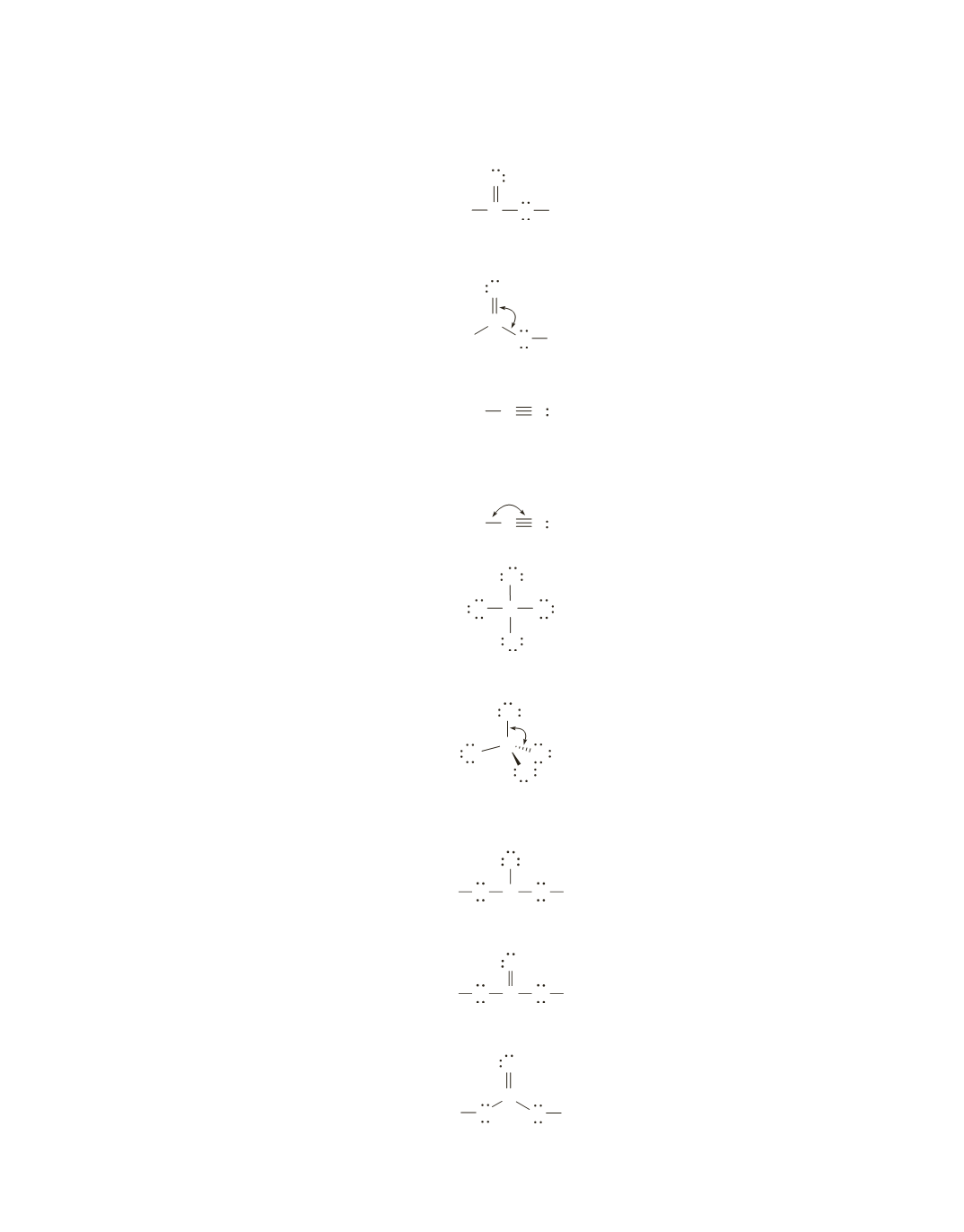
Using one of oxygen’s lone pairs to put a double bond between the carbon and oxygen solves both
problems.
H
O
C O H
b(1).
The
sp
2
hybridized
C
“
O
carbon has
120
°
bond angles, uses
sp
2
orbitals to form the three
s
bonds,
a
p
orbital to form the
p
bond, and has bond angles of 120°.
H
C
120
°
O
O H
a(2).
In order to fill their octets and form the required number of bonds, carbon and nitrogen must form
a triple bond.
H C N
b(2).
Because the carbon is
sp
hybridized, the carbon uses
sp
orbitals to form the two
s
bonds and
p
orbitals to form the two
p
bonds. The bond angle is
180
°
.
H C N
180
°
a(3).
The carbon forms four bonds, and each chlorine forms one bond.
C
Cl
Cl
Cl
Cl
b(3).
The carbon uses
sp
3
orbitals to form the bonds with the chlorine atoms, so the bond angles are
all
109.5
°
.
C Cl
Cl
Cl
Cl
109.5
°
a(4).
The first attempt at drawing a Lewis structure (and remembering to avoid oxygen–oxygen single
bonds) results in a carbon that does not have a complete octet and does not form the needed number
of bonds.
C H
H
O
O O
Using one of oxygen’s lone pairs to put a double bond between the carbon and the oxygen solves
both problems.
C H
H
O
O O
b(4).
The carbon uses
sp
2
orbitals to form the three
s
bonds and a
p
orbital to form the
p
bond. The bond
angles are 120°.
C
O
O H
OH