



 97 / 912

Chapter 1
89
Copyright © 2017 Pearson Education, Inc.
71.
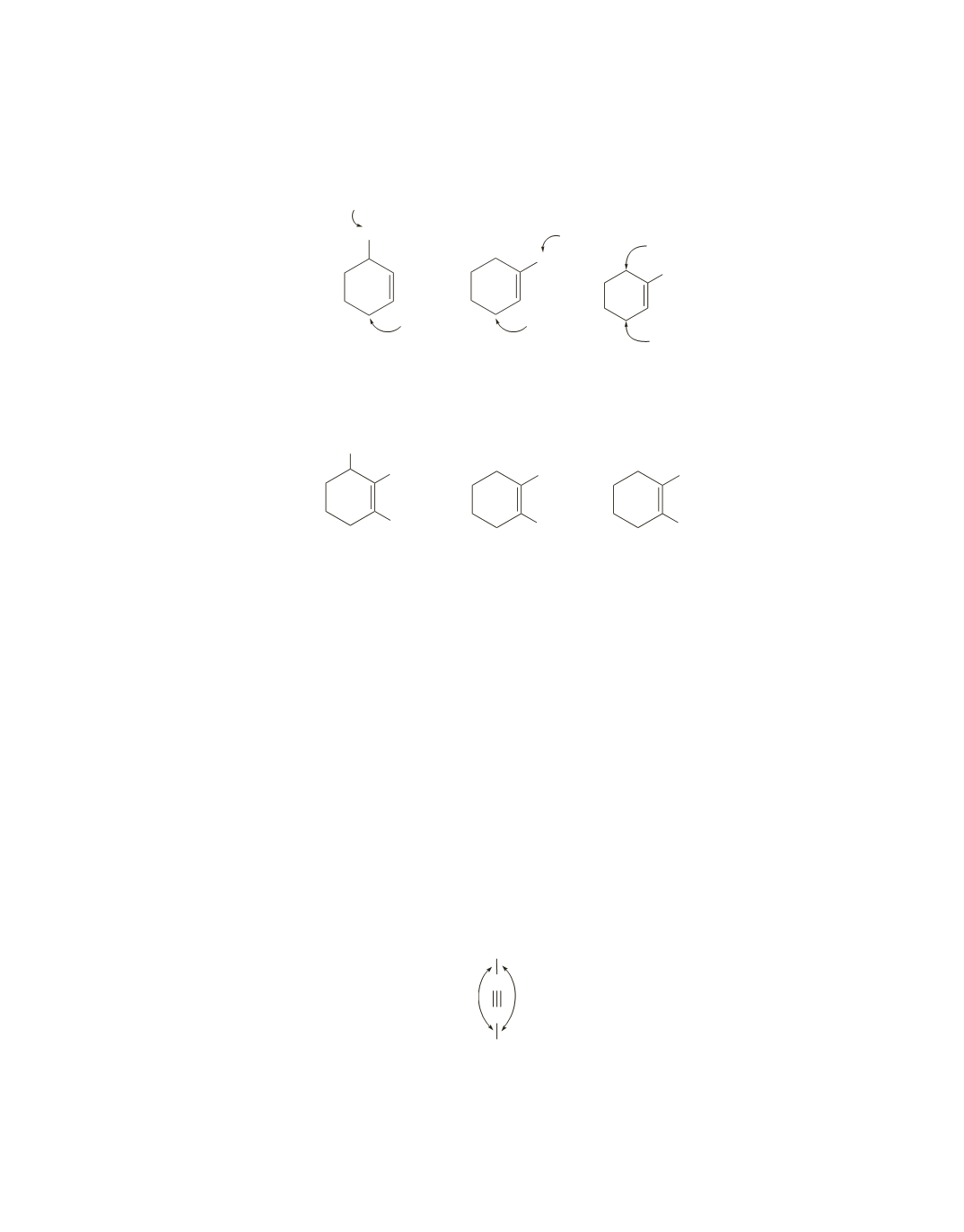
In an alkene, six atoms are in the same plane: the two
sp
2
carbons and the two atoms that are bonded to
each of the two
sp
2
carbons. The other atoms in the molecule will not necessarily be in the same plane with
these six atoms.
CH
yes
yes
3
no
CH
3
yes
CH
3
yes
yes
If you put stars next to the six atoms that lie in a plane in each molecule, you will be able to see more
clearly whether the indicated atoms lie in the same plane.
CH
3
CH
3
*
* H
H
*
*
*
*
H *
*
*
*
*
*
CH
3
H *
*
*
*
*
*
72.
a.
If the central atom is
sp
3
hybridized and it does not have a lone pair, the molecule will have tetrahe-
dral bond angles
(109.5
°
).
Therefore, only
+
NH
4
has tetrahedral bond angles. The following species
are close to being perfectly tetrahedral:
H
2
O, H
3
O
+
, NH
3
,
-
CH
3
.
However, they all have bond angles
slightly smaller than
109.5
°
.
b.
+
CH
3
and
BF
3
73.
CH
3
CH
2
Cl
has the longer
C
¬
Cl
bond because it is formed by the overlap of an
sp
3
orbital of Cl with an
sp
3
orbital of C, whereas the
C
¬
Cl
bond in
CH
2
“
CHCl
is formed by the overlap of an
sp
3
orbital of Cl
with an
sp
2
orbital of C. (The more the
s
character, the shorter and stronger the bond.)
74.
CH
2
Cl
2
has the larger dipole moment because the two chlorines are withdrawing electrons in the same gen-
eral direction, whereas in
CH
3
Cl
, only one chlorine is withdrawing electrons.
75.
The bond angles at the triple-bonded carbons, when the bonding orbitals overlap maximally, are
180
°
.
A
180
°
angle cannot fit into the ring structure. Therefore, the overlap between the
sp
orbital and the adjacent
sp
3
orbital becomes distorted from the ideal end-on overlap. This poor overlap causes the compound to be
unstable. (Compare the structure shown here with Figure 3.8 on page 122 of the text.)
C
C
C
C
180
°
76.
The dipole moment depends on the size of the charge and the distance between the bonded electrons.
The longer
C
¬
Cl
bond more than makes up for the greater charge on fluorine.