


 103 / 912

Chapter 2
95
Copyright © 2017 Pearson Education, Inc.
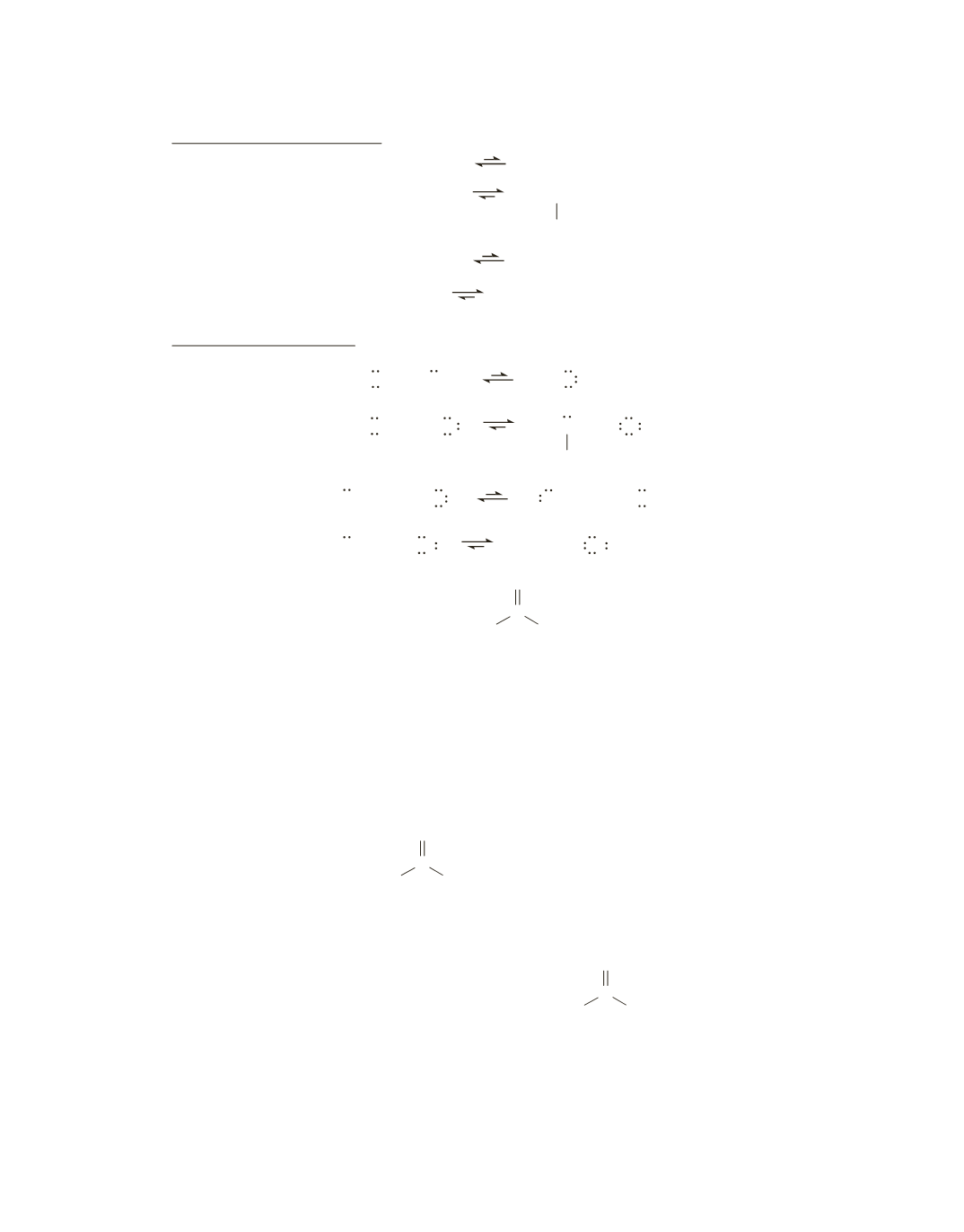
If the lone pairs are not shown:
a.
3
3
3
CH OH as an acid: CH OH NH
+
3
4
CH O NH
+
−
+
3
3
CH OH as a base:
CH OH HCl
+
CH
3
OH
H
+
Cl
−
+
b.
3
3
3
NH as an acid:
NH CH O
−
+
2
3
NH CH OH
−
+
+
3
3
NH as a base:
NH HBr
+
−
+
4
NH Br
If the lone pairs are shown:
a.
3
3
3
CH OH as an acid: CH OH NH
+
3
4
CH O NH
+ −
+
3
3
CH OH as a base:
CH OH HCl
+
CH
3
OH
H
+
Cl
−
+
b.
3
3
3
NH as an acid:
NH CH O
−
+
2
3
NH CH OH
−
+
3
3
NH as a base:
NH HBr
+
4
NH Br
+
−
+
12.
a.
40
b.
15
c.
5
(Note that a
C
O
OH
group can be written as
¬
COOH)
d.
10
13.
a.
CH
3
COO
-
is the stronger base.
Because
CH
3
COOH
is the weaker acid, it has the stronger conjugate base.
b.
-
NH
2
is the stronger base.
Because
NH
3
is the weaker acid, it has the stronger conjugate base.
c.
H
2
O
is the stronger base.
Because
H
3
O
+
is the weaker acid, it has the stronger conjugate base.
14.
The conjugate acids of the given bases have the following relative strengths:
CH
3
OH
2
>
> CH
3
NH
3
> CH
3
OH > CH
3
NH
2
+
+
C
O
OH
CH
3
The bases, therefore, have the following relative strengths, because the weakest acid has the strongest
conjugate base.
CH
3
NH >
> CH
3
NH
2
>
CH
3
O
−
> CH
3
OH
−
C
O
O
CH
3
−
15.
Methanol is the acid because it is a stronger acid (
p
K
a
15
) than methylamine (
p
K
a
about 40).