


 495 / 912

Chapter 15 487
Copyright © 2017 Pearson Education, Inc.
12.
a.
H
2
O
b.
NH
3
c.
CH
3
CH
2
CH
2
OH
d.
(CH
3
)
2
NH
e.
HO
f.
HO
NO
2
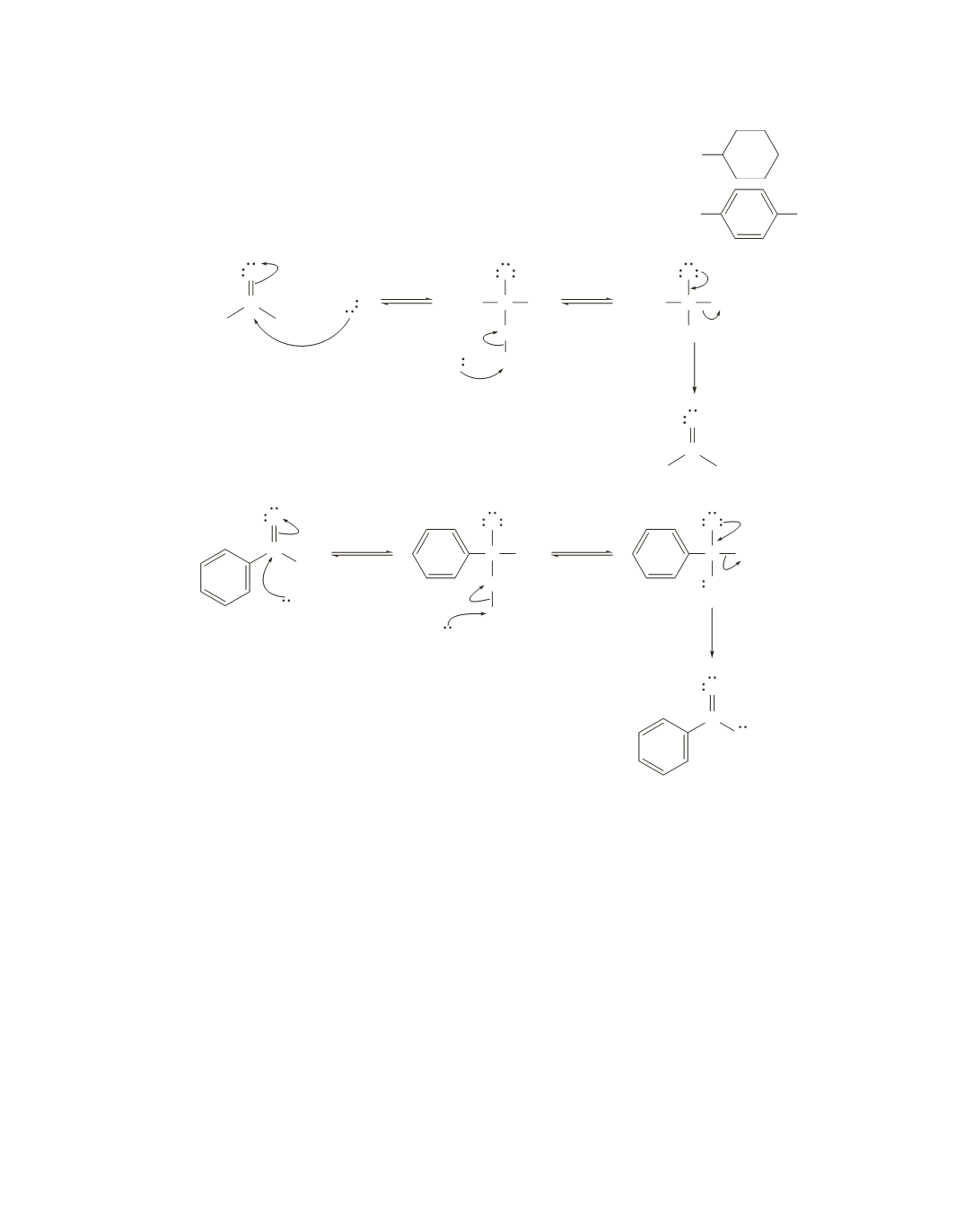
13.
a.
O
C
Cl
CH
3
+
O
C
OH
Cl
CH
3
H
−
+
O
C
OH
Cl
CH
3
−
+
HB
+
B
O
C
OH
CH
3
+
Cl
−
H
2
O
b.
Cl
C
O
CH
3
NH
2
+
CH
3
NH
2
O
C
H
NHCH
3
Cl
+
−
O
C
NHCH
3
C
O
NHCH
3
Cl
−
Cl
−
14.
Solved in the text.
15.
a.
ethanol
b.
ammonia
c.
phenol
d.
benzyl alcohol
16.
A protonated amine has a p
K
a
∼
11. Therefore, the neutral amine will be protonated by the acid that is
produced in the reaction, and a protonated amine is not a nucleophile. Excess amine is used to have some
unprotonated amine available to react as a nucleophile.
A protonated alcohol has a p
K
a
∼
-
2. Therefore, the alcohol will not be protonated by the acid that is
produced in the reaction.