



 496 / 912

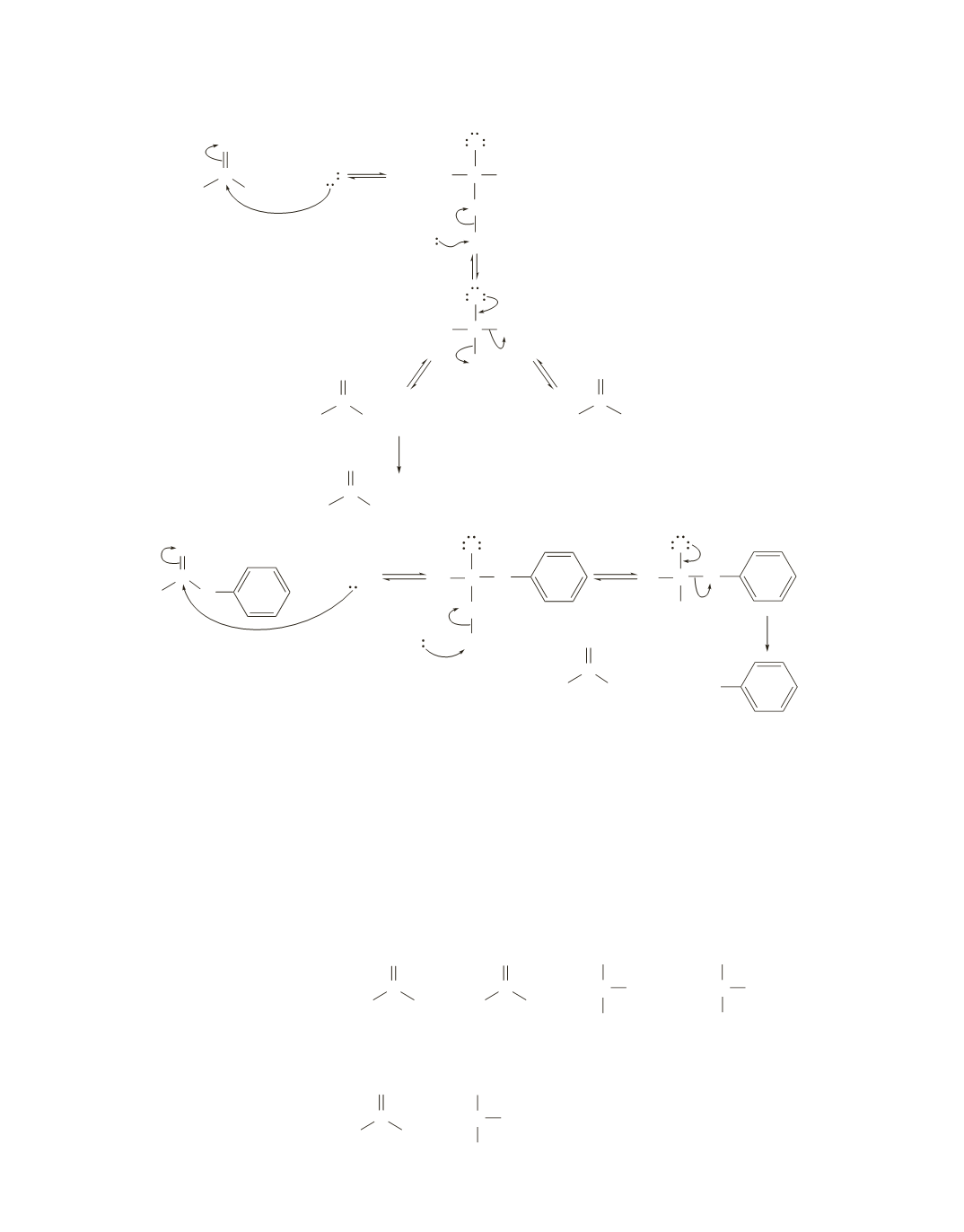
488 Chapter 15
Copyright © 2017 Pearson Education, Inc.
17.
a.
+
H
2
O
CH
3
CH
2
OCH
3
O
+
OH
H
+
HB
+
+
HO
−
+
CH
3
O
−
+
CH
3
OH
B
−
C
CH
3
CH
2
OCH
3
C
O
CH
3
3
CH
2
OCH
C
C
O
CH
3
CH
2
OH
−
C
O
CH
3
CH
2
O
O
CH
3
CH
2
OCH
3
O
OH
a
a
b
b
−
C
CH
3
O
−
(path a) and HO
−
(path b)
have the same leaving propensity,
so either one can be eliminated.
b.
O H C
O
O H C
O
O
NHCH
3
NHCH
3
H
+
CH
3
NH
2
−
+
HB
+
B
+
−
−
+
C
O
O H
C
O
H NHCH
3
18.
Solved in the text.
19.
a.
phenyl acetate because phenoxide is a weaker base than methoxide
b.
phenyl acetate because phenoxide is a weaker base than the conjugate base of benzyl alcohol
20.
a. 1.
The carbonyl group of an ester is a weak electrophile.
2.
Water is a weak nucleophile.
3.
-
OCH
3
is a strong base and, therefore, a poor leaving group.
b.
Aminolysis is faster because an amine is a better nucleophile than water.
21.
a.
Any species with an acidic proton can be represented by HB
+
.
H
3
O
+
CH
3
OH
2
CH
3
C
OH
OH
OCH
3
C
OH
CH
3
OH
OCH
3
+
+
+
H
H
CH
3
C
OH
O
+
CH
3
C
OH
OH
b.
Any species with a lone pair can be represented by :B.
H
2
O CH
3
OH
CH
3
C
OH
OH
OCH
3
CH
3
C
OH
O