


 499 / 912

Chapter 15 491
Copyright © 2017 Pearson Education, Inc.
29.
a.
The alcohol (CH
3
CH
2
OH) contained the
18
O label.
b.
The carboxylic acid would have contained the
18
O label.
30.
Solved in the text.
31.
a.
C
O
C
O
CH
3
CH
2
CH
2
O
CH
3
CH
2
CH
2
OCH
3
C
O
CH
3
CH
2
CH
2
OCH
3
_
or
C
O
CH
3
CH
2
CH
2
OH
CH
3
Br
CH
3
OH
excess
HCl
b.
or
CH
3
O(CH
2
)
7
CH
3
_
CH
3
O
CH
3
(CH
2
)
7
Br
C
O
C
O
CH
3
O(CH
2
)
7
CH
3
C
O
C
O
CH
3
OH
CH
3
(CH
2
)
7
OH
excess
HCl
32.
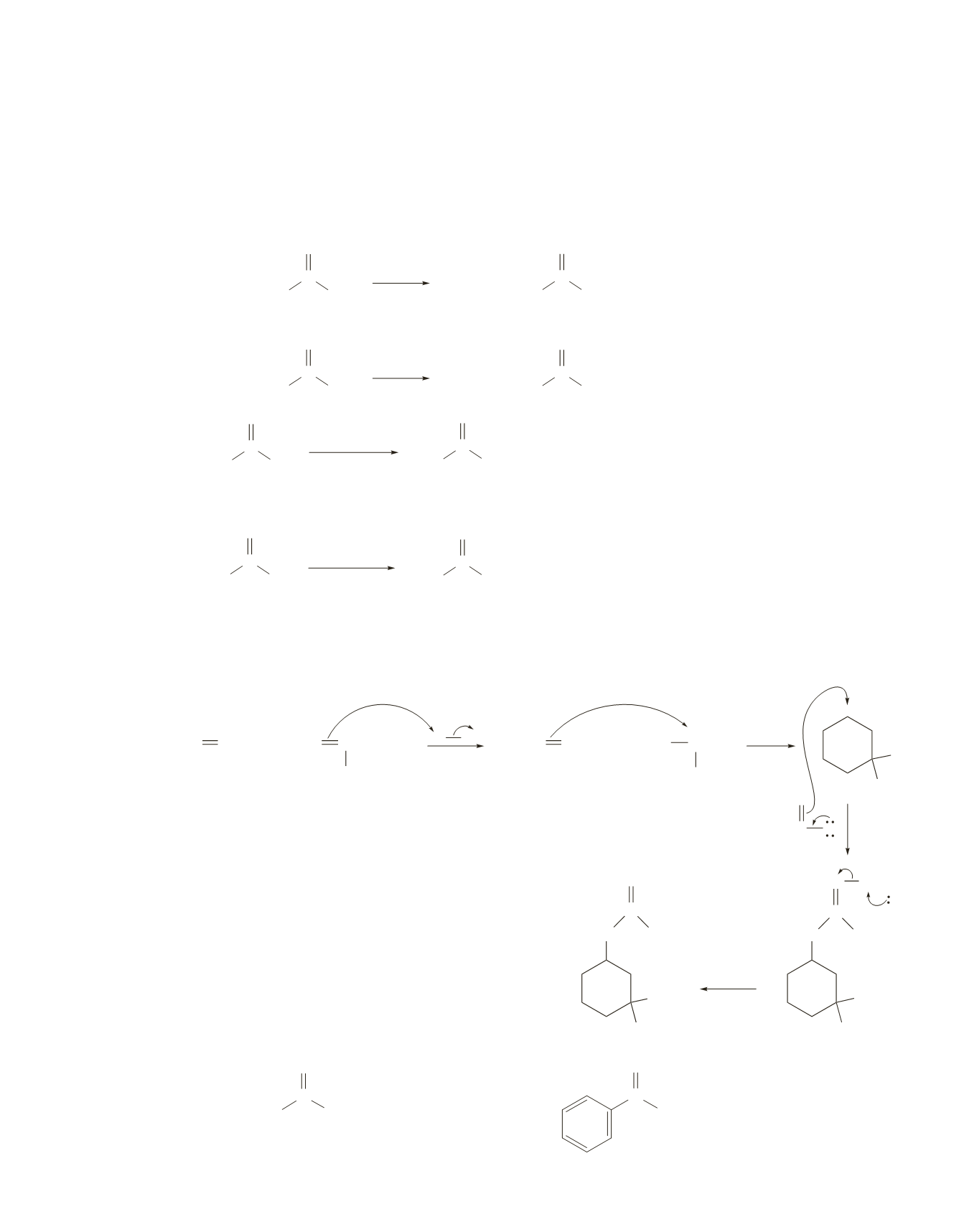
In the first step, protonation occurs on the carbon that results in formation of the most stable carbocation
(a tertiary carbocation). In the second step, the pair of electrons of the second
p
bond provides the nucleophile
that adds to the carbocation because, as a result of that reaction, a stable six-membered ring is formed.
CH
2
CHCH
2
CH
2
CH CCH
3
CH
3
H B
+
CH
2
CHCH
2
CH
2
CH
2
CCH
3
CH
3
6
5 4 3 2
1
+
CH
3
CH
3
HB
+
CH
3
CH
3
CH
3
+
CH
3
C OH
O
CH
3
CH
3
+
1
2
3
4 5 6
H
B
O
CH
3
O
C
O
C
O
33.
a.
CH
3
CH
2
CH
2
Cl
C
O
+ 2 CH
3
CH
2
NH
2
b.
Cl
C
O
2 CH
3
NHCH
3
+