


 505 / 912

Chapter 15 497
Copyright © 2017 Pearson Education, Inc.
52.
a.
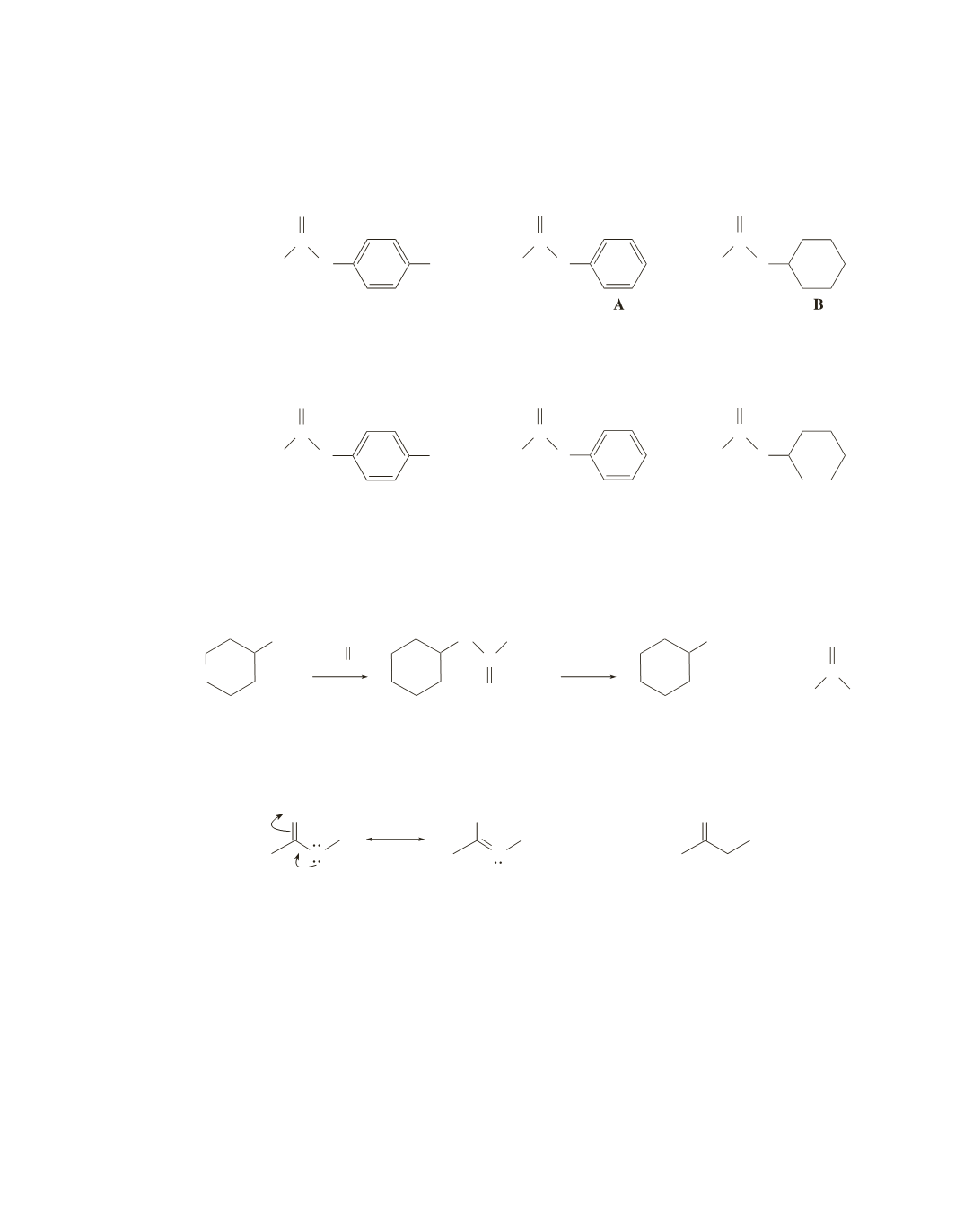
The weaker the base attached to the acyl group, the stronger its electron-withdrawing ability; therefore,
the easier it is to form the tetrahedral intermediate.
para
-Chlorophenol is a stronger acid than phenol,
so the conjugate base of
para
-chlorophenol is a weaker base than the conjugate base of phenol.
>
>
O CH
3
C
O
O CH
3
C
O
Cl
O CH
3
C
O
C
b.
The tetrahedral intermediate collapses by eliminating the OR group. The weaker the OR group is as a
base, the easier it is to eliminate.
>
>
O CH
3
C
O
O CH
3
C
O
Cl
O CH
3
C
O
Thus, the rate of both formation of the tetrahedral intermediate and collapse of the tetrahedral interme-
diate is decreased by increasing the basicity of the OR group.
53.
Because acetate ion is a weak base, the S
N
2 reaction forms only a substitution product. (See page 430 of the
text.) The product of the S
N
2 reaction is an ester which, when hydrolyzed, forms cyclohexanol (the target
molecule) and acetic acid.
OH
CH
3
C
O
O
Br
OH
CH
3
+
CH
3
CO
O
_
HCl
H
2
O
C
O
54.
a.
Methyl acetate has a resonance contributor that butanone does not. This resonance contributor causes
methyl acetate to be more polar than butanone. Because methyl acetate is more polar, it has the greater
dipole moment.
+
O
O
O
O
O
_
compared to
b.
Because it is more polar, the intermolecular forces holding methyl acetate molecules together are
stronger, so we expect methyl acetate to have a higher boiling point.