


 500 / 912

492 Chapter 15
Copyright © 2017 Pearson Education, Inc.
34.
Only
B
and
E
will form amides.
A
will form an amide if it is heated to about 225
°
C.
35.
O
C
R
+
+
+
+
+
NH
2
+
+
+
OH
OH
C
OCH
3
R
H
H B
OH
C
R NH
2
NH
2
H B
OH
C
OCH
3
R NH
2
+
+
O
H
O
C
R OCH
3
C
R OCH
3
B
C
OCH
3
R NH
3
NH
3
NH
4
CH
3
OH
36.
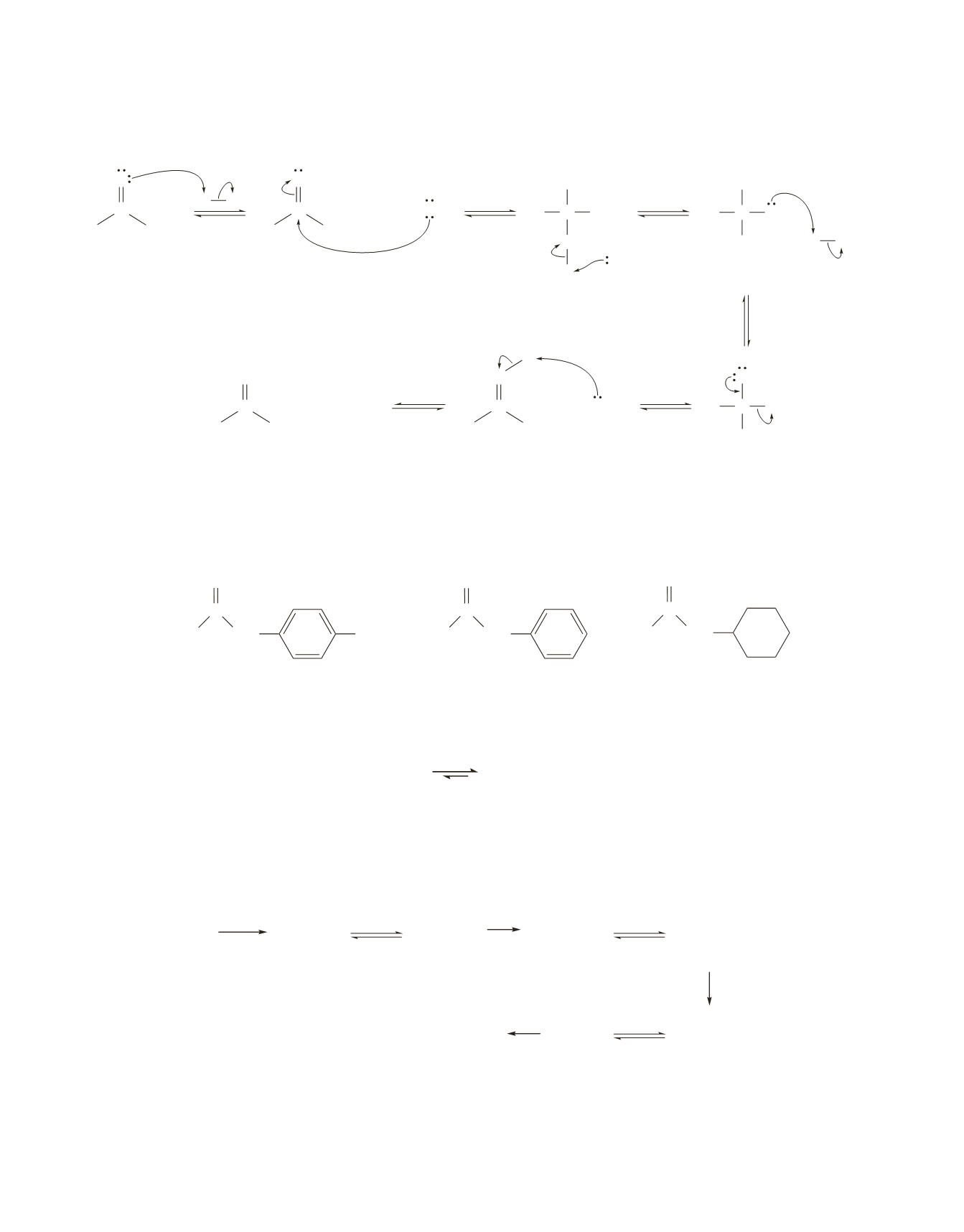
The relative reactivities of the amides depend on the basicities of their leaving groups: the weaker the base,
the more reactive the amide. (
para
-Nitroanilinium ion has a p
K
a
value of 0.98, the anilinium ion has a p
K
a
value of 4.58, and the cyclohexylammonium ion has a p
K
a
value of 11.2.) Recall that the stronger the acid,
the weaker its conjugate base and that the weaker the base, the better it is as a leaving group.
NO
2
>
>
B
C
A
C
NH
CH
3
O
NH
CH
3
NH
CH
3
C
O
C
O
37.
Because the acid–base reaction below favors the products. Recall that the equilibrium favors reaction of
the strong acid (H
2
O) and formation of the weak acid (NH
3
) (Section 2.5).
–
NH
NH
+
HO
–
+
2
H
3
2
O
38.
a.
pentyl bromide
b.
isohexyl bromide
c.
benzyl bromide
d.
cyclohexyl bromide
39.
The reaction of an alkyl halide with ammonia leads to primary, secondary, and tertiary amines and even
quaternary ammonium ions. Thus, the yield of primary amine would be relatively low.
RBr
NH
3
NH
3
3
RNH
Br
+
−
+
2
RNH
RBr
2 2
R NH
Br
+
−
+
+
+
2
R NH NH
4
+
+ NH
4
+
+ NH
4
RBr
4
R N
Br
+
−
+
RBr
3
R N
3
R NH Br
+
−
+
NH
3
NH
3
In contrast, the Gabriel synthesis forms only primary amines. The reaction of an alkyl halide with azide ion
also forms only primary amines because the compound formed from the initial reaction of the two reagents
is not nucleophilic, so polyalkylation does not occur.