


 498 / 912

490 Chapter 15
Copyright © 2017 Pearson Education, Inc.
25.
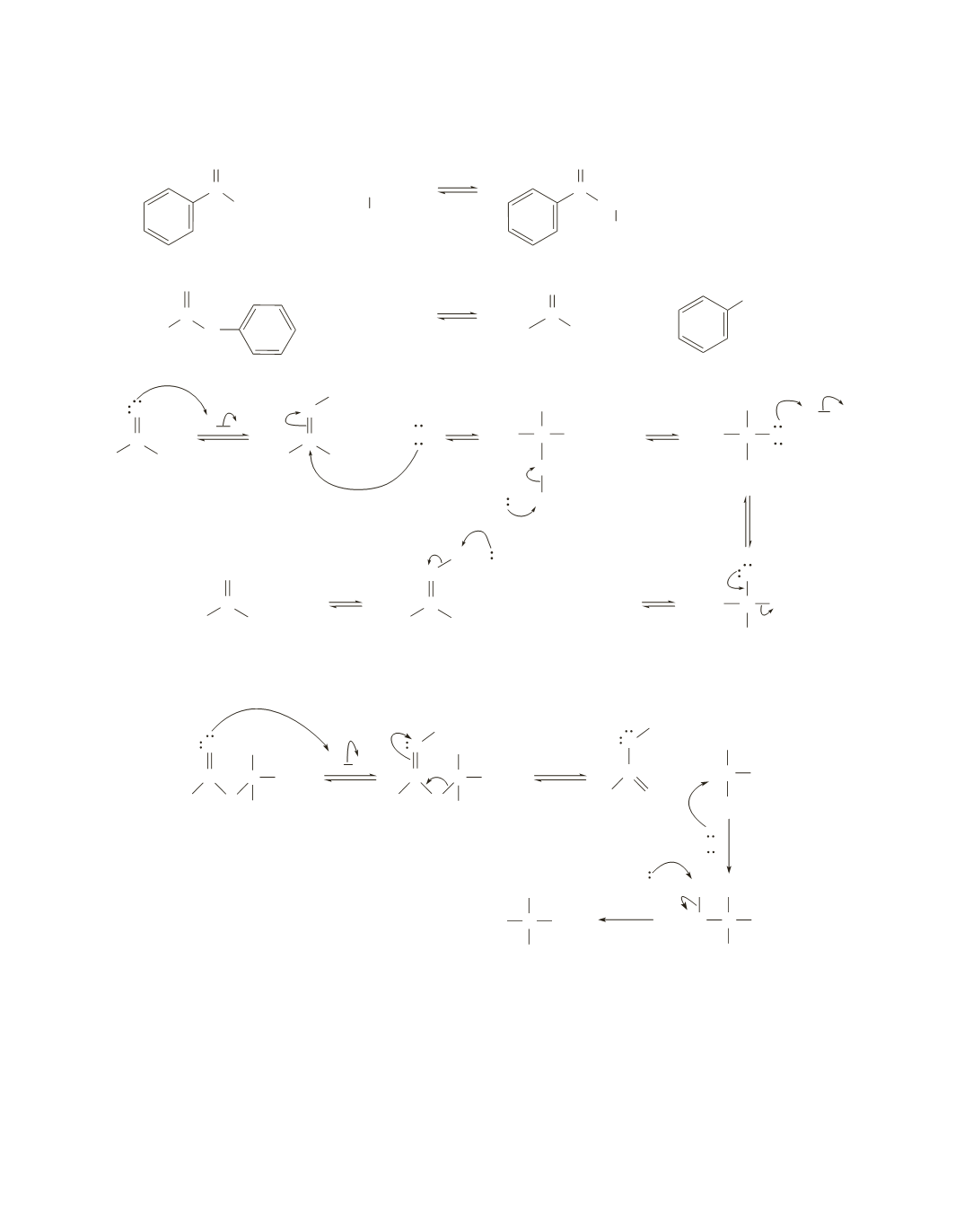
These are transesterification reactions.
a.
+
C
O
O
OH
C
O
OCH
2
CH
3
CH
3
+
C
O
OCHCH
3
CH
3
CH
3
CHCH
HCl
HCl
3
OH
+ CH
3
CH
2
OH
C
O
OCH
2
CH
3
CH
3
CH
3
CH
2
OH
+
b.
26.
CH
3
OCH
2
H B
+
O
C
CH
3
CH
3
OCH
2
CH
3
OCH
2
CH
3
OCH
2
CH
3
OCH
2
CH
3
O
C
+
H
+
CH
3
OH
OH
C
OCH
3
OCH
3
OCH
3
OCH
3
OCH
3
CH
3
H
+
OH
C CH
3
H B
+
B
OH
C CH
3
+
CH
3
+
CH
3
CH
2
OH
H B
CH
3
HB
+
+
H
O
C
O
C
27.
The mechanism is the same as the one on page 705 of the text except that the nucleophile is methanol
rather than water.
O
C
CH
3
CH
3
CH
3
R
H B
+
O
R
CH
3
CH
3
CH
3
H
+
O R
H
C
CH
3
CH
3
CH
3
+
CH
3
OH
+
C
CH
3
CH
3
CH
3
CH
3
O
H
B
C
CH
3
CH
3
CH
3
CH
3
O
+
HB
+
C
C
C
O
O
C
O
28.
a.
The conjugate base (CH
3
CH
2
CH
2
O
-
) of the reactant alcohol (CH
3
CH
2
CH
2
OH) can be used to increase
the rate of the reaction because it is the nucleophile that we want to become attached to the carbonyl carbon.
b.
If H
+
is used as a catalyst, the amine will be protonated in the acidic solution and, therefore, will not
be able to react as a nucleophile.
If HO
-
is used as a catalyst, HO
-
will be the best nucleophile in the solution. Therefore, it will add to
the ester, and the product of the reaction will be a carboxylate ion rather than an amide.
If RO
-
is used as a catalyst, RO
-
will be the nucleophile, and the product of the reaction will be an
ester rather than an amide.