


 493 / 912

Chapter 15 485
Copyright © 2017 Pearson Education, Inc.
5.
a.
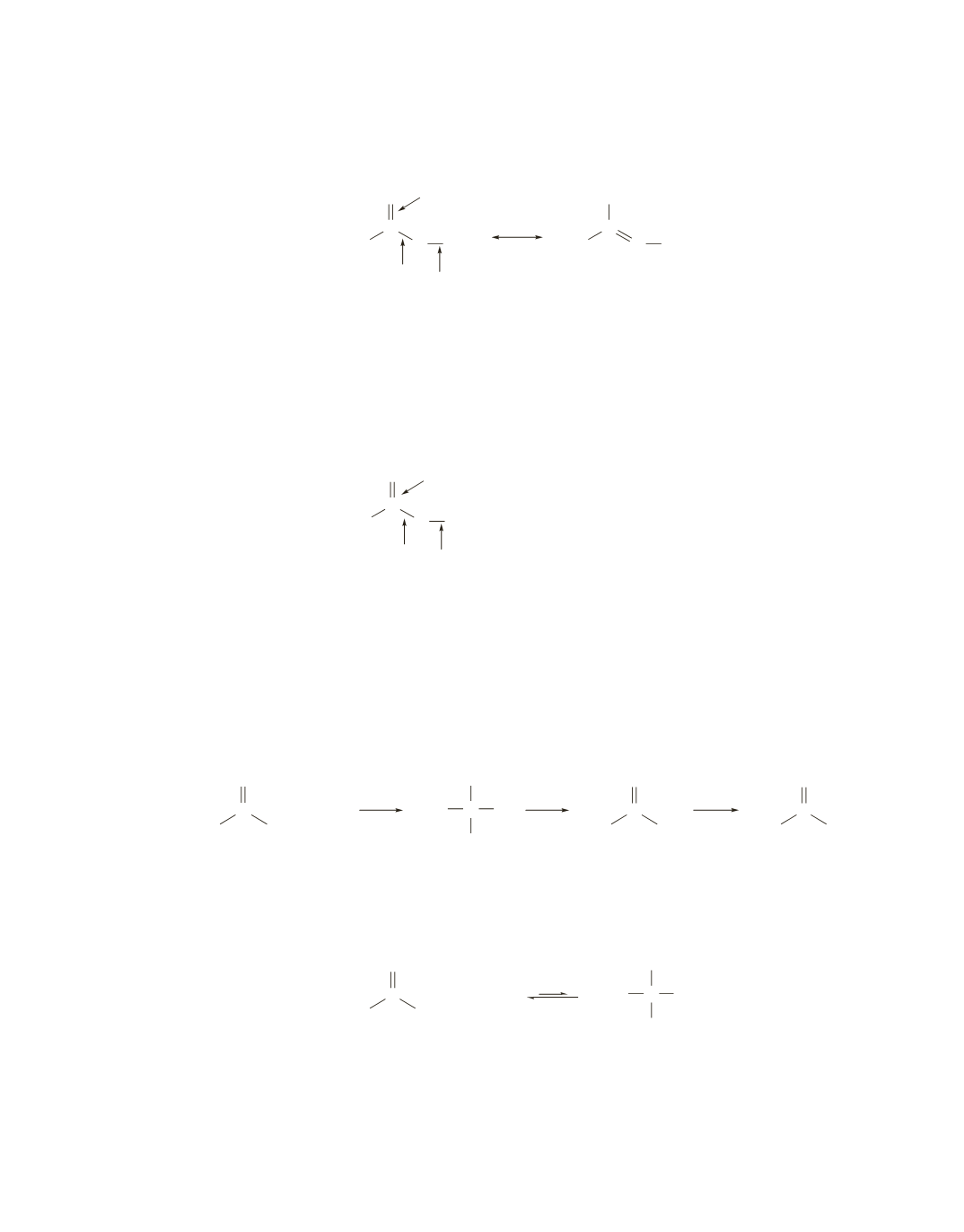
The bond between oxygen and the methyl group is the longest, because it is a pure single bond, whereas
the other two carbon–oxygen bonds have some double-bond character.
3
=
longest 1
=
shortest
less stable
more stable
CH
3
C
O
O CH
3
1
2 3
CH
3
C
O
O CH
3
−
+
The bond between carbon and the carbonyl oxygen is the shortest, because it has the most double-bond
character.
b.
Notice that the longer the bond, the lower its IR stretching frequency.
CH
3
C
O
O CH
3
1
=
highest frequency
3
=
lowest frequency
1
2 3
6.
B
is a correct statement. The delocalization energy (resonance energy) is greater for the amide than for the
ester because the second resonance contributor of the amide has a greater predicted stability and so contributes
more to the overall structure of the amide. (Recall that nitrogen is less electronegative than oxygen, so it is
more stable with a positive charge.)
7.
a.
Because HCl is a stronger acid than H
2
O, Cl
-
is a weaker base than HO
-
.
Therefore, Cl
-
will be eliminated from the tetrahedral intermediate, so the product of the reaction will be
acetic acid. Because the solution is basic, acetic acid will be in its basic form as a result of losing a proton.
CH
3
O
C
O
HO
acetyl chloride
−
+
O
C Cl
CH
3
OH
−
acetic acid Cl
−
HO
−
−
H
2
O
CH
3
Cl
C
O
CH
3
OH
C
O
+
+
b.
Because H
2
O is a stronger acid than NH
3
, HO
-
is a weaker base than
-
NH
2
.
Therefore, HO
-
will be eliminated from the tetrahedral intermediate, so the reactant will reform. In
other words, no reaction will take place.
HO
−
+
O
C NH
2
CH
3
OH
−
acetamide
CH
3
NH
2
C
O
8.
a.
a new carboxylic acid derivative
b.
no reaction
c.
a mixture of two carboxylic acid derivatives