


 492 / 912

484 Chapter 15
Copyright © 2017 Pearson Education, Inc.
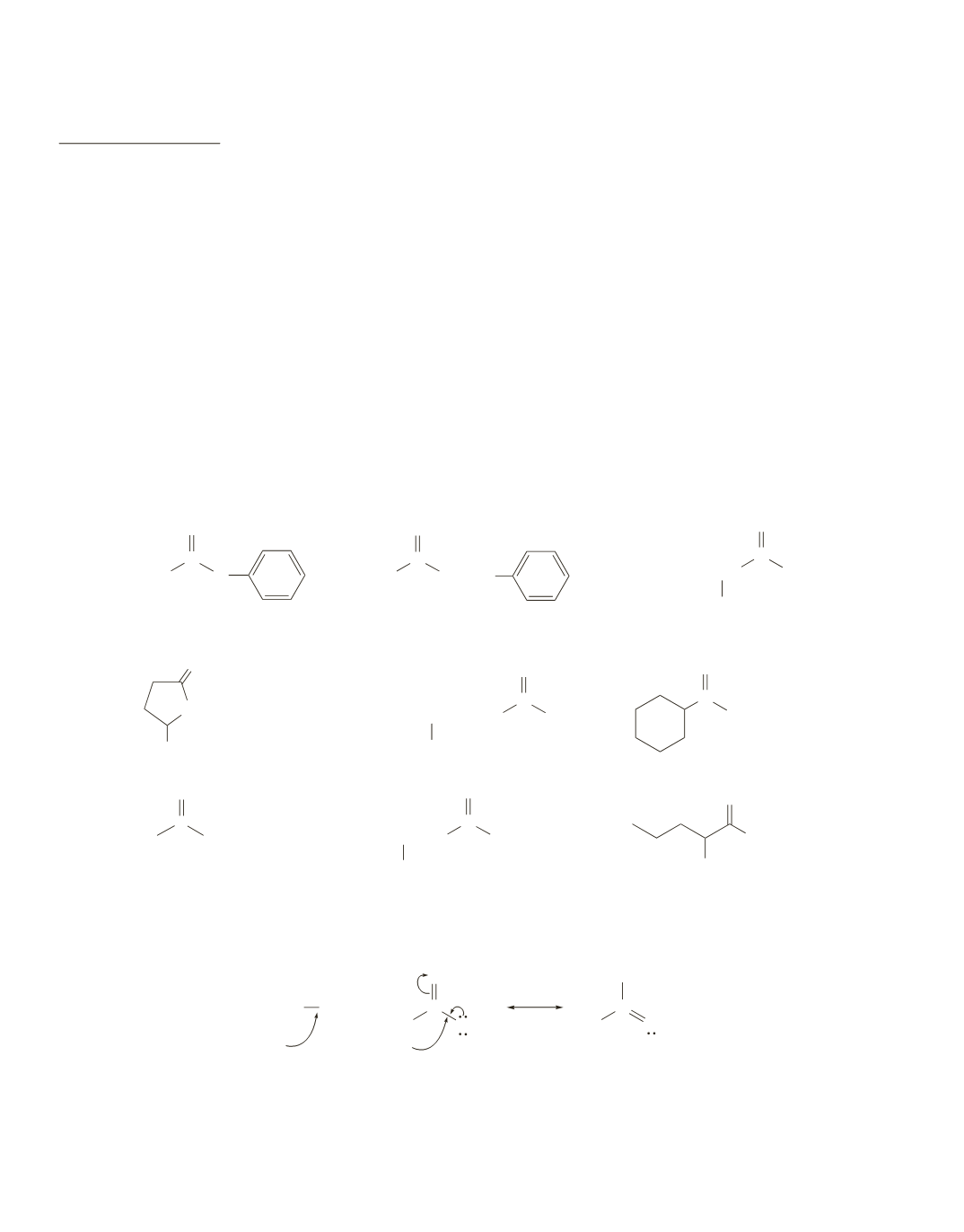
Solutions to Problems
1.
a.
benzyl acetate
b.
isopentyl acetate
c.
methyl butyrate
2.
a.
potassium butanoate
potassium butyrate
b.
isobutyl butanoate
2-methylpropyl butanoate
isobutyl butyrate
c.
N,N
-dimethylhexanamide
N,N
-dimethylcaproamide
d.
pentanoyl chloride
valeryl chloride
e.
5-methylhexanoic acid
d
-methylcaproic acid
f.
propanamide
propionamide
g.
g
-butyrolactam or
2-azacyclopentanone
h.
cyclopentanecarboxylic acid
i.
b
-methyl-
d
-valerolactone or
5-methyl-2-oxacyclohexanone
3.
a.
O
C
O
CH
3
d.
O
C
NHCH
2
CH
3
g.
O
C
OCH
2
CH
3
CH
3
CH
2
CH
2
CH
Cl
b.
NH
CH
2
CH
3
O
e.
O
C
OH
CH
3
CH
2
CHCH
2
CH
2
CH
3
h.
C
Cl
O
c.
O Na
+
H
C
O
–
f.
O
C
NH
2
CH
3
CHCH
2
Br
i.
OH
Cl
O
4.
The carbon–oxygen single bond in an alcohol is longer because, as a result of electron delocalization, the
carbon–oxygen single bond in a carboxylic acid has some double-bond character.
RCH
2
OH
O
C
OH R
O
−
C
OH R
longer
shorter
+