


 488 / 912

480 Chapter 14
Copyright © 2017 Pearson Education, Inc.
Chapter 14 Practice Test
1.
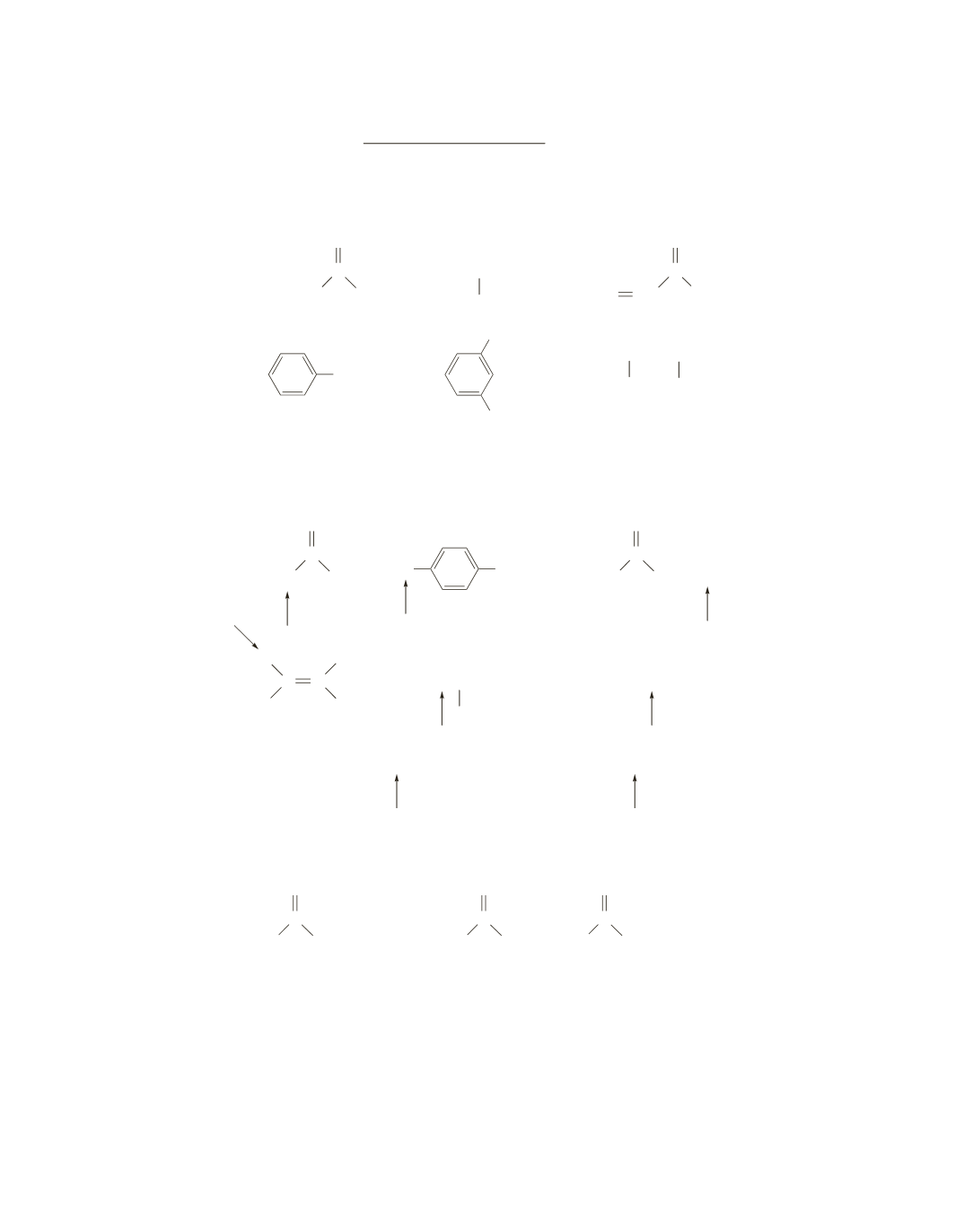
How many signals would you expect to see in the
1
H
NMR spectrum of each of the following compounds?
CH
3
CH
2
CHCH
2
CH
3
Cl
NO
2
Cl
Cl
CH
3
CHCH
2
CHCH
3
CH
3
CH
3
C
CH
3
CH
2
CH
2
CH
3
O
C
CH H
O
CH
2
2.
Indicate the multiplicity of each of the indicated sets of protons. (That is, indicate whether it is a singlet,
doublet, triplet, quartet, quintet, multiplet, or doublet of doublets.)
CH
3
OCH
2
CH
2
CH
2
OCH
3
BrCH
2
CH
2
Br
NO
2
H
C
CH
3
CH
2
CH
3
O
C
CH
3
CH
2
OCH
2
CH
3
O
C C
H
Cl
H
H
CH
3
CHCH
2
Cl
CH
3
ClCH
2
CH
2
CH
2
OCH
3
3.
How can you distinguish the following compounds using
1
H
NMR spectroscopy?
C
CH
3
OCH
2
CH
3
O
C
CH
3
CH
2
OCH
3
O
C
H OCH
2
CH
2
CH
3
O
4.
Indicate whether each of the following statements is true or false:
a.
The signals on the right of an NMR spectrum are deshielded compared to the
signals on the left.
T F
b.
Dimethyl ketone has the same number of signals in its
1
H
NMR spectrum as
in its
13
C
NMR spectrum.
T F