


 494 / 912

486 Chapter 15
Copyright © 2017 Pearson Education, Inc.
9.
a.
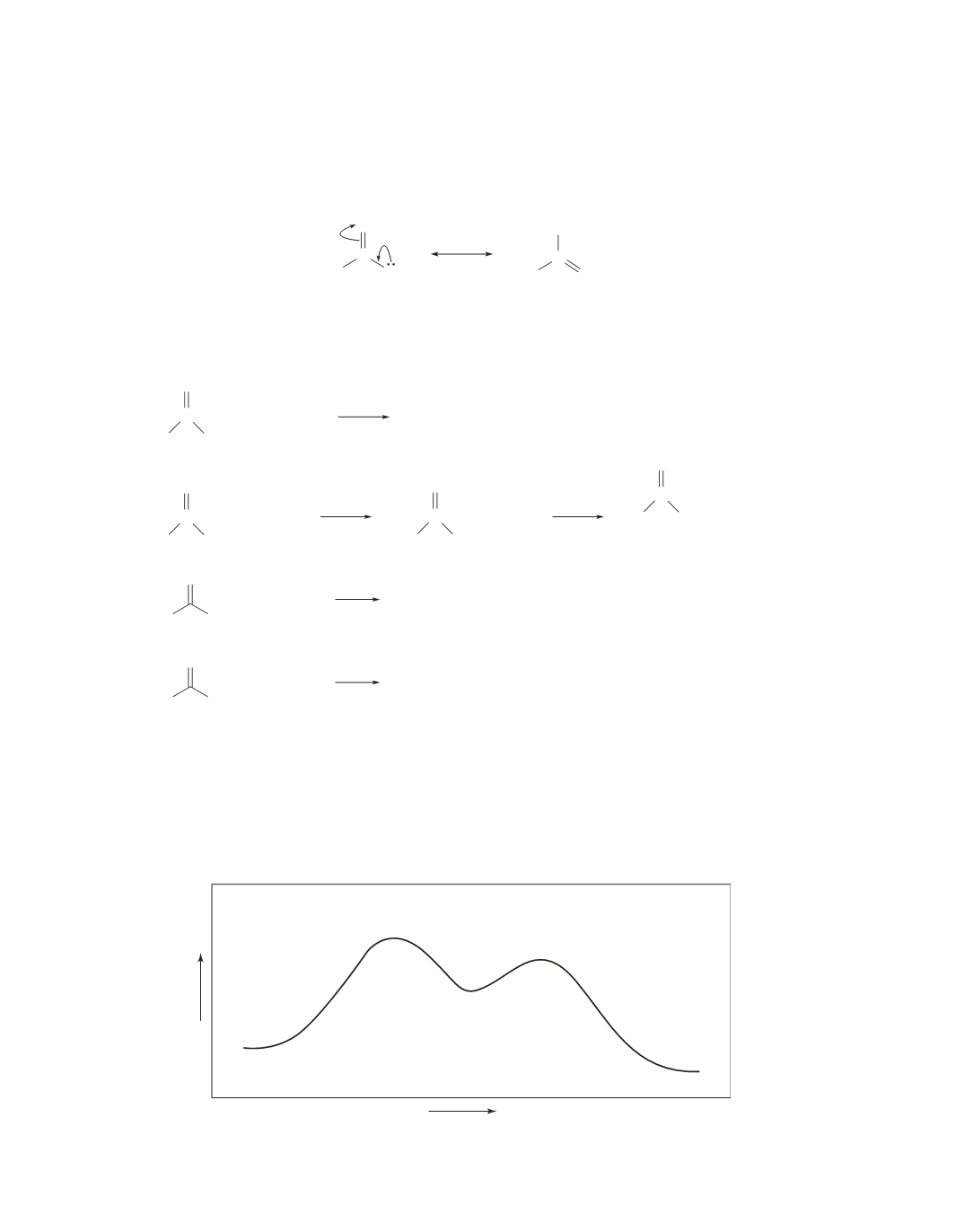
Acetyl chloride has the stretching vibration for its carbonyl group at the highest frequency because it
has the most C
“
O double-bond character, since it has the smallest contribution from the resonance
contributor with a positive charge on Y.
CH
3
C
Y
O
CH
3
C
Y
O
+
_
b.
Acetamide has the stretching vibration for its carbonyl group at the lowest frequency because it has the
least C
“
O double-bond character, since it has the largest contribution from the resonance contributor
with a positive charge on Y.
10.
a.
OCH
3
CH
3
+
NaCl
no reaction, because Cl
−
is weaker base than CH
3
O
−
C
O
b.
Cl
CH
3
+
NaOH
OH
H
2
O
CH
3
+
NaCl
O
−
HO
−
C
O
C
O
CH
3
+
C
O
c.
NaCl
no reaction, because Cl
−
is a weaker base than
−
NH
2
+
NH
2
O
CH
3
d.
NaOH
no reaction, because HO
−
is a weaker base than
−
NH
2
+
NH
2
O
CH
3
11.
It is a true statement.
If the nucleophile is the stronger base, it will be harder to eliminate the nucleophile from the tetrahedral
intermediate (
B
) than the group attached to the acyl group in the reactant. In other words, the hill that has
to be climbed from the intermediate back to the reactants (
B
to
A
) is higher than the hill that has to be
climbed from the intermediate to the products (
B
to
C
). We know that the first step is the rate-limiting step
because it has the transition state with the greatest energy.
Progress of the reaction
A
B
C
Free energy