


 501 / 912

Chapter 15 493
Copyright © 2017 Pearson Education, Inc.
40.
a.
butanenitrile
butyronitrile
propyl cyanide
41.
Notice that the alkyl halide has one less carbon than the target carboxylic acid, because the alkyl halide
will obtain a carbon from the cyanide ion.
CH
3
CH
2
CH
2
Br
CH
3
CHCH
2
Br
CH
3
Br
a.
b.
c.
42.
Solved in the text.
43.
a.
+
H
2
O
CH
3
C
+
OH
H
O C
O
CH
3
CH
3
CH
3
C
OH
O C
O
+
HB
+
+
−
B
O
−
O
−
O CH
3
CH
3
CH
3
C
O
O
CH
3
C
OH
O
C
O
C
O
b.
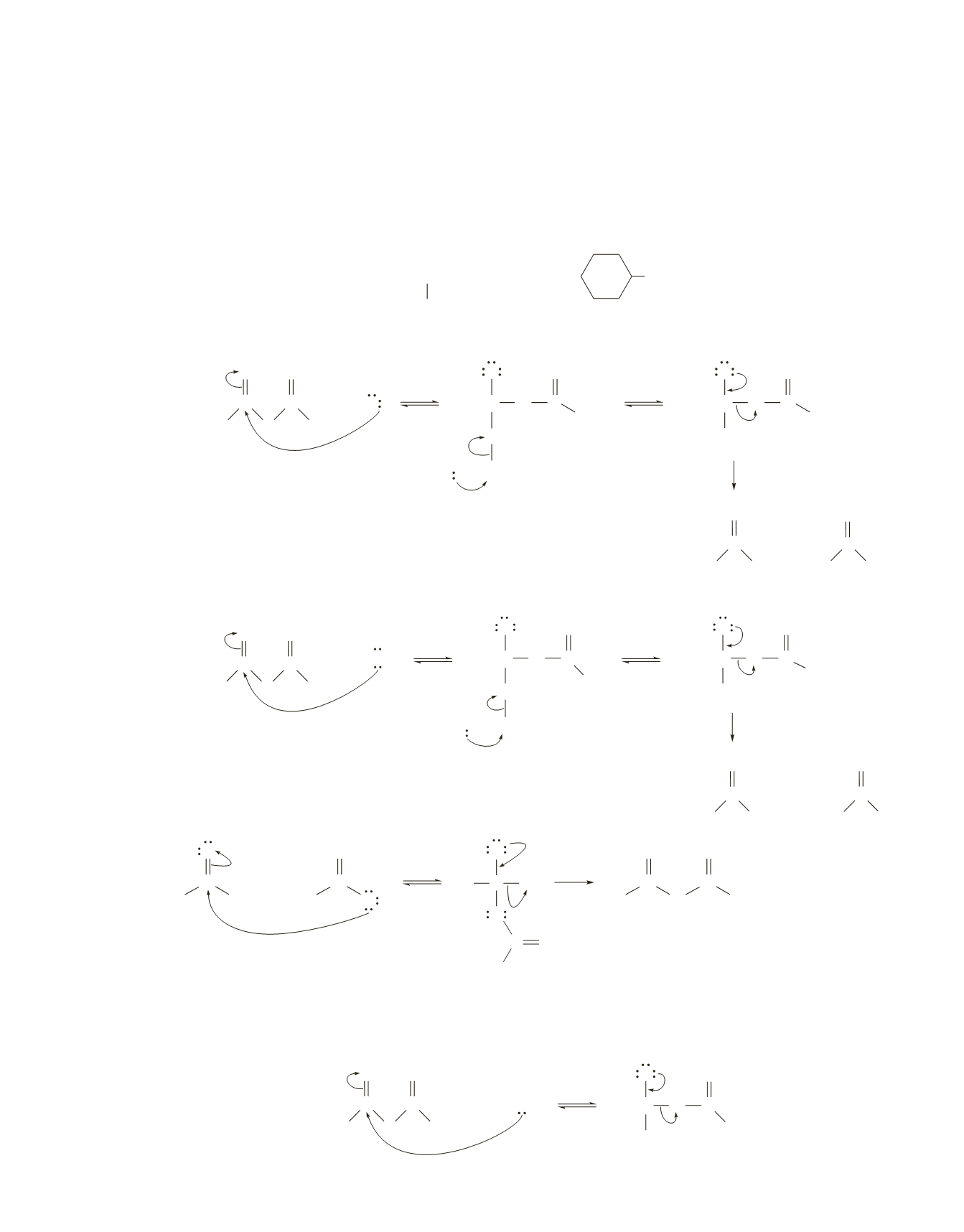
The mechanisms are exactly the same.
+
O
CH
3
C
+
OCH
3
H
O C
O
O
CH
3
C
OCH
3
O C
O
+
HB
+
+
−
−
B
CH
3
OH
CH
3
CH
3
CH
3
−
C
O
O
CH
3
OCH
3
C
O
O CH
3
CH
3
C
O
C
O
44.
+
+
C
Cl
R
O
C
O R
O
C
CH
3
O
CH
3
O
C
O
−
R C Cl
O
−
O
C O
CH
3
Cl
−
45.
When an acid anhydride reacts with an amine, the tetrahedral intermediate does not have to lose a proton before
it eliminates the carboxylate ion, because the carboxylate ion is a weaker base (p
K
a
of its conjugate acid is
∼
5)
than the amine (p
K
a
of its conjugate acid is
∼
10). Therefore, the carboxylate ion is the better leaving group.
+
O
CH
3
C
+
NH
2
CH
3
O C
O
−
CH
3
NH
2
CH
3
O CH
3
CH
3
C
O
C
O
b.
4-methylpentanenitrile
g
-methylvaleronitrile
isopentyl cyanide