



 374 / 912

366 Chapter 10
Copyright © 2017 Pearson Education, Inc.
30.
a.
O
CH
3
O
−
O
−
OCH
3
OCH
3
O
−
+
The nucleophile can attack the back side of either of the carbons in the three-membered ring.
b.
O
CH
3
NH
2
OH
NHCH
3
NHCH
3
OH
+
31.
a.
CH
3
C CHCH
2
CH
3
OH OH
CH
3
b.
CH
2
OH
OH
32.
a.
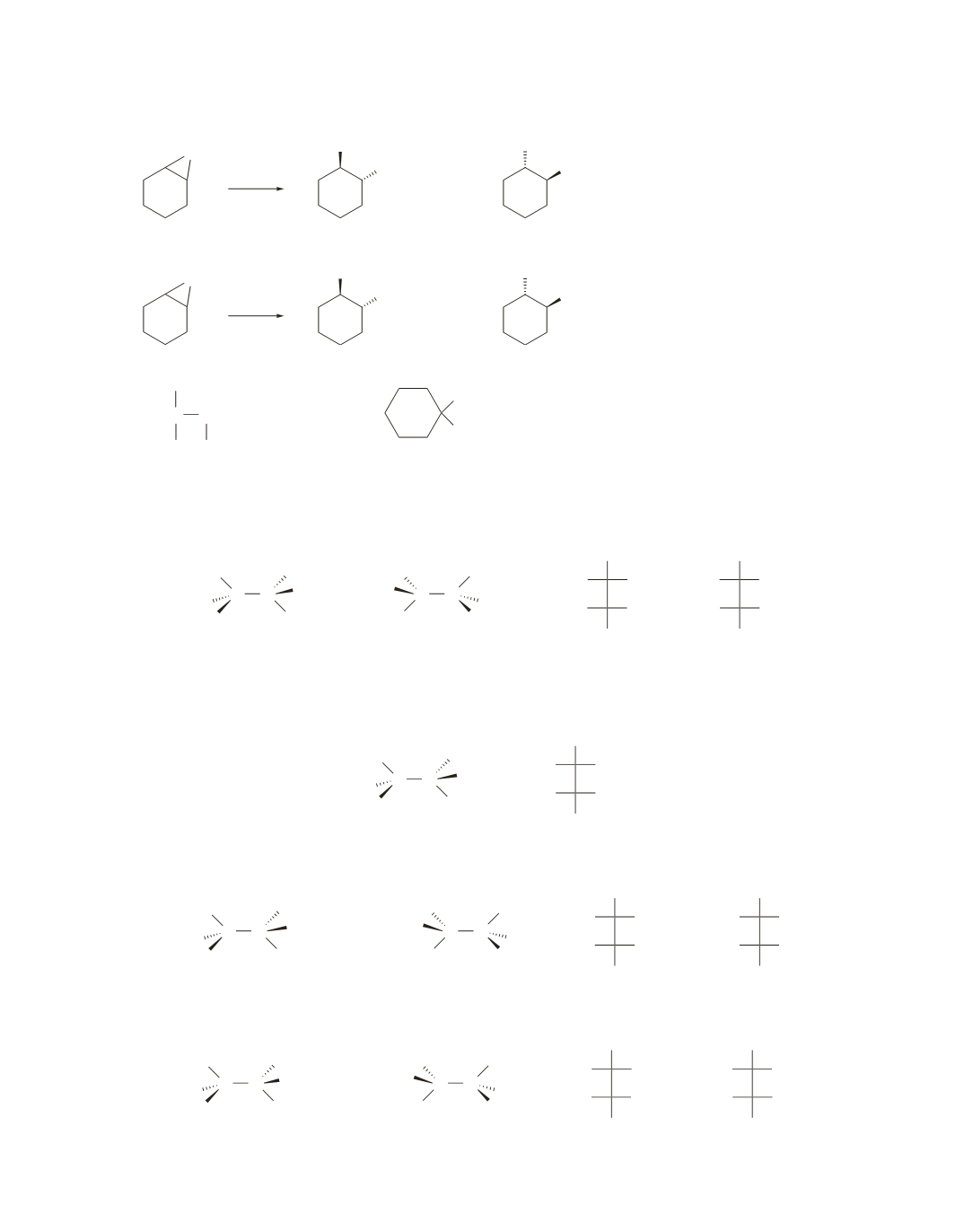
The reaction of an alkene with OsO
4
is a syn addition reaction. Syn addition to the trans isomer forms
the threo pair of enantiomers. (See Section 6.13, particularly page 268.)
C
H
3
C
HO
H
C OH
H
CH
3
+
C
CH
3
OH
H
C HO
H
H
3
C
or
CH
3
H OH
CH
3
HO H
CH
3
HO H
CH
3
H OH
S S
R R
S
S
R
R
b.
Syn addition to the cis isomer forms the erythro pair of enantiomers. In this case, the product is a meso
compound because each asymmetric center is bonded to the same four substituents. Therefore, only
one stereoisomer is formed.
C
HO
H
C H
CH
3
or
CH
3
H OH
CH
3
H OH
S R
R
S
H
3
C
OH
c.
Syn addition to the cis isomer forms the erythro pair of enantiomers.
C
HO
H
C H
CH
2
CH
3
+
C
CH
3
OH
H C H
HO
CH
3
CH
2
or
CH
3
H OH
CH
2
CH
3
H OH
CH
3
HO H
CH
2
CH
3
HO H
S
S
R
R
S R
S R
H
3
C
OH
d.
Syn addition to the trans isomer forms the threo pair of enantiomers.
C
H
3
C
HO
H
C OH
H
CH
2
CH
3
+
C
CH
3
OH
H
C HO
H
CH
3
CH
2
or
CH
3
H OH
CH
2
CH
3
HO H
CH
3
HO H
CH
2
CH
3
H OH
S S
R R
S
S
R
R