



 369 / 912

Chapter 10 361
Copyright © 2017 Pearson Education, Inc.
c.
CCH
3
CH
3
CH
3
CH
3
CH
2
CH
H
2
SO
4
CCH
3
CH
3
CH
3
CH
3
CH
2
CH
H
CCH
3
CH
3
CH
3
CH
3
CH
2
CH
+
+
H
2
O
1,2-methyl shift
CCH
3
CH
3
CH
3
CH
2
CH
+
H
3
C
CH
3
CH
2
CH
3
CH
3
H
3
O
+
+
OH
CH
3
OH
+
C C
d.
CH
3
CH
2
CH
3
CH
2
CH
3
CH
2
CH
2
CH
2
CH
2
OH
H
2
SO
4
CH
3
CH
2
CH
2
CH
2
CH
2
OH
+
H
CH
3
CH
2
CH
2
CH CH
2
+
H
3
O
+
CH
2
CH
2
CH
2
CHCH
3
+
H
2
O
+
C C
H
CH
3
H
+
H
3
O
+
+
major product
C C
H
H
CH
3
e.
+
+
H
3
O
f.
In
d
and
f
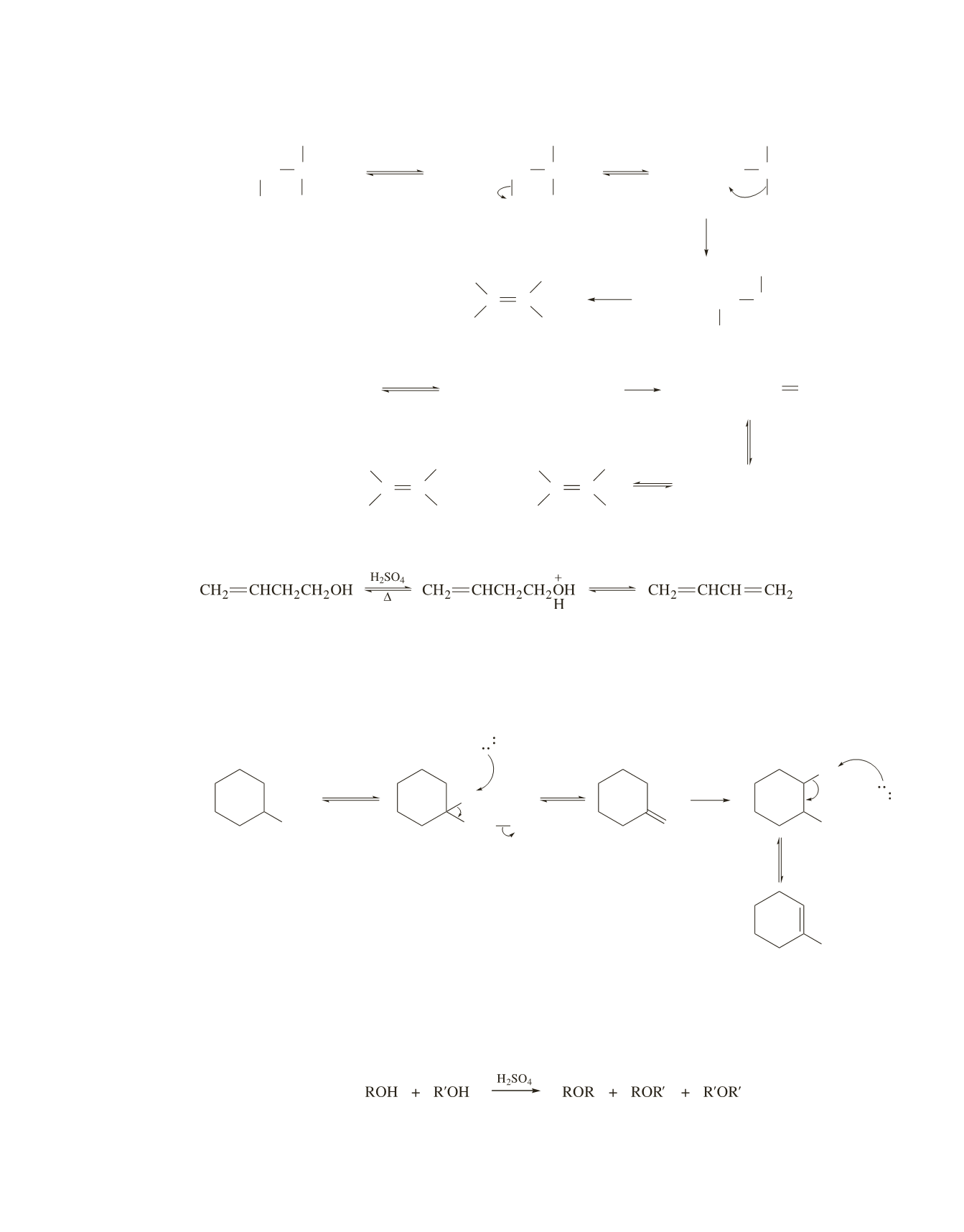
, the reactant is a primary alcohol. Therefore, elimination of water takes place via an E2
reaction. Because the dehydration reaction is being carried out in an acidic solution, the alkene that is
formed initially is protonated to form a carbocation. The proton that is then lost from the carbocation
results in formation of the most stable alkene.
CH
2
OH
H
2
SO
4
CH
2
H
H
H
2
O
+
CH
2
+
H
3
O
+
CH
3
H
H
2
O
+
CH
3
H
3
O
+
+
OH
15.
a.
To synthesize an unsymmetrical ether
1
ROR
2
by this method, two different alcohols
1
ROH and
R OH
2
have to be heated with sulfuric acid. Therefore, three different ethers would be obtained as
products. Consequently, less than half of the total amount of ether that is synthesized would be the
desired ether.
target
molecule