


 365 / 912

Chapter 10 357
Copyright © 2017 Pearson Education, Inc.
Solutions to Problems
1.
They no longer have a lone pair of electrons.
2.
Solved in the text.
3.
The leaving group of
CH
3
O
+
H
2
is
H
2
O;
the
p
K
a
of its conjugate is
-
1.7.
The leaving group of
CH
3
OH
is
HO
-
;
the
p
K
a
of its conjugate acid is 15.7.
Because
H
3
O
+
is a much stronger acid than
H
2
O, H
2
O
is a much weaker base than
HO
-
and, therefore, is
the better leaving group. Therefore,
CH
3
O
+
H
2
is more reactive than
CH
3
OH.
4.
Solved in the text.
5.
a.
OH
1. HBr,
O
O
2. CH
3
CH
2
CO
−
O
b.
OH
1. HBr,
+
N
2.CH
3
CH
2
N(CH
3
)
2
c.
3 2 2 2
CH CH CH CH OH
1. HBr,
2.
−
C N
3 2 2 2
CH CH CH CH C
Ν
6.
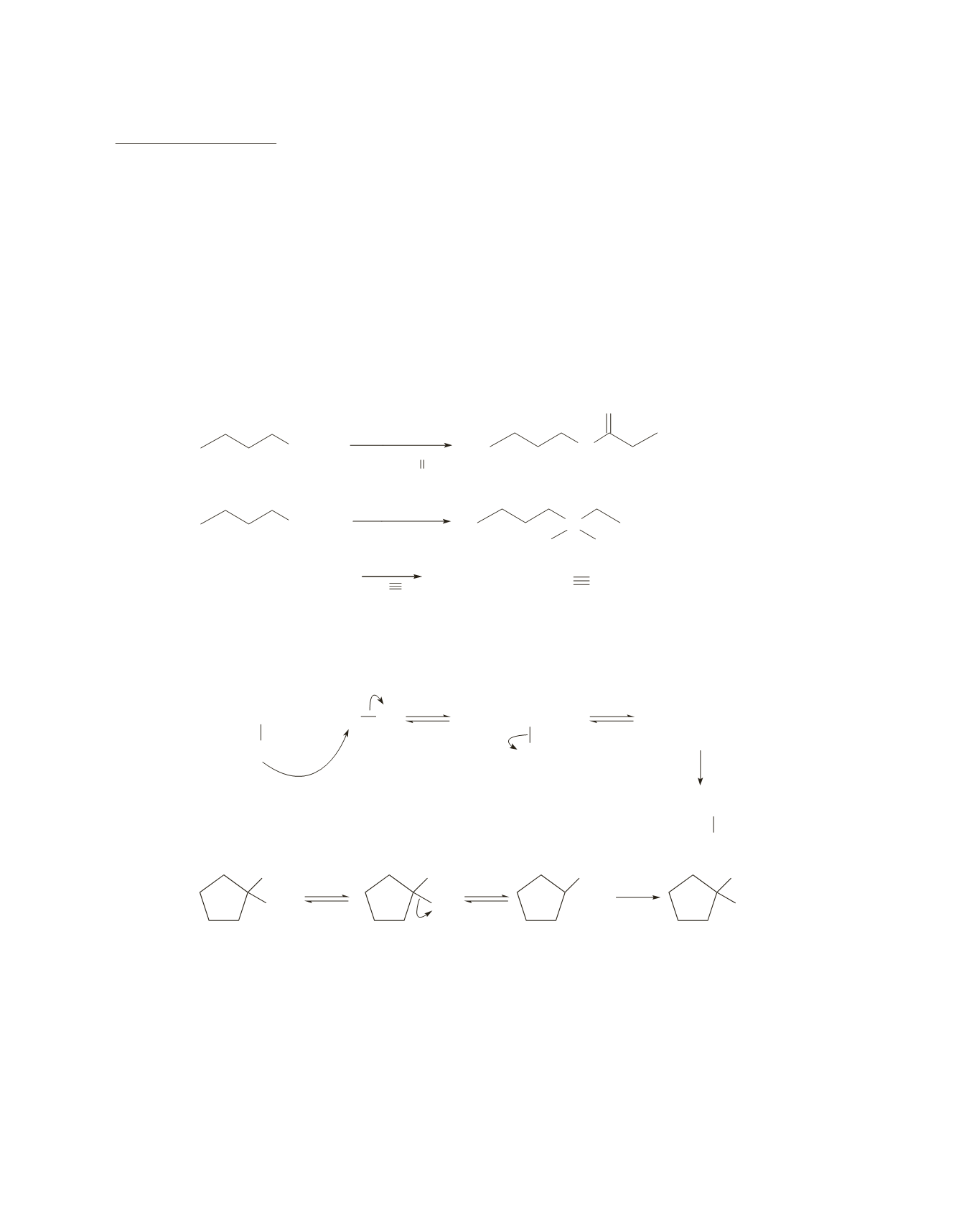
All six alcohols undergo an
S
N
1
reaction, because they are either secondary or tertiary alcohols. The arrows
are shown for the first protonation step in part
a
, but are not shown for that step in parts
b
,
c
,
d
,
e
, and
f
.
a.
..
+
+
CH
3
CH
2
CHCH
3
OH
H Br
..
CH
3
CH
2
CHCH
3
OH
H
..
CH
3
CH
2
CHCH
3
+
+ H
2
O
Br
−
CH
3
CH
2
CHCH
3
Br
b.
CH
3
OH
CH
3
OH
CH
3
CH
3
Cl
H
HCl
+
+
Cl
−
+
H
2
O