


 339 / 912

Chapter 9 331
Copyright © 2017 Pearson Education, Inc.
71.
a.
The rate will be increased nine-fold.
b.
The reaction will be slower because of the more polar solvent.
c.
The reaction will be slower because the leaving group will be poorer.
d.
The reaction will be slower because there will be more steric hindrance.
72.
a.
The reaction will be slower because the leaving group is poorer.
b.
The reaction will be slower because it will be an
S
N
2
reaction with a poor nucleophile, and the leaving
group is poorer.
73.
a.
Br
OCH
3
HBr
CH
3
O
−
b.
Br
NH
2
CH
3
HBr
CH
3
NH
2
+
HO
−
NHCH
3
(A large excess of methylamine has to be used in the second step to minimize the formation of a
tertiary amine and a quarternary ammonium ion.)
c.
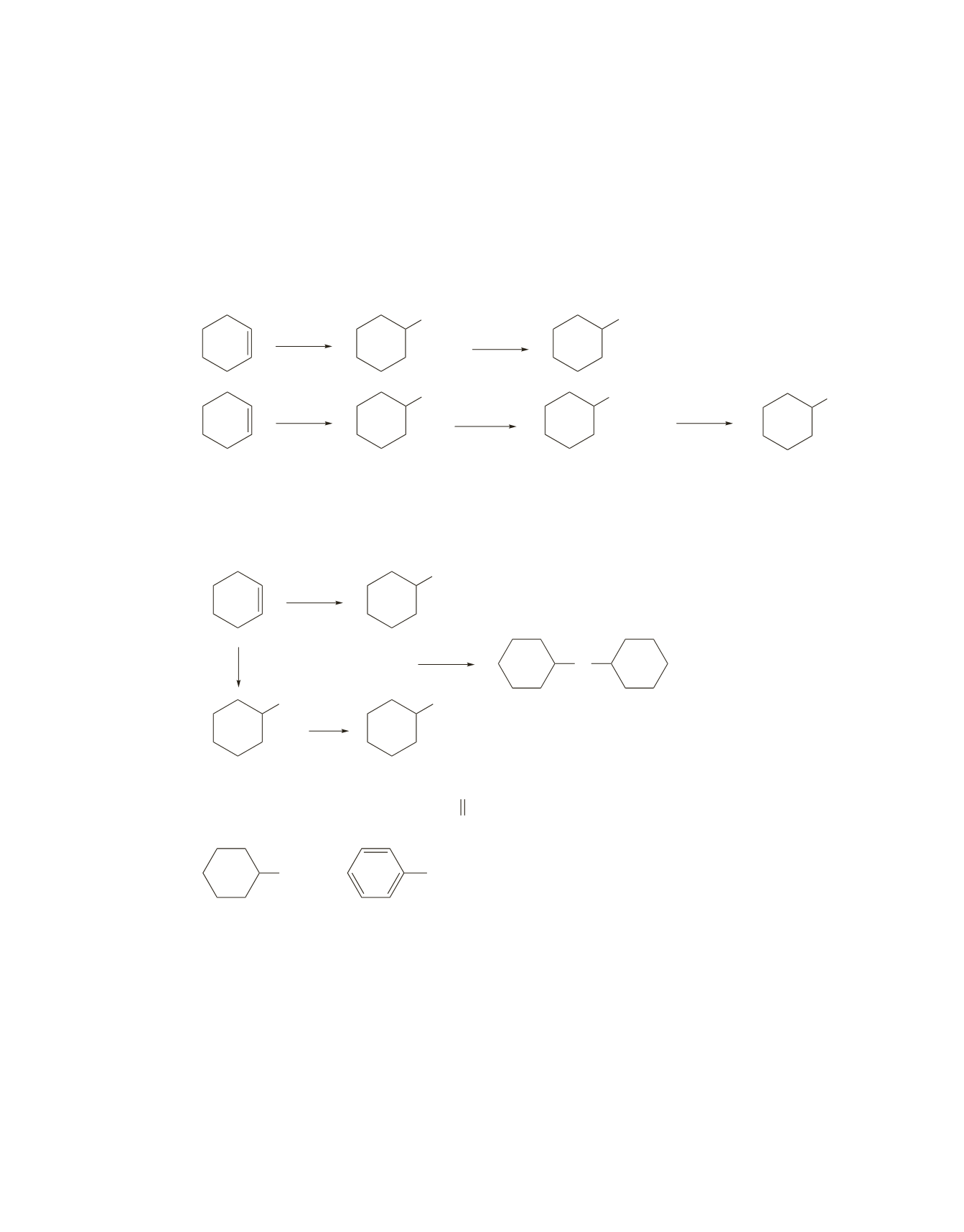
Half of the cyclohexene is converted to bromocyclohexane, and half is converted to an alkoxide ion.
The ether is formed from the reaction of bromocyclohexane with the alkoxide ion.
Br
HBr
O
−
OH
NaH
+
H H
2
SO
4 2
O
O
74.
a.
CH
3
CO
−
O
CH
3
CH
2
S
−
> CH
3
CH
2
O
−
>
b.
O
−
>
O
−
c.
NH
3
7
H
2
O
d.
I
-
7
Br
-
7
Cl
-
75.
The
p
K
a
will increase (it will be a weaker acid) because of a decreased tendency to form a charged species
in a less polar solvent. (See Problem 57 on page 442.)