


 338 / 912

330 Chapter 9
Copyright © 2017 Pearson Education, Inc.
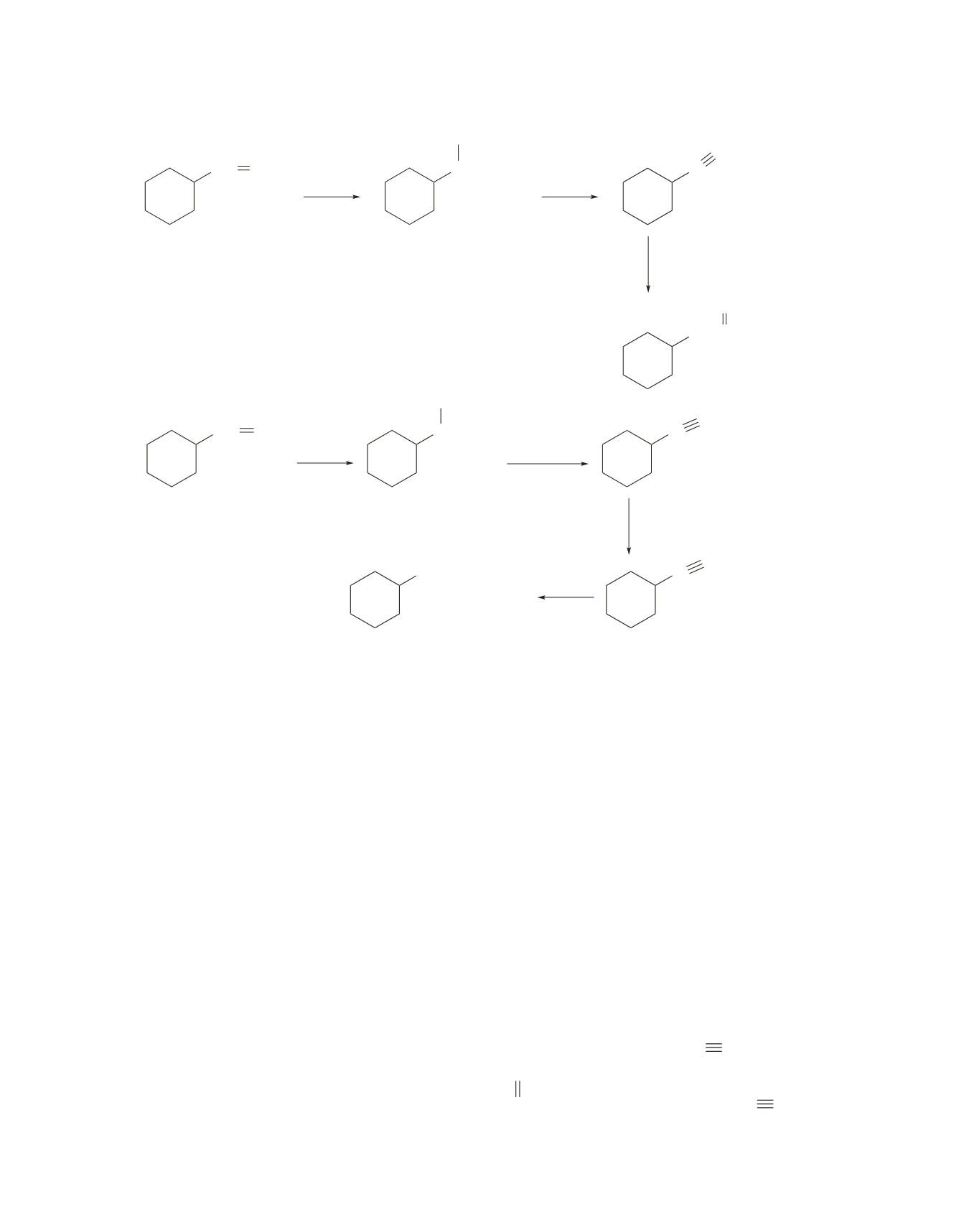
c.
CH
C
Br
2
CH
2
Cl
2
NH
2
excess
CH
2
CHCH
2
Br
Br
−
CH
1. R
2
BH/THF
2. HO
−
, H
2
O
2
, H
2
O
CH
2
CH
O
d.
CH
CHCH
2
Br
C
C
CH
2
CH
2
CH
2
CH
3
CH
2
Br
CHC
2
CH
3
Br
2
2 NaNH
2
1. NaNH
2
2. CH
3
CH
2
Br
H
2
Pd/C
CH
67.
a.
CH
3
CH
2
CH
2
OH
b.
CH
3
CH
2
CH
2
NH
2
c.
CH
3
CH
2
CH
2
SCH
3
d.
CH
3
CH
2
CH
2
SH
e.
CH
3
CH
2
CH
2
OCH
3
f.
+
CH
3
CH
2
CH
2
NH
2
CH
3
(Notice that the product in part
c
is not protonated because its
p
K
a
is
-
7;
the product in
f
is protonated
because its
p
K
a
is
11.
In part
f
,
CH
3
N
+
H
1
CH
2
CH
2
CH
3
2
2
and CH
3
N
1
CH
2
CH
2
CH
3
2
3
can also be formed,
depending on the concentration of 1-bromopropane; see Problem 16 on page 404 of the text.)
68.
If the atoms are in the same horizontal row of the periodic table, the stronger base is the better nucleophile.
If the atoms are in the same column, the larger atom is the better nucleophile in the protic polar solvent
because the solvent forms stronger hydrogen bonds with the smaller atom.
a.
HO
-
b.
NH
3
c.
H
2
S
d.
HS
-
e.
I
-
f.
Br
-
69.
The weaker base is the better leaving group.
a.
H
2
O
b.
H
2
O
c.
H
2
S
d.
HS
-
e.
I
-
f.
Br
-
70.
a.
HO
-
b.
CH
3
O
-
c.
CH
3
NH
2
d.
HS
-
e.
CH
3
CH
2
S
-
f.
−
CH
3
CO
O
g.
C N
−
h.
−
CH
3
CH
2
C C
In part
c
, a tertiary amine and a quaternary ammonium ion can also form unless a large excess of
CH
3
NH
2
is used. (See Problem 16 on page 404 of the text.)