


 334 / 912

326 Chapter 9
Copyright © 2017 Pearson Education, Inc.
50.
Because a cumulated diene is less stable than an alkyne, the transition state for its formation is less stable
than that for the formation of the alkyne, so the cumulated diene is harder to make.
51.
Solved in the text.
52.
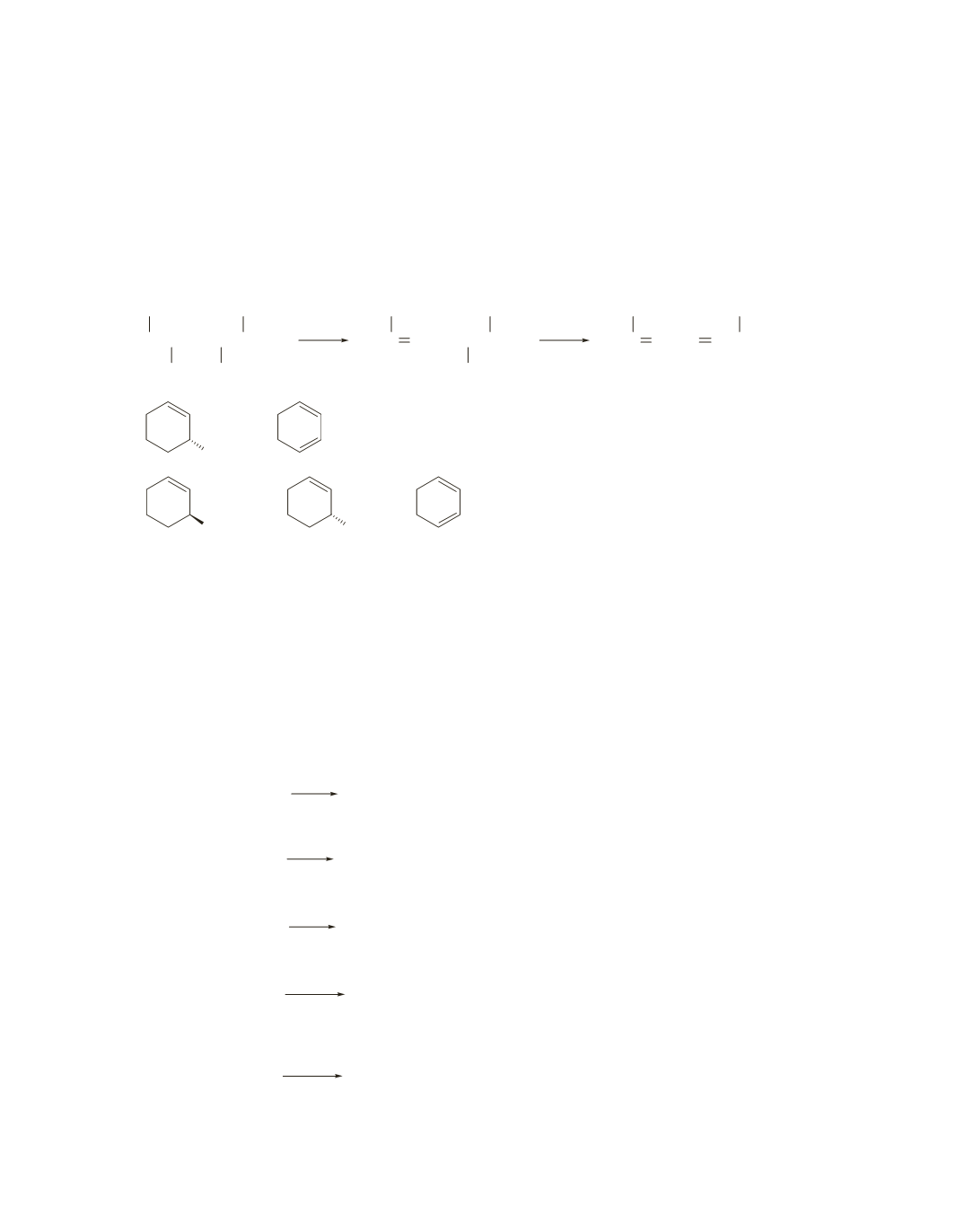
In the first elimination reaction, a hydrogen will be removed from the
b
-carbon bonded to the fewest
hydrogens as expected. In the second elimination reaction, a hydrogen will be removed from the
b
-carbon
that results in the formation of a conjugated double bond.
CH
3
CHCHCH
2
CHCHCH
3
CH
3
CH
3
Cl
Cl
HO
−
CH
3
C CHCH
2
CHCHCH
3
CH
3
CH
3
Cl
HO
−
CH
3
C CHCH
CH
3
CHCHCH
major product = (
E
)-stereoisomer
minor product = (
Z
)-stereoisomer
3
CH
3
53.
a.
OCH
3
+
b.
OCH
3
OCH
3
+
+
54.
Because both reactants in the rate-limiting step are neutral, the reaction will be faster if the polarity of the
solvent is increased.
55.
a.
Increasing the polarity decreases the rate of the reaction because the concentration of charge on the
reactants is greater (the reactants are charged) than the concentration of charge on the transition state.
b.
Increasing the polarity decreases the rate of the reaction because the concentration of charge on the
reactants is greater (the reactants are charged) than the concentration of charge on the transition state.
c.
Increasing the polarity increases the rate of the reaction because the concentration of charge on the
reactants is less (the reactants are not charged) than the concentration of charge on the transition state.
56.
a.
3
CH Br
HO
−
+
3
CH OH Br
−
+
HO
-
is a better nucleophile than
H
2
O.
b.
3
CH I
HO
−
+
3
CH OH I
−
+
I
-
is a better leaving group than
Cl
-
.
c.
3
CH Br
+
+
3 3
CH NH Br
−
+
3
NH
NH
3
is a better nucleophile than
H
2
O
.
d.
3
CH Br
HO
−
+
DMSO
3
CH OH Br
−
+
Unlike ethyl alcohol, DMSO does not stabilize the nucleophile (and, therefore, decrease the rate of the
reaction) by hydrogen bonding.
e.
EtOH
3
3
CH Br
NH
+
+
3 3
CH NH Br
−
+
A more polar solvent stabilizes the transition state more than it stabilizes the reactants. (EtOH is ethanol.)