



 329 / 912

Chapter 9 321
Copyright © 2017 Pearson Education, Inc.
29.
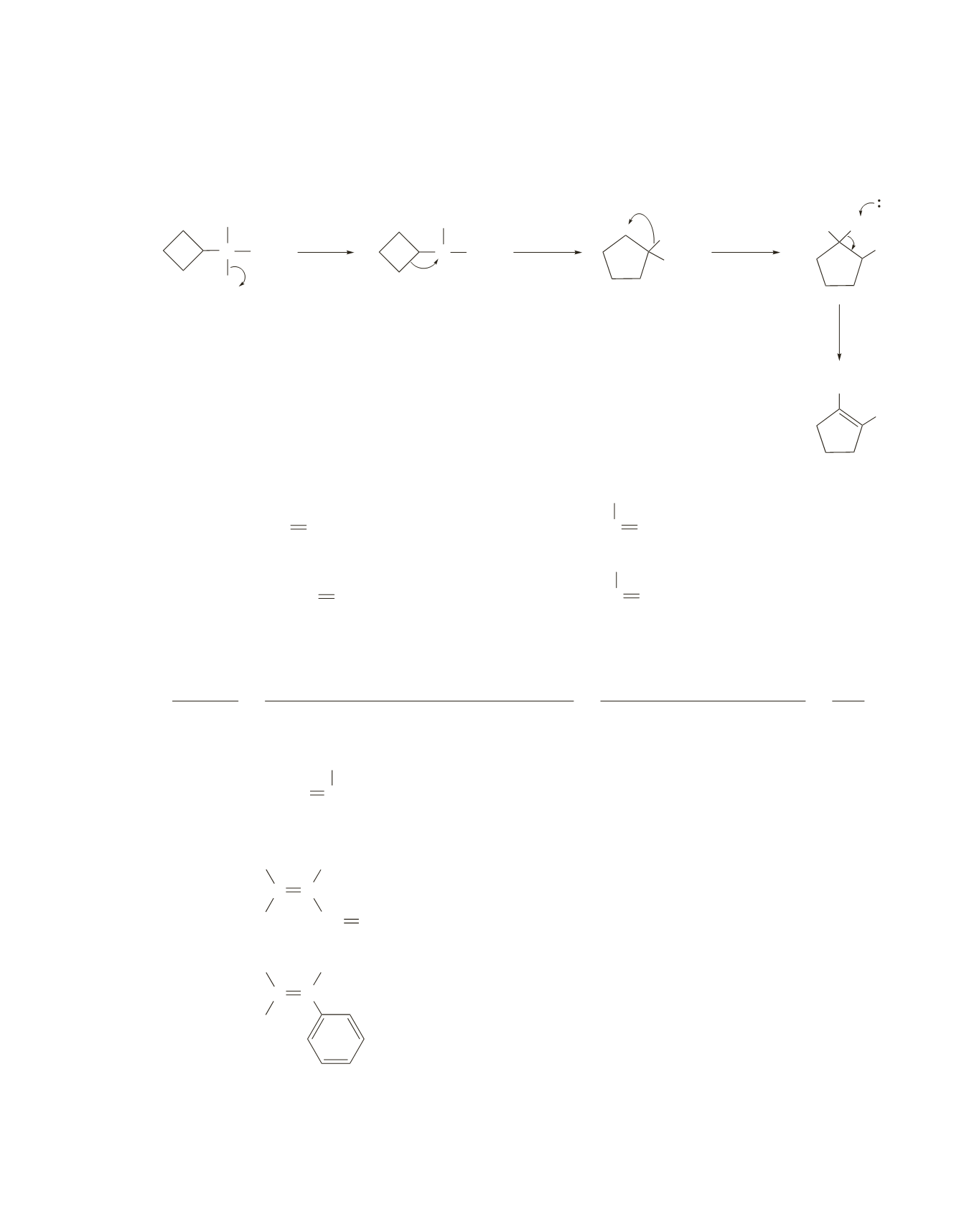
A tertiary carbocation with a strained four-membered ring is less stable than a secondary carbocation with
an unstrained five-membered ring, so a carbocation rerrangement occurs. A second carbocation rearrange-
ment forms a tertiary carbocation.
C CH
E1
3
CH
3
Cl
C CH
3
CH
3
shift
shift
CH
3
CH
3
CH
3
H CH
3
CH
3
CH
3
1 2
3
+
2
+
1
3
B
+
+
HB
+
+
Cl
−
1,2-alkyl
1,2-methyl
30.
a.
E2 CH
3
CH CHCH
3
b.
E2 CH
3
CH
2
CH CH
2
c.
E1 CH
3
C
CH
3
CH
2
d.
E2 CH
3
C
CH
3
CH
2
31.
Solved in the text.
32.
E2
E2
+
E1
=
7.1
*
10
-
5
*
2.5
*
10
-
3
7.1
*
10
-
5
*
2.5
*
10
-
3
+
1.50
*
10
-
5
=
1.78
*
10
-
7
1.78
*
10
-
7
+
150
*
10
-
7
=
1.78
152
=
1.2%
33.
a. 1.
CH
3
CH
2
CH CCH
3
CH
3
No stereoisomers are possible because there are two methyl groups
on one of the
sp
2
carbons.
2.
CH
3
CH
2
2
CC
H
H CH CH
The major product is the conjugated diene with the larger group
bonded to one
sp
2
carbon on the opposite side of the double bond
from the larger group bonded to the other
sp
2
carbon.
3.
CH
3
CH
2
CC
H
H
The major product is the conjugated alkene with the larger group
bonded to one
sp
2
carbon on the opposite side of the double bond
from the larger group bonded to the other
sp
2
carbon.
b.
In none of the reactions is the major product dependent on whether you start with the
R
or
S
enanti-
omer of the reactant.