


 326 / 912

318 Chapter 9
Copyright © 2017 Pearson Education, Inc.
13.
Solved in the text.
14.
a.
3 2
CH CH Br + HO
−
HO
-
is a better nucleophile than
H
2
O.
b.
CH
3
CHCH
2
Br
CH
3
+
HO
−
This alkyl halide has less steric hindrance
toward nucleophilic attack.
c.
3 2
3
CH CH Cl + CH S
−
CH
3
S
-
is a better nucleophile than
CH
3
O
-
in a protic
solvent (a solvent that can form hydrogen bonds).
d.
3 2
CH CH Br + I
−
Br
-
is a weaker base than
Cl
-
,
so
Br
-
is a better leaving group.
15.
These are all
S
N
2
reactions.
a.
b.
c.
+
−
d.
16.
Solved in the text.
17.
a.
Reaction of an alkyl halide with ammonia gives a low yield of primary amine, because as soon as the
primary amine is formed, it can react with another molecule of alkyl halide to form a secondary amine;
the secondary amine can react with the alkyl halide to form a tertiary amine, which can then react with
an alkyl halide to form a quaternary ammonium salt. (See Problem 16 on page 404.)
b.
The alkyl azide is not treated with hydrogen until after all the alkyl halide has reacted with azide ion.
Therefore, when the primary amine is formed, there is no alkyl halide for it to react with to form a
secondary amine.
18.
a.
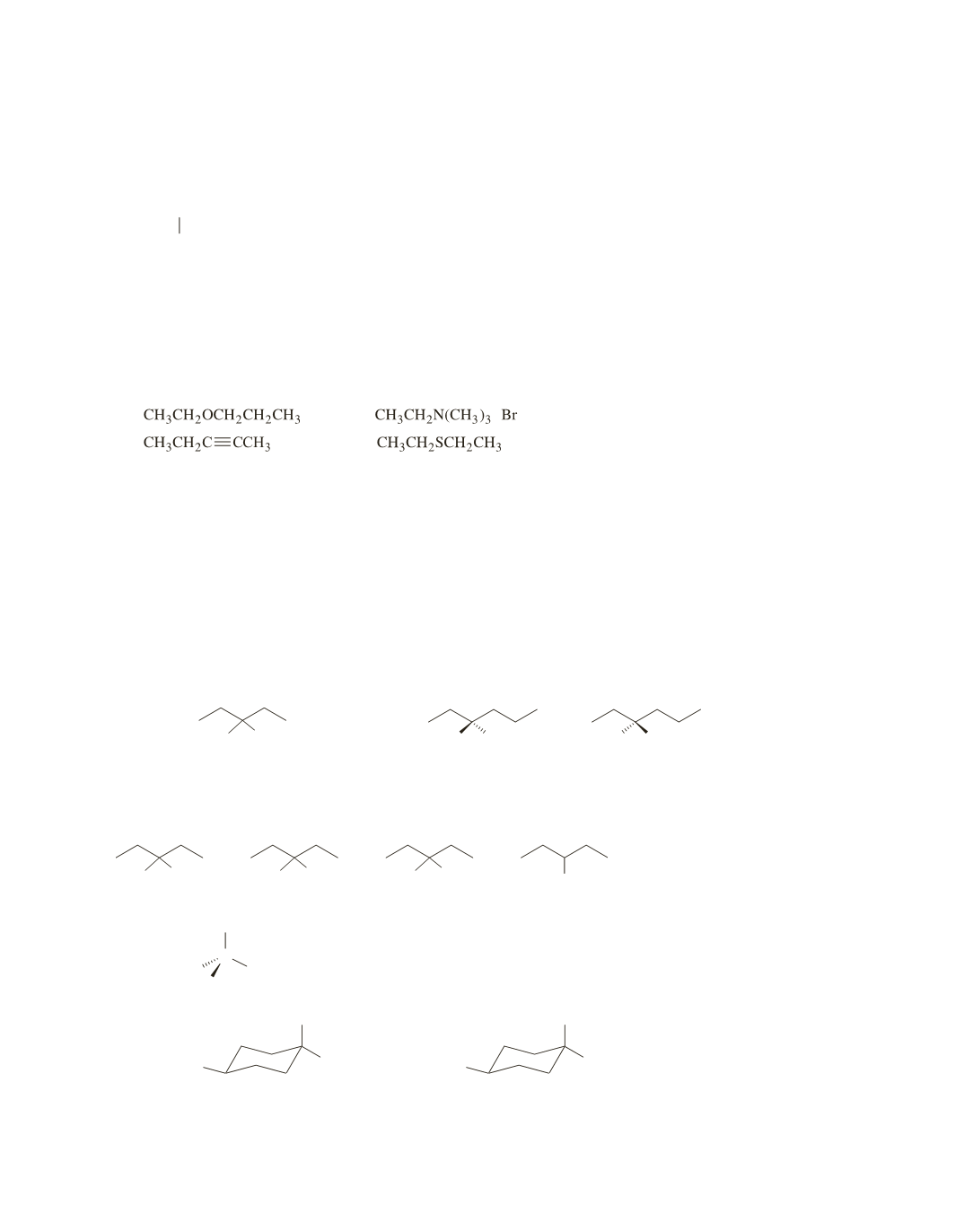
one product because the leaving
group is not attached to an
asymmetric center
OCH
3
b.
R
and
S
because the leaving
group is attached to an
asymmetric center
OCH
3
OCH
3
+
19.
>
I
Br
Cl
Cl
>
>
20.
a.
C
CH
3
H CH
2
CH
3
CH
3
CH
2
O
The product has the inverted configuration compared to that of the reactant.
b.
CH
3
CH
3
CH
2
CH
3
CH
2
OCH
3
+
OCH
3
CH
3
Once the tertiary carbocation forms, methanol can attack the
sp
2
carbon from the top or bottom of the
planar carbocation.