


 793 / 912

Chapter 24 785
Copyright © 2017 Pearson Education, Inc.
40.
Each molecule of acetyl-CoA forms 2 molecules of CO
2
. Therefore, the 8 molecules of acetyl-CoA
obtained from a molecule of a 16-carbon fatty acyl-CoA will form 16 molecules of CO
2
.
41.
No ATP is formed from
b
-oxidation.
42.
Each molecule of acetyl-CoA that is cleaved from the 16-carbon fatty acyl-CoA forms 1 molecule of
FADH
2
and 1 molecule of NADH. Because a 16-carbon fatty acyl-CoA undergoes 7 cleavages, 7 molecules
of FADH
2
and 7 molecules of NADH are formed from the 16-carbon fatty acyl-CoA.
43.
Because each NADH forms 2.5 molecules of ATP and each FADH
2
forms 1.5 molecules of ATP in
oxidative phosphorylation, the 7 molecules of NADH form 17.5 molecules of ATP and the 7 molecules of
FADH
2
form 10.5 molecules of ATP. Therefore, 28 molecules of ATP are formed.
44.
We have seen that each molecule of acetyl-CoA that enters the citric acid cycle forms 10 molecules of ATP
(Section 24.10). A molecule of a 16-carbon fatty acid will form 8 molecules of acetyl-CoA. These will
form 80 molecules of ATP. When these are added to the number of ATP molecules formed from the NADH
and FADH
2
generated in
b
-oxidation (80 + 28), we see that 108 molecules of ATP are formed from com-
plete metabolism of a 16-carbon saturated fatty acyl-CoA.
45.
Each molecule of glucose, while being converted to 2 molecules of pyruvate, forms 2 molecules of ATP
and 2 molecules of NADH.
The 2 molecules of pyruvate form 2 molecules of NADH while being converted to 2 molecules of
acetyl-CoA.
Each molecule of acetyl-CoA that enters the citric acid cycle forms 3 molecules of NADH, 1 molecule
of FADH
2
and 1 molecule of ATP. Therefore, the 2 molecules of acetyl-CoA obtained from glucose form
6 molecules of NADH, 2 molecules of FADH
2
, and 2 molecules of ATP.
Therefore, each molecule of glucose forms 4 molecules of ATP, 10 molecules of NADH (2 + 2 + 6), and
2 molecules of FADH
2
.
Because each NADH forms 2.5 molecules of ATP and each FADH
2
forms 1.5 molecules of ATP, 1 molecule
of glucose forms 4 + (10 × 2.5) + (2 × 1.5) molecules of ATP. That is, each molecule of glucose forms
32 molecules of ATP.
46.
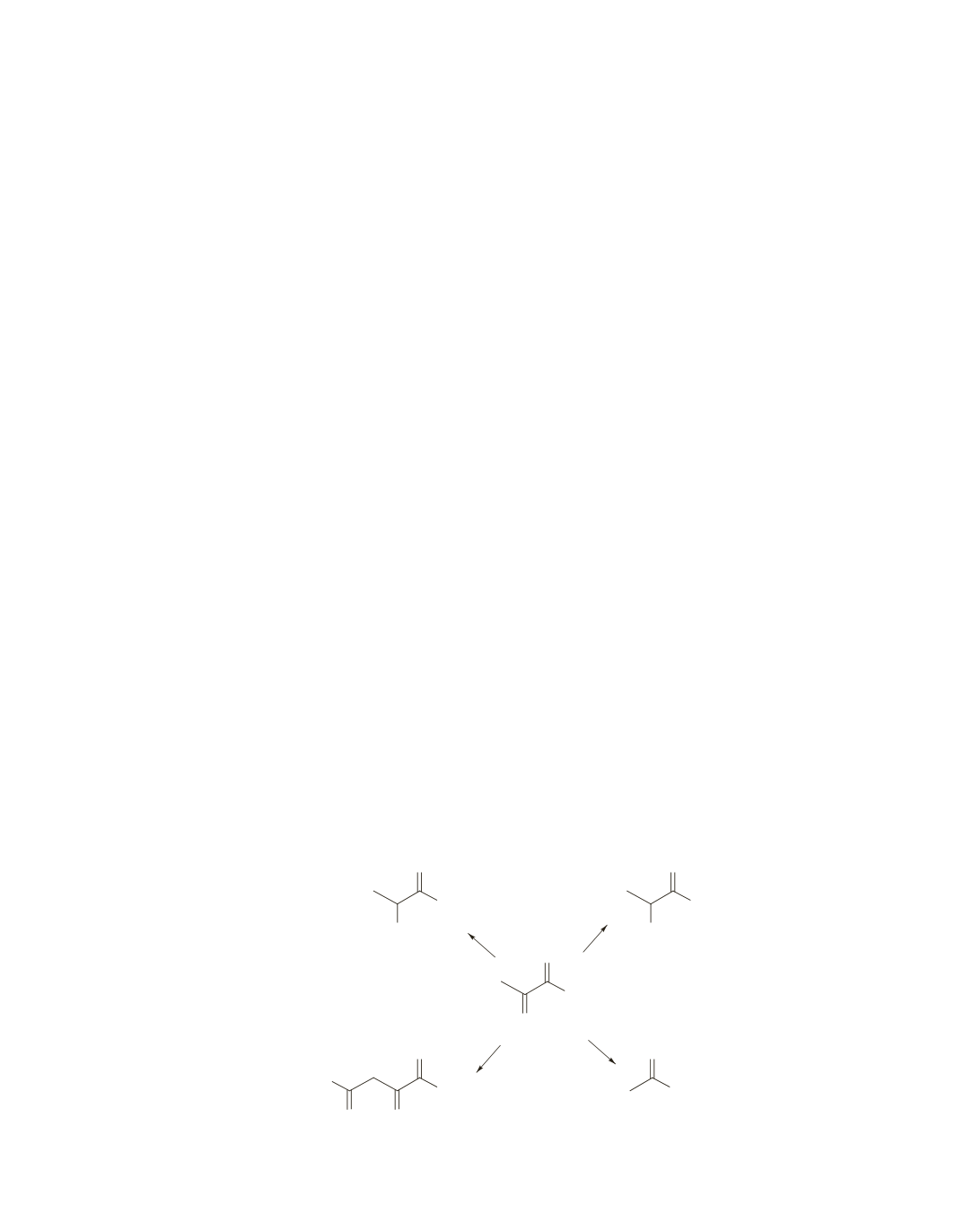
Pyruvate can be converted to alanine (transamination), oxaloacetate (carboxylation), lactate (reduction),
and acetyl-CoA (by the pyruvate dehydrogenase complex).
O
−
−
O
O
O O
oxaloacetate
SCoA
O
acetyl-CoA
O
−
O
O
pyruvate
alanine
O
−
O
NH
3
+
O
−
O
OH
lactate