



 789 / 912

Chapter 24 781
Copyright © 2017 Pearson Education, Inc.
21.
a.
Succinyl-CoA synthetase: this enzyme catalyzes a reaction of succinyl-CoA, but it is named for the
reverse reaction, which is the synthesis of succinyl-CoA.
b.
aldolase: it is a retroaldol reaction, but it is named for an aldol addition; phosphoglycerate kinase
(a kinase puts a phosphoryl group on the substrate); pyruvate kinase
22.
a.
The conversion of one molecule of glycerol to dihydroxyacetone phosphate consumes one mole-
cule of ATP. The conversion of dihydroxyacetone phosphate to pyruvate produces two molecules of
ATP. Therefore, one molecule of ATP is obtained from the conversion of one molecule of glycerol to
pyruvate.
b.
One NADH is formed from the conversion of one molecule of glycerol to dihydroxyacetone phos-
phate, and one NADH is formed from the conversion of dihydroxyacetone phosphate to pyruvate. Each
NADH forms 2.5 ATP in the fourth stage of catabolism. So when the fourth stage of catabolism is
included, six molecules (2.5 + 2.5 + 1 = 6) of ATP are obtained from the conversion of one molecule of
glycerol to pyruvate.
23.
a.
glycerol kinase
b.
phosphatidic acid phosphatase
24.
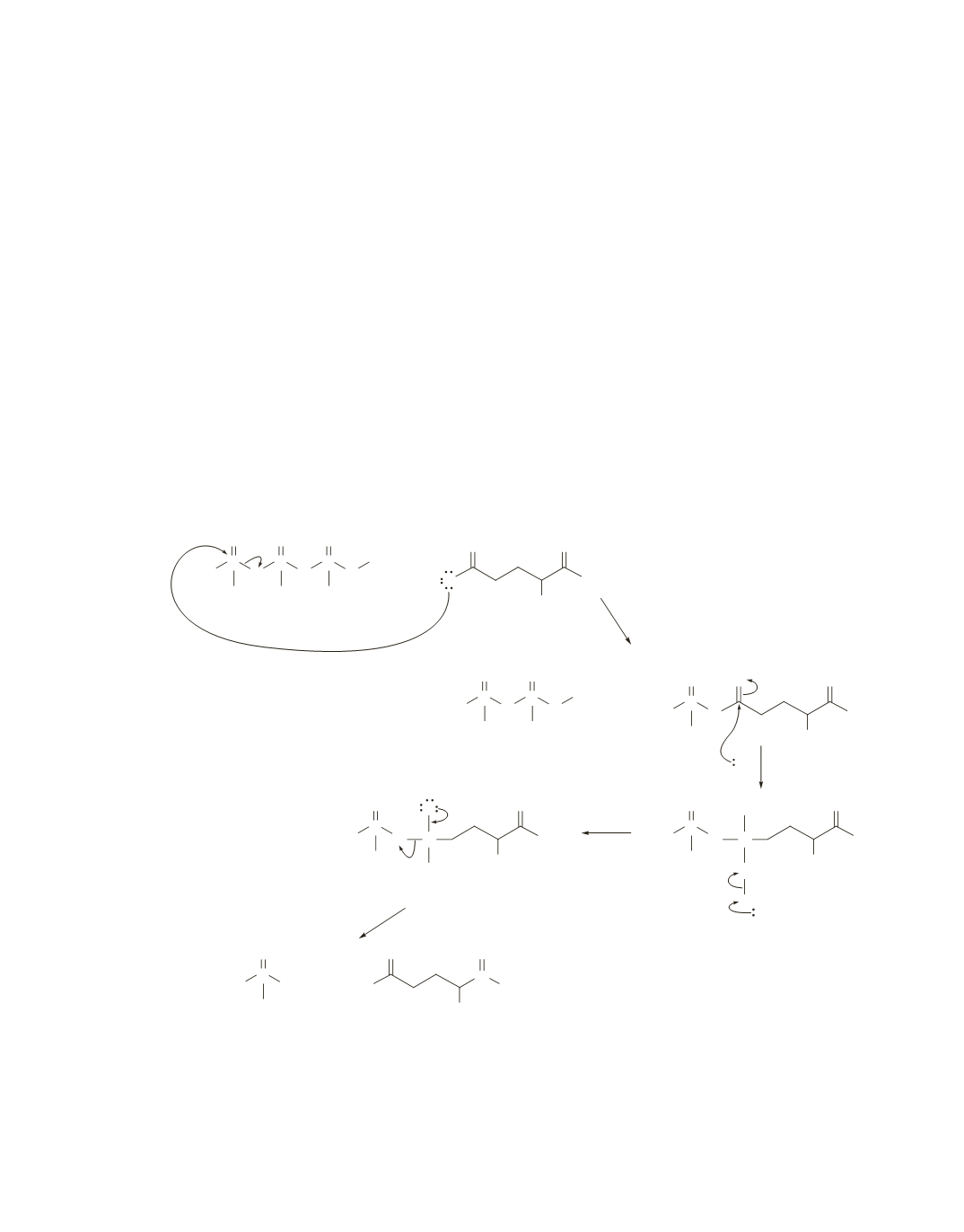
The first step is an S
N
2 reaction; the second step is a nucleophilic acyl substitution reaction.
+
C
−
O
−
O O
P
+
ATP
ADP
glutamate
O
O
+
−
−
O
NH
3
O
O O
+
−
O
−
O
H
NH
3
NH
3
−
O
−
O O
P
O
O
O
+
−
O
NH
3
+
NH
2
C
−
O
−
O
−
O O
P
O
O
+
−
O
NH
3
+
HB
NH
2
glutamine
H
2
N
O
+
−
O
NH
3
C
−
O
−
O O
P
O
+
+
−
−
O
HO B
O
P
O
−
O
O
P
Ad
O
−
O
O
P
O
−
O
−
O O
P
Ad
O
−
O
O
P
O
B
O
25.
a.
catabolic
b.
catabolic