



 787 / 912

Chapter 24 779
Copyright © 2017 Pearson Education, Inc.
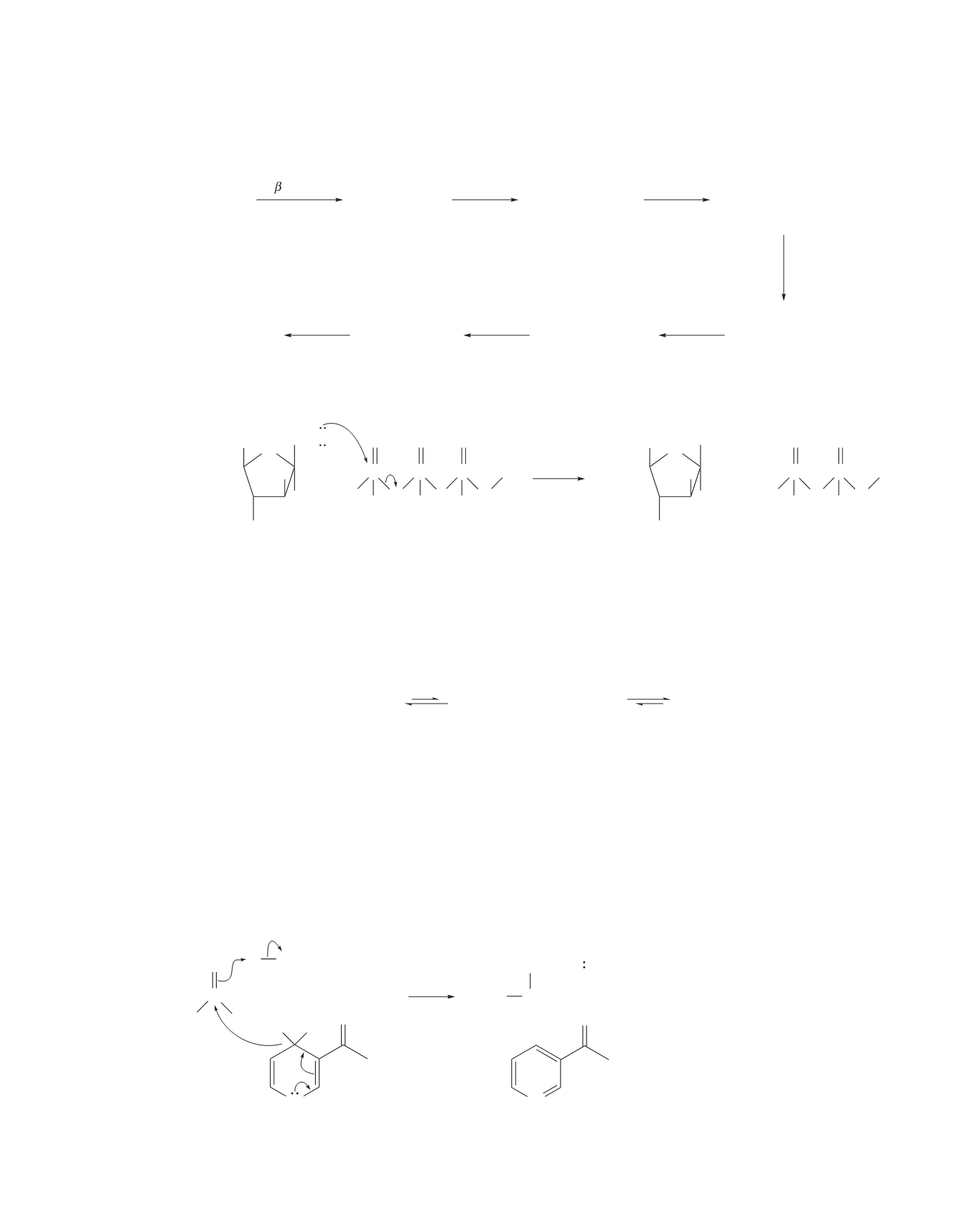
7.
seven: one mole of NADH is obtained from each round of
b
-oxidation.
16
carbons
14
carbons
+
1 acetyl-CoA
2nd round
12
carbons
+
1 acetyl-CoA
3rd round
10
carbons
+
1 acetyl-CoA
8
carbons
+
1 acetyl-CoA
6
carbons
+
1 acetyl-CoA
4
carbons
+
1 acetyl-CoA
2 acetyl-CoA
4th round
5th round
6th round
7th round
1st round
of
-oxidation
8.
The OH group attacks the
g
-phosphorus of ATP.
O
2
−
O
3
POCH
2
HO
OH
CH
2
OH
HO
O
−
O
Ad
O
−
+
O
2
−
O
3
POCH
2
HO
OH
CH
2
OPO
3
HO
2
−
+
−
O
fructose-6-phosphate
ATP
fructose-1,6-bisphosphate
ADP
+
H
+
P
O
OO
−
P
O
OO
−
P
O
Ad
OO
−
P
O
OO
−
P
O
9.
The reaction that follows the oxidation of glyceraldehyde-3-phosphate to 1,3-bisphosphoglycerate (the
conversion of 1,3-bisphosphoglycerate to 3-phosphoglycerate) is highly exergonic. Therefore, as
1,3-bisphosphoglycerate is converted to 3-phosphoglycerate, glyceraldehyde-3-phosphate will be converted
to 1,3-bisphosphoglycerate to replenish it.
glyceraldehyde-3-phosphate
1,3-bisphosphoglycerate
3-phosphoglycerate
10.
two; each molecule of d-glucose is converted to two molecules of glyceraldehyde-3-phosphate, and each
molecule of glyceraldehyde-3-phosphate requires one molecule of
NAD
+
for it to be converted to one
molecule of pyruvate.
11.
acetaldehyde reductase
12.
a ketone
13.
thiamine pyrophosphate
14.
N
R
H H
H
H B
+
CH
2
NH
2
NH
2
OH
CH
3
N
R
+
B
CH
3
C
O
O
O