



 792 / 912

784 Chapter 24
Copyright © 2017 Pearson Education, Inc.
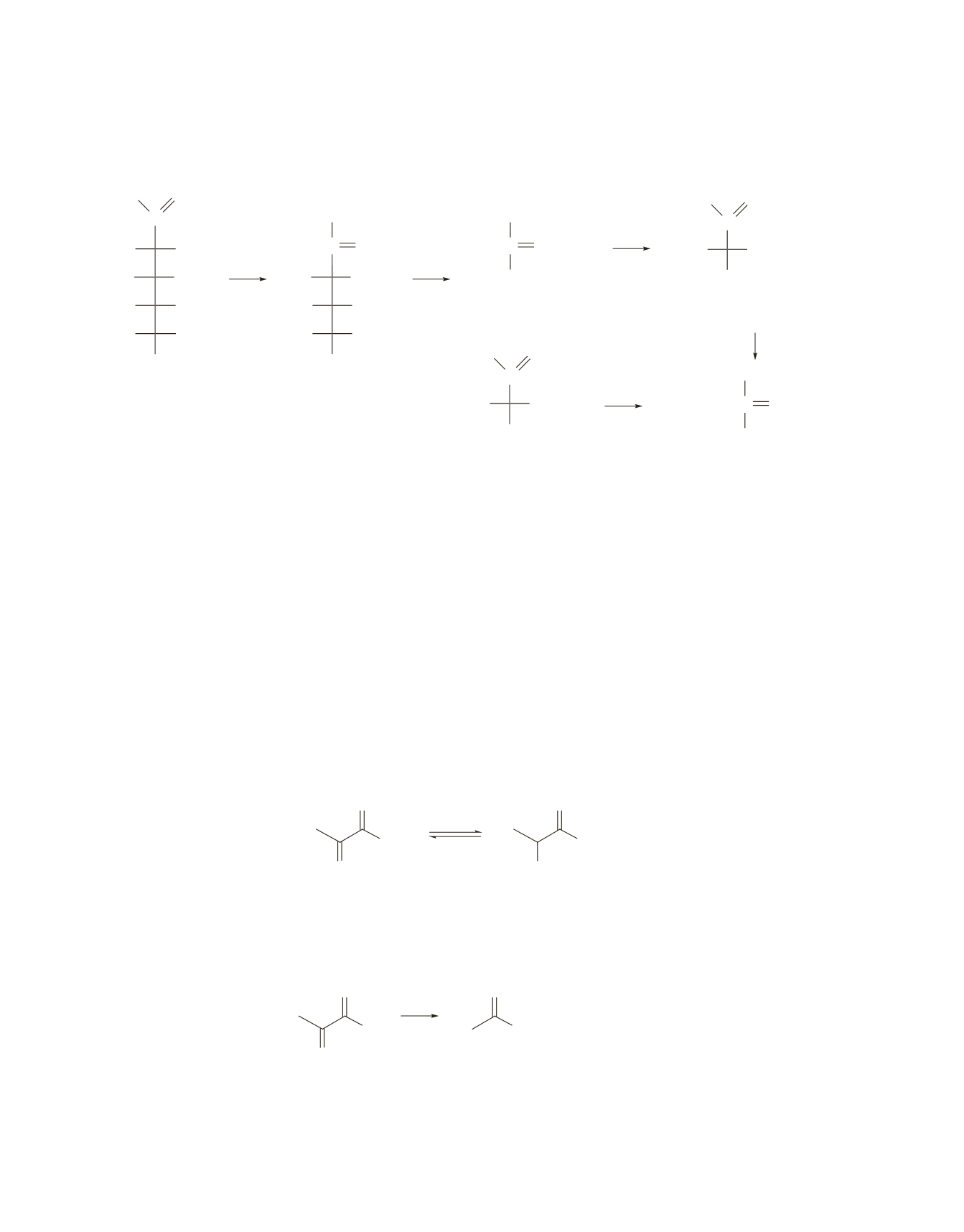
Then if you look at the bottom of page 1109, you will see how the carbons in dihydroxyacetone phosphate
correspond to the carbons in d-glyceraldehyde-3-phosphate.
H
C
CH
2
OPO
3
2
−
H HO
OH
H
OH
H
D
-glucose-
6-phosphate
OH
H
O
1
2
3
4
5
6
C
CH
2
OPO
3
2
−
H HO
OH H
OH H
O
3
4
5
6
CH
2
OPO
3
2
−
2
D
-fructose-
1,6-bisphosphate
1
C
CH
2
OH
O
CH
2
OPO
3
2
−
2
1
3
dihydroxyacetone
phosphate
6
5
4
D
-glyceraldehyde-
3-phosphate
D
-glyceraldehyde-
3-phosphate
3
2
CH
2
OPO
3
2
−
OH H
1
CH
2
OPO
3
2
−
OH
H
3 and 4
2 and 5
1 and 6
pyruvate
C
CH
3
O
COO
−
C
O H
C
O H
Finally, we see how the carbons in d-glyceraldehyde-3-phosphate correspond to the carbons in pyruvate.
Therefore, both C-3 and C-4 of glucose become a carboxyl group in pyruvate.
36.
Pyruvate loses its carboxyl group when it is converted to ethanol. Because the carboxyl group is C-3 or C-4
of glucose, half of the ethanol molecules contain C-1 and C-2 of glucose and the other half contain C-5 and
C-6 of glucose.
37.
At the beginning of a fast, blood glucose levels would be normal.
After a 24-hour fast, blood glucose levels would be very low because both dietary glucose and stored
glucose (glycogen) have been depleted and glucose cannot be synthesized because of the deficiency of
fructose-1,6-bisphosphatase.
38.
The conversion of pyruvate to lactate is a reversible reaction. Lactate can be converted back to pyruvate by
oxidation.
O
_
O
O
O
_
O
OH
pyruvate
lactate
reduction
oxidation
The conversion of pyruvate to acetaldehyde is not a reversible reaction because it is a decarboxylation. The
CO
2
cannot be put back onto acetaldehyde.
O
_
+
O
O
H
CO
2
O
pyruvate
acetaldehyde
39.
The
b
-oxidation of a molecule of a 16-carbon fatty acyl-CoA forms 8 molecules of acetyl-CoA.