



 796 / 912

788 Chapter 24
Copyright © 2017 Pearson Education, Inc.
52.
a.
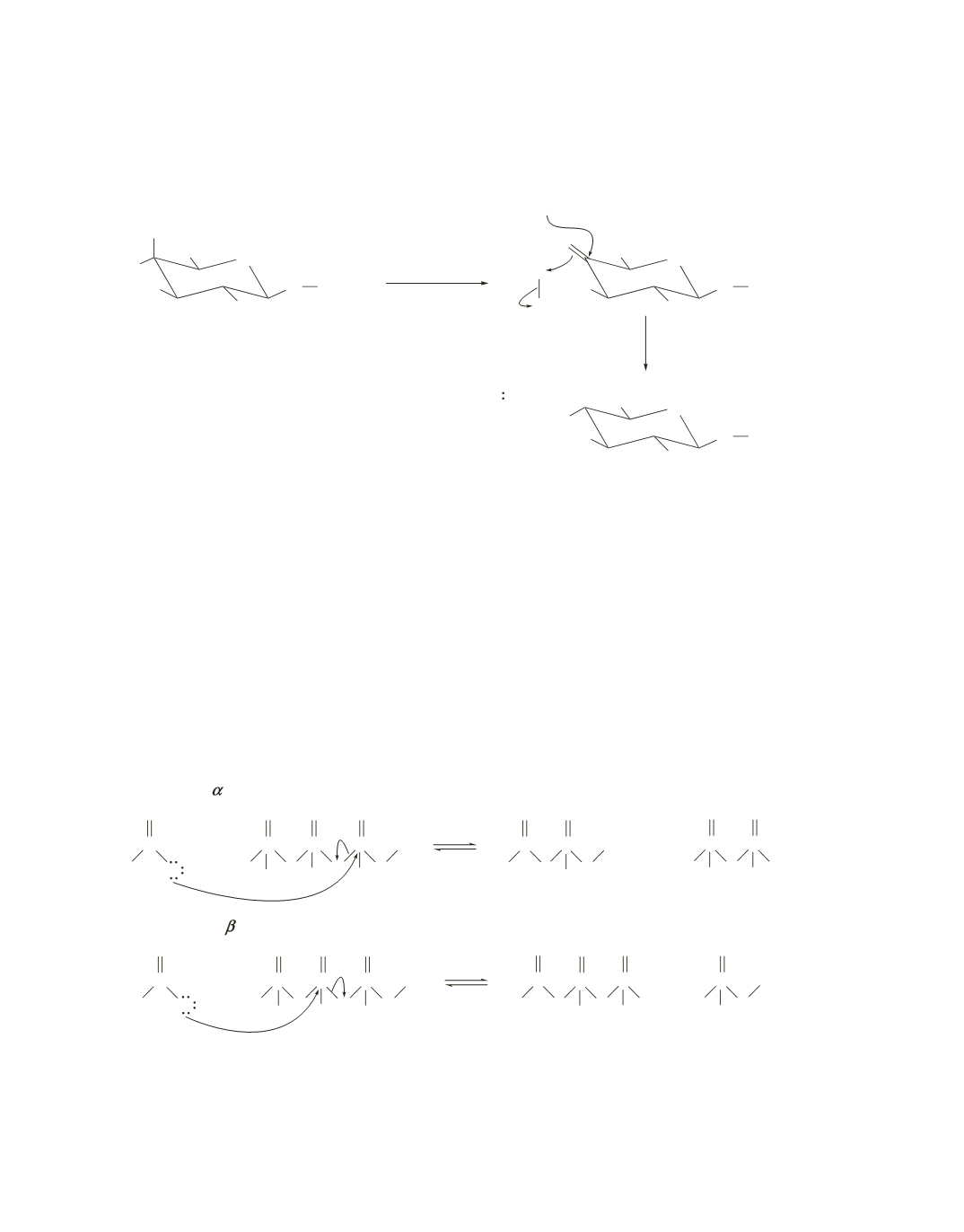
UDP-galactose and UDP-glucose are C-4 epimers. NAD
+
oxidizes the C-4 OH group of UDP-galactose
to a ketone. When NADH reduces the ketone back to an OH, it attacks the
sp
2
carbon from above the
plane, forming the C-4 epimer of the starting material.
O
OH
HO
H
CH
2
OH
OH
O UDP
UDP-galactose
NAD H
O
HO
CH
2
OH
OH
O UDP
O
O
HO
CH
2
OH
OH
O UDP
H
B
HO
NAD
+
UDP-glucose
NAD
+
+
+
–
+
B
b.
The enzyme is called an epimerase because it converts a compound into an epimer (in this case, a C-4
epimer).
53.
Because the compound that would react in the second step with the activated carboxylic acid group is
excluded from the incubation mixture, the reaction between the carboxylate ion and ATP will come to
equilibrium.
If radioactively labeled pyrophosphate is put into the incubation mixture, ATP will become radioactive
if the mechanism involves attack on the
a
-phosphorus because pyrophosphate is a reactant in the reverse
reaction that forms ATP.
ATP will not become radioactive if the mechanism involves attack on the
b
-phosphorus because pyrophos-
phate is not a reactant in the reverse reaction that forms ATP. (In other words, because pyrophosphate is not
a product of the reaction, it cannot become incorporated into ATP in the reverse reaction.)
+
+
−
O O
O
−
−
O
O
−
E
pyrophosphate
attack on the -phosphorus
_
R O
C
O
P P
O
O
O
−
O
P
O
O
−
O
P
O
−
P
O
A
P
O
A
O
O
−
O
O
−
O
C
O R
O
+
+
−
O O
O
A
O
−
−
O
E
AMP
attack on the -phosphorus
_
R O
C
O
P P P
O
OO
−
O
O
−
O
O
−
P
O
−
O
O
−
O
O
P
O
−
A
O
P
O
O R
C
O
54.
If radioactive AMP is added to the reaction mixture, the results will be the opposite. If the mechanism
involves attack on the
a
-phosphorus, ATP will not become radioactive because AMP is not a reactant in the
reverse reaction that forms ATP. If the mechanism involves attack on the
b
-phosphorus, ATP will become
radioactive because AMP is a reactant in the reverse reaction that forms ATP.