


 69 / 912

Spectroscopy Problems
61
Copyright © 2017 Pearson Education, Inc.
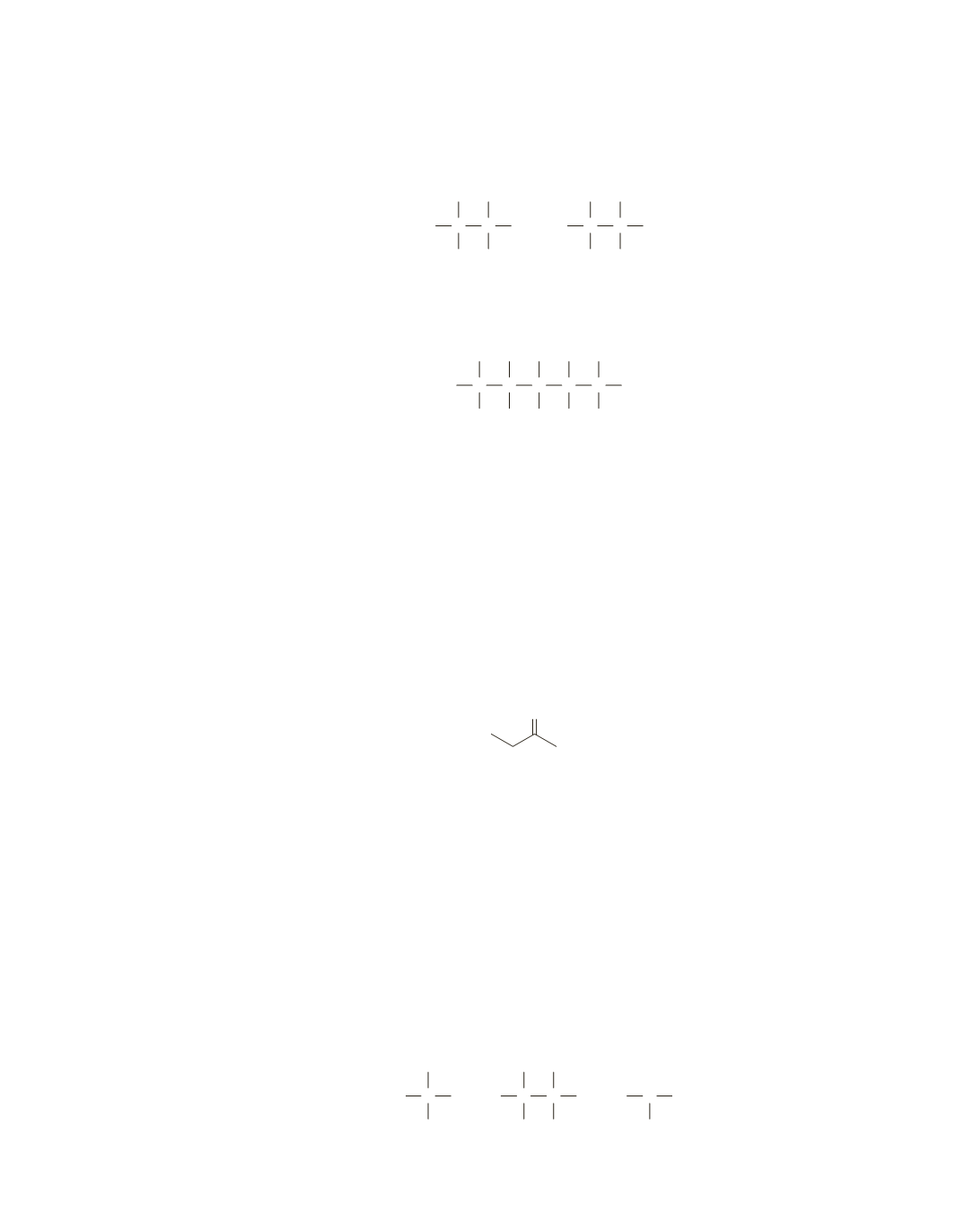
Because the compound must be symmetrical, the two oxygens in the compound must be due to two OH groups
in identical environments. The hydrogens of the OH groups give a singlet (3.8 ppm) that integrates to 2 protons.
C
H
C H
H
H
C
H OH
H
H C
H
OH
The protons that give the triplet (2.6 ppm) must be bonded to a carbon that is adjacent to a total of two protons.
Because the triplet integrates to 2 protons, it must be due to a methylene group that connects the two pieces.
C
H
HOH
H
C
H
H
C
H
OH
C H
H
H
C
H
This structure is confirmed by the relatively high-frequency multiplet (4.2 ppm) that is given by the protons
attached to the carbons that are attached to the OH groups. The signal for these protons is split by both the
adjacent methyl group and the adjacent methylene group.
40.
The absorption in the IR spectrum at
1650 cm
-
1
could be due to either a carbonyl group or an alkene.
Its strength and breadth tells us that it is probably due to a carbonyl
(C
“
O)
group. The strong and broad
absorption at
3300 cm
-
1
that contains two broad peaks suggests two N—H bonds; thus, an
NH
2
group is
present. When these two groups are subtracted from the molecular formula, all that is left is
C
2
H
5
.
The triplet
( 1.1 ppm)
that integrates to 3 protons and the quartet (2.2 ppm) that integrates to 2 protons
indicate the presence of an ethyl group; this accounts for the
C
2
H
5
fragment. Thus, all the fragments of the
compound have been identified:
C
“
O, NH
2
,
and
CH
3
CH
2
.
The compound, therefore, is
propanamide
.
O
NH
2
The presence of an amide explains the lower-than-normal frequency of the
C
“
O
stretch in the IR
spectrum. The breadth of the
N
¬
H
stretches confirms that these are amide
N
¬
H
stretches and not amine
N
¬
H
stretches. The broad singlets (6.2 and 6.6 ppm) in the NMR spectrum are given by the protons
attached to the nitrogen. The protons resonate at different frequencies because the C
¬
N bond has partial
double-bond character, which causes the protons to be in different environments.
41.
The singlet (2.3 ppm) in the first spectrum that integrates to 3 hydrogens must be due to an isolated methyl
group.
The triplet (1.1 ppm) that integrates to 3 protons and the quartet (2.5 ppm) that integrates to 2 protons are
characteristic of an ethyl group.
The singlet (4.8 ppm) that integrates to 1 proton must be due to a single hydrogen attached to nitrogen.
C H
H
HH
H
C
C
H
H
H
N
H