


 66 / 912

58
Spectroscopy Problems
Copyright © 2017 Pearson Education, Inc.
spectrum
(a)
is 3-ethylmethylbenzene because 2-ethylmethylbenzene would not show a triplet. Therefore,
spectrum
(c)
is 2-ethylmethylbenzene.
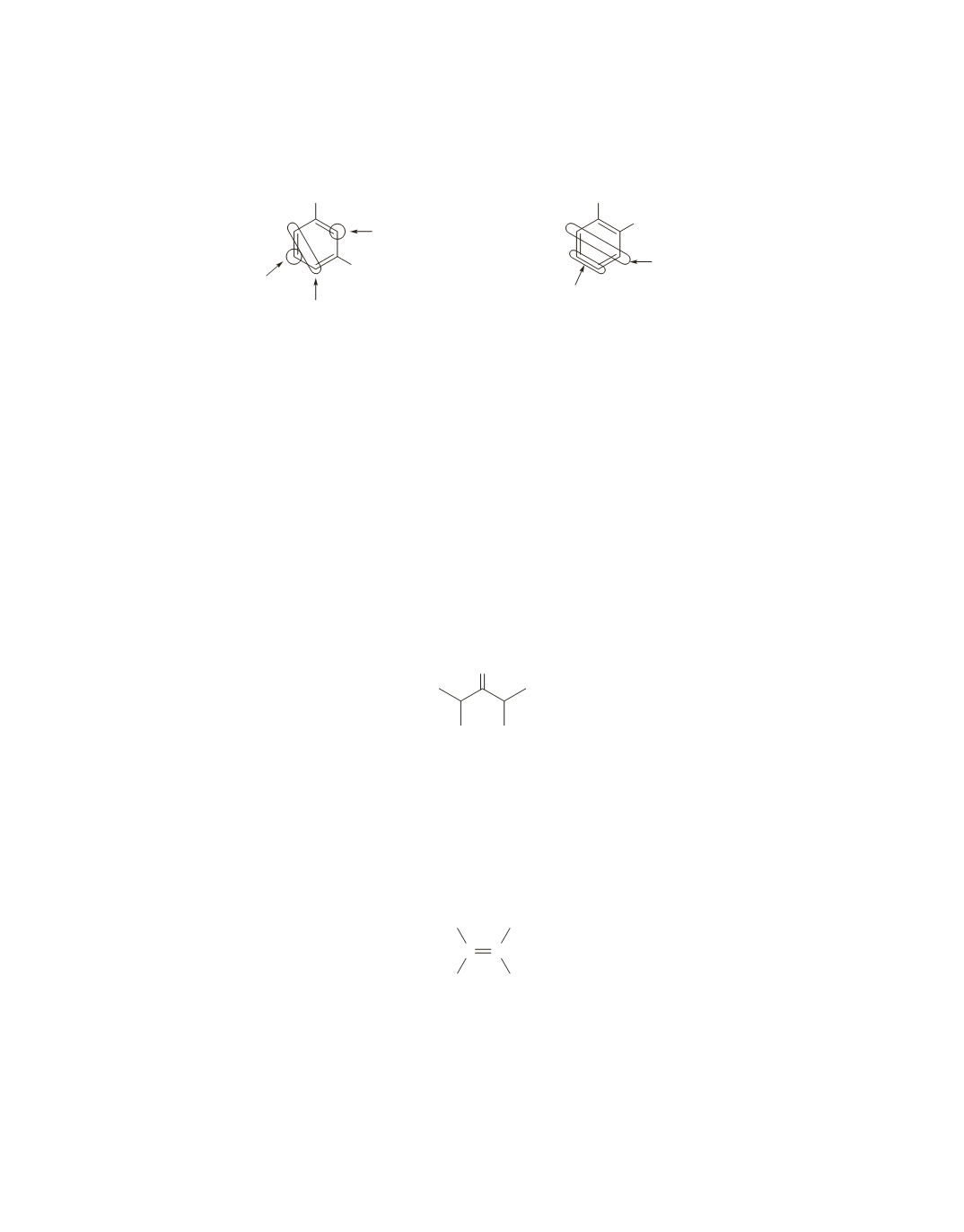
splitting pattern for 3-methylethyl benzene
splitting pattern for 2-methylethyl benzene
R'
doublet (2H)
singlet (1H)
triplet (1H)
R
doublet (2H)
doublet (2H)
R
R'
The final assignments are:
(a) 3-ethylmethylbenzene (b) 4-ethylmethylbenzene (c) 2-ethylmethylbenzene
33.
The simplicity of the NMR spectrum of a compound with 7 carbons and 14 hydrogens indicates that the
compound must be symmetrical. From the molecular formula, we see that it has one degree of unsaturation.
The absence of signals near 5 ppm rules out an alkene. Because the compound has an oxygen, the degree
of unsaturation may be due to a carbonyl group.
The doublet (1.1 ppm) that integrates to 12 protons and the septet (2.8 ppm) that integrates to 2 protons
suggest the presence of two isopropyl groups.
If two isopropyl groups are subtracted from the molecular formula, we find that the remainder of the
molecule is composed of one carbon and one oxygen. Thus, the compound is the one shown here.
O
34.
The molecular formula tells us that the compound has one degree of unsaturation. The multiplet (5.2 ppm)
that integrates to 1 proton is due to a vinylic proton (that is, it is attached to an
sp
2
carbon). Thus, the
degree of unsaturation is due to a carbon–carbon double bond. Because there is only one vinylic proton, we
can assume that the alkene is trisubstituted.
Three additional signals are present that each integrate to 3 protons, suggesting that all three signals are
due to methyl groups. The alkene, therefore, is
2-methyl-2-butene
.
H
CH
3
CH
3
CH
3
CC
Notice that two of the three signals given by the methyl groups are singlets and one is a doublet. The
methyl group that gives the doublet is bonded to the carbon that is attached to the vinylic proton. The other
two methyl groups are bonded to the other
sp
2
carbon.