



 73 / 912

Spectroscopy Problems
65
Copyright © 2017 Pearson Education, Inc.
48.
The molecular formula indicates that the compound has one degree of unsaturation. The NMR spectrum does
not show any signals in the area expected for vinylic protons, so the compound must be either a ketone or a
cyclic ether. A cyclic ether would be expected to have protons on adjacent carbons, so the signals would show
splitting. Because the two signals in the spectrum are both singlets, the compound must be a ketone.
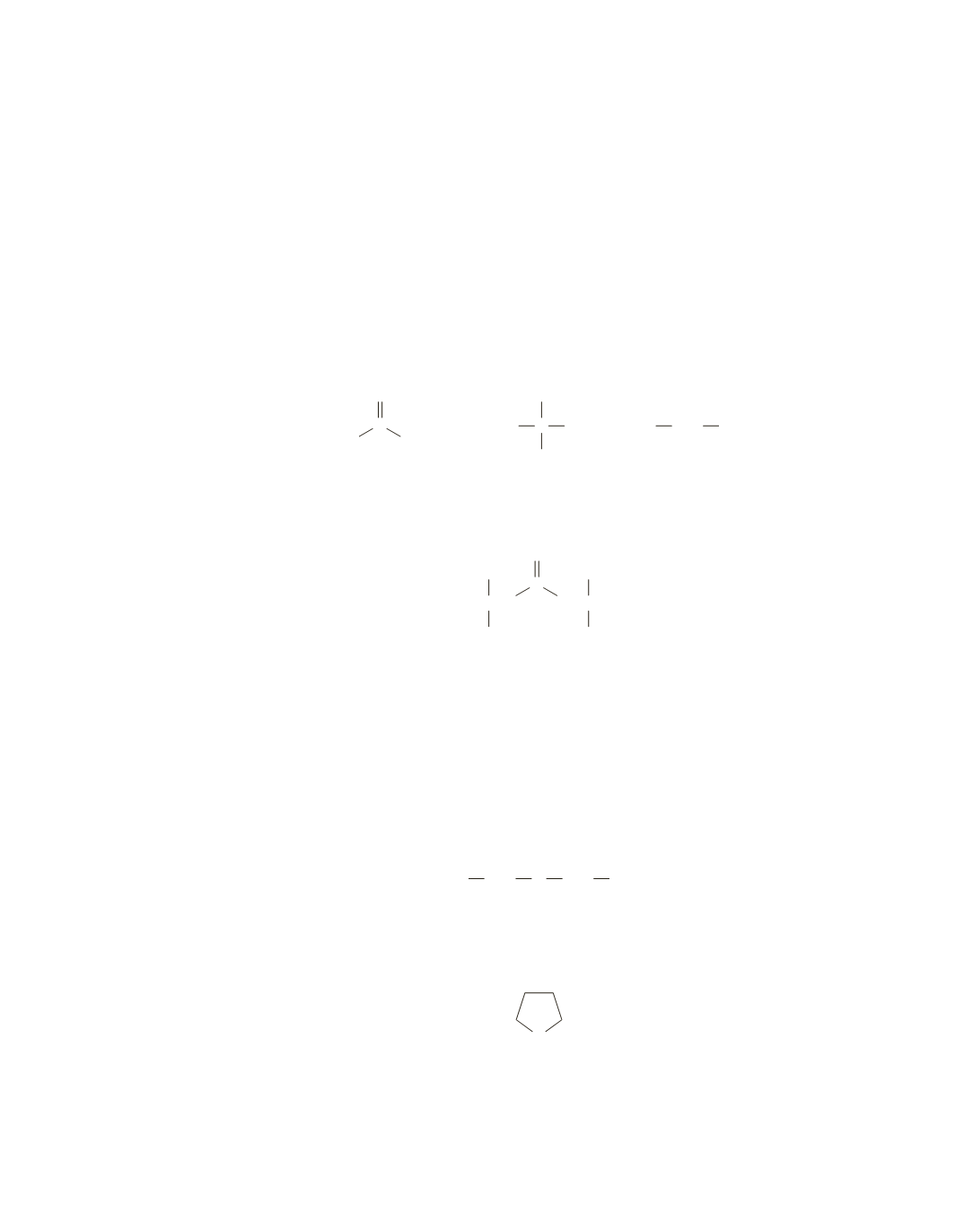
The fact that the compound has 11 carbons and 22 hydrogens but gives only two singlets in the NMR
spectrum indicates that the compound must be symmetrical.
We know that a
tert
-butyl group gives a singlet that integrates to 9 protons. The symmetry of the
molecule leads us to conclude that the singlet that integrates to 18 protons is due to two
tert
-butyl
groups. We can then assume that the singlet that integrates to 4 protons is due to two nonadjacent
methylene groups.
C
CH
3
CH
3
CH
3
CH
2
C
O
2
2
These fragments account for all atoms in the molecular formula. Therefore, the compound must be
2,2,4,4-tetramethyl-4-heptanone
.
CH
3
CH
3
CH
2
CCH
3
CH
3
CH
3
CH
3
CCH
2
2,2,6,6-tetramethyl-4-heptanone
C
O
49.
The molecular formula has one degree of unsaturation, so it must have a carbon–carbon double bond, a
cyclic structure, or a carbonyl group.
The signal (3.8 ppm) that integrates to 4 hydrogens suggests the presence of two methylene groups in
identical environments because a single carbon (other than the carbon in methane) cannot be attached
to four hydrogens. The chemical shift suggests that each methylene group must be attached to an
oxygen. Because the compound has only one oxygen, the two methylene groups must be attached to the
same oxygen.
O CH
2
CH
2
The signal (1.6 ppm) that integrates to 4 hydrogens also suggests the presence of two methylene groups
in identical environments. The four methylene groups and the oxygen account for all the atoms in the
molecular formula. Thus, the compound must be a cyclic ether.
O
The fact that the signal at the higher frequency is a triplet and the other signal is a multiplet confirms this
structure.