


 79 / 912

Spectroscopy Problems
71
Copyright © 2017 Pearson Education, Inc.
62.
The three signals in the
1
H NMR spectrum at 5.9–6.3 ppm are due to three vinylic hydrogens. The 3H
signal in the
1
H NMR spectrum at 2.3 ppm is due to a methyl group close to an electron-withdrawing
group. The signal in the
13
C NMR spectrum at
∼
200 ppm indicates a carbonyl carbon. Putting the pieces
together results in the following compound.
H
H H
C C
CH
3
C
O
63.
The strong and broad absorption band at
∼
3400 cm
-
1
indicates that the compound is an alcohol. The
compound loses water when it is heated with H
2
SO
4
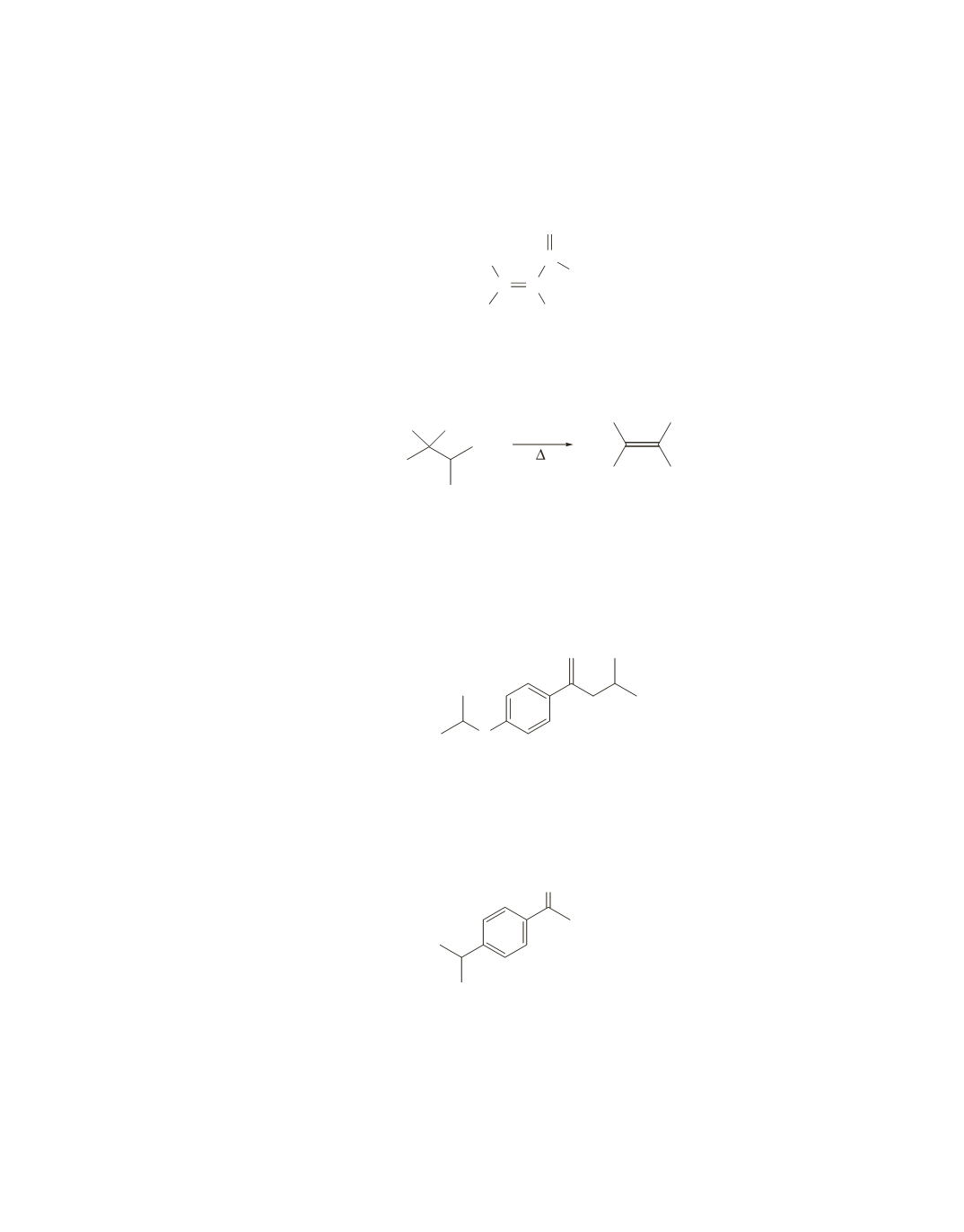
, forming a compound with six carbons that has only
one kind of hydrogen and two kinds of carbon atoms. The reactant and product are shown below.
OH H
2 4
SO
64.
The IR absorption bands at 1600 cm
-
1
, 1500 cm
-
1
, and 3030 cm
-
1
indicate a benzene ring. This
is confirmed by the two doublets between 7.1 and 7.9 ppm in the
1
H NMR spectrum that indicate a
1,4-disubstituted benzene. The IR absorption band at 1690 cm
-
1
indicates a ketone carbonyl group with
significant single-bond character. Therefore, the carbonyl group must be attached to the benzene ring. The
two 6H doublets indicate two isopropyl groups. The septet at
∼
4.8 ppm indicates that one of the isopropyl
groups is attached to an electron-withdrawing group. The structure of the compound is shown below.
O
O
65.
The IR absorption band at 1730 cm
-
1
indicates a carbonyl group, the IR absorption bands at
2700–2800 cm
-
1
indicate an aldehyde, and the IR absorption bands at 1600 cm
-
1
and 1500 cm
-
1
indicate a benzene ring. The two doublets between 7.5 and 7.9 ppm in the
1
H NMR spectrum indicate
a 1,4-disubstituted benzene. The doublet at 1.2 ppm and the multiplet at 5.0 ppm indicate an isopropyl
group. The structure of the compound is shown below.
O
H