



 756 / 912

748 Chapter 22
Copyright © 2017 Pearson Education, Inc.
+
O
−
−
Co
+
CH
2
H
2
N
N
O
HO
C
H
2
N R
2
N
CH
2
H
2
N
N
N
C
R
2
N
H
O
36.
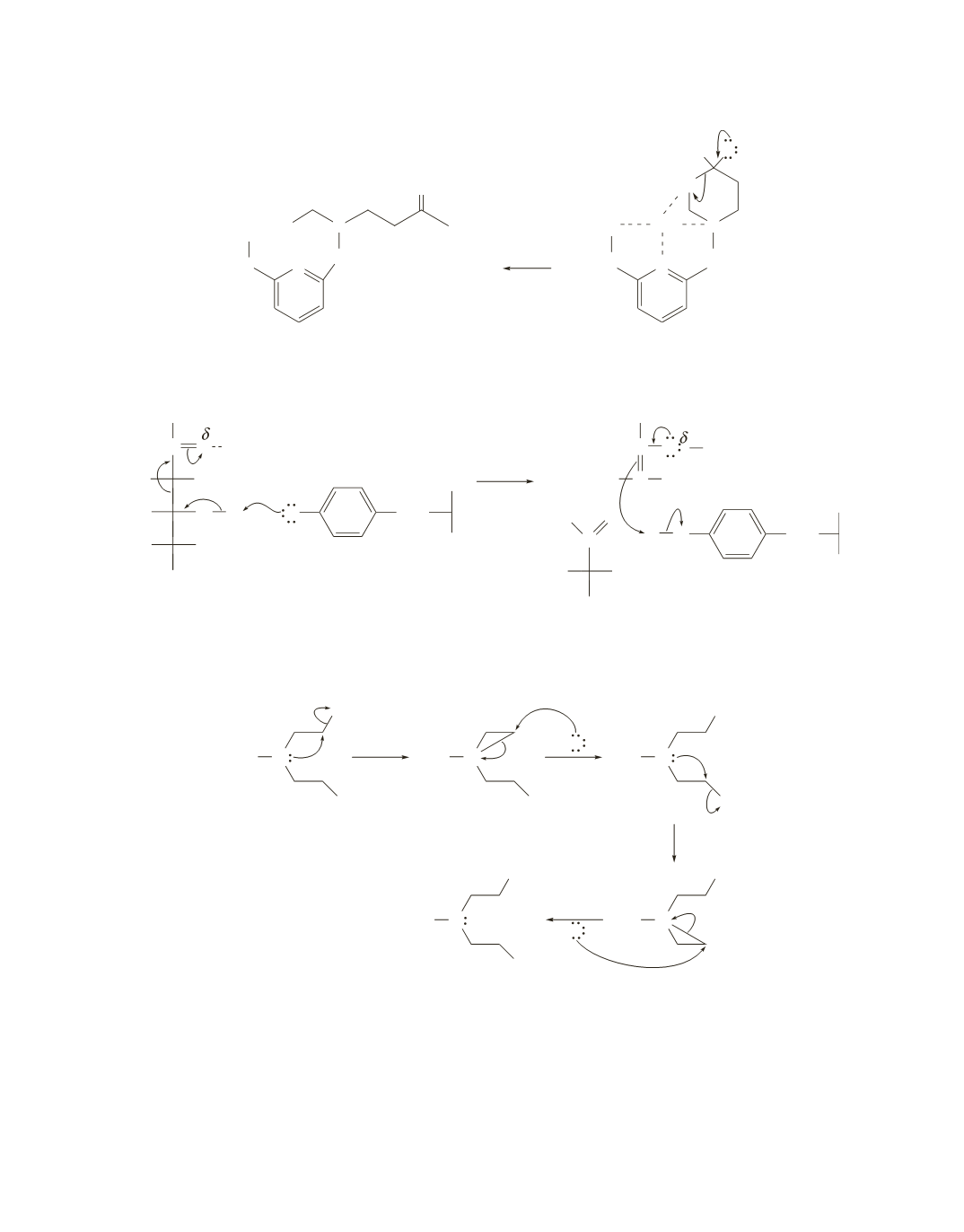
Class I aldolases use a protonated imine as a site to which electrons can be delocalized (see Problem 25). Class II
aldolases use a metal ion complexed with the carbonyl group as a site to which electrons can be delocalized.
CH
2
OPO
3
C
H
HO
O H
H
OH
H
CH
2
OPO
3
O
CH
2
O
−
OH
H
CH
2
OPO
3
CH
2
OPO
3
C
C H
H O
HO
O Zn
+
CH
2
Zn
2+
2
2
2
2
+
−
C
H O
−
−
−
−
37.
Knowing that the reaction is much slower if the N is replaced by a CH tells us that the N must be acting as
a catalyst. We see that the N is in position to be an intramolecular nucleophilic catalyst.
CH
3
N
Cl
CH
3
N
Cl
CH
3
N
Cl
Cl
+
HO
−
OH
CH
3
N
OH
HO
−
CH
3
N
OH
OH
+
38.
In the absence of morpholine, the first step of the reaction is addition of water to the
ester
because addition
of water to the aldehyde would form a hydrate that would be in equilibrium with the aldehyde.
Two mechanisms can account for the observed catalysis by morpholine. In the presence of morpholine, the
first step of the reaction (in both mechanisms) is addition of morpholine to the
aldehyde
. The reaction of
morpholine with the aldehyde is a faster reaction than the reaction of water with the ester because morpholine
is a better nucleophile than water and an aldehyde is more susceptible to nucleophilic addition than an ester.