



 755 / 912

Chapter 22 747
Copyright © 2017 Pearson Education, Inc.
32.
a.
CH
3
CH
2
SCH
2
CH
2
Cl
intramolecular nucleophilic catalysis
b.
C
O
OH
HO
O H
intramolecular general-acid catalysis
The OH substituent is protonating the leaving group as it departs,
causing it to be a weaker base and, therefore, a better leaving group.
33.
If the
ortho
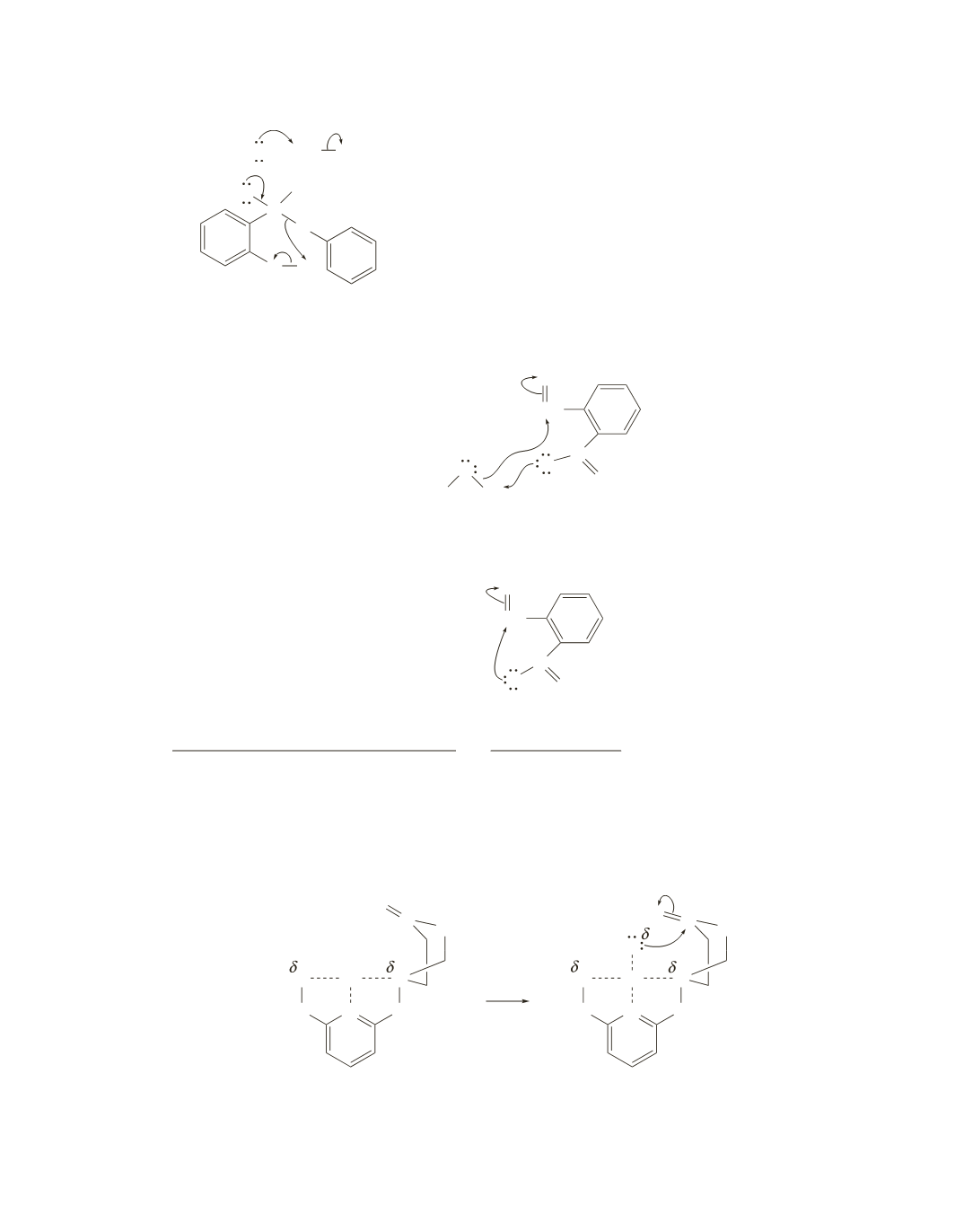
-carboxylate ion is acting as a general-base catalyst, the kinetic isotope effect will be greater
than 1.0 (see Problem 91 in Chapter 9), because an O
¬
H (or O
¬
D) bond is broken in the slow step of
the reaction and an O
¬
D bond is stronger than an O
¬
H bond and, therefore, is harder to break.
CH
3
CO
O
C
O
O
D D
−
O
If the
ortho
-carboxylate ion is acting as a nucleophilic catalyst, the kinetic isotope effect will be about 1.0,
because an O
¬
H (or O
¬
D) bond is not broken in the slow step of the reaction.
CH
3
CO
O
C
O O
−
34.
rate constant for the catalyzed reaction
rate constant for the uncatalyzed reaction
1.5
*
10
6
M
-
1
s
-
1
0.6 M
-
1
s
-
1
=
2.5
*
10
6
35.
Co
2
+
can catalyze the hydrolysis reaction by complexing with three nitrogen atoms in the substrate as well
as with water. Complexation increases the acidity of water, thereby providing a better nucleophile (metal-
bound hydroxide) for the hydrolysis reaction. Complexation with three nitrogens locks the nucleophile into
the correct position for addition to the carbonyl carbon.
N CH
2
H
2
C
R
2
N Co N
+
+
NH C
O
N CH
2
H
2
C
R
2
N Co N
+
+
−
+
NH C O
H
2
O
HO
+
H
+
+