



 754 / 912

746 Chapter 22
Copyright © 2017 Pearson Education, Inc.
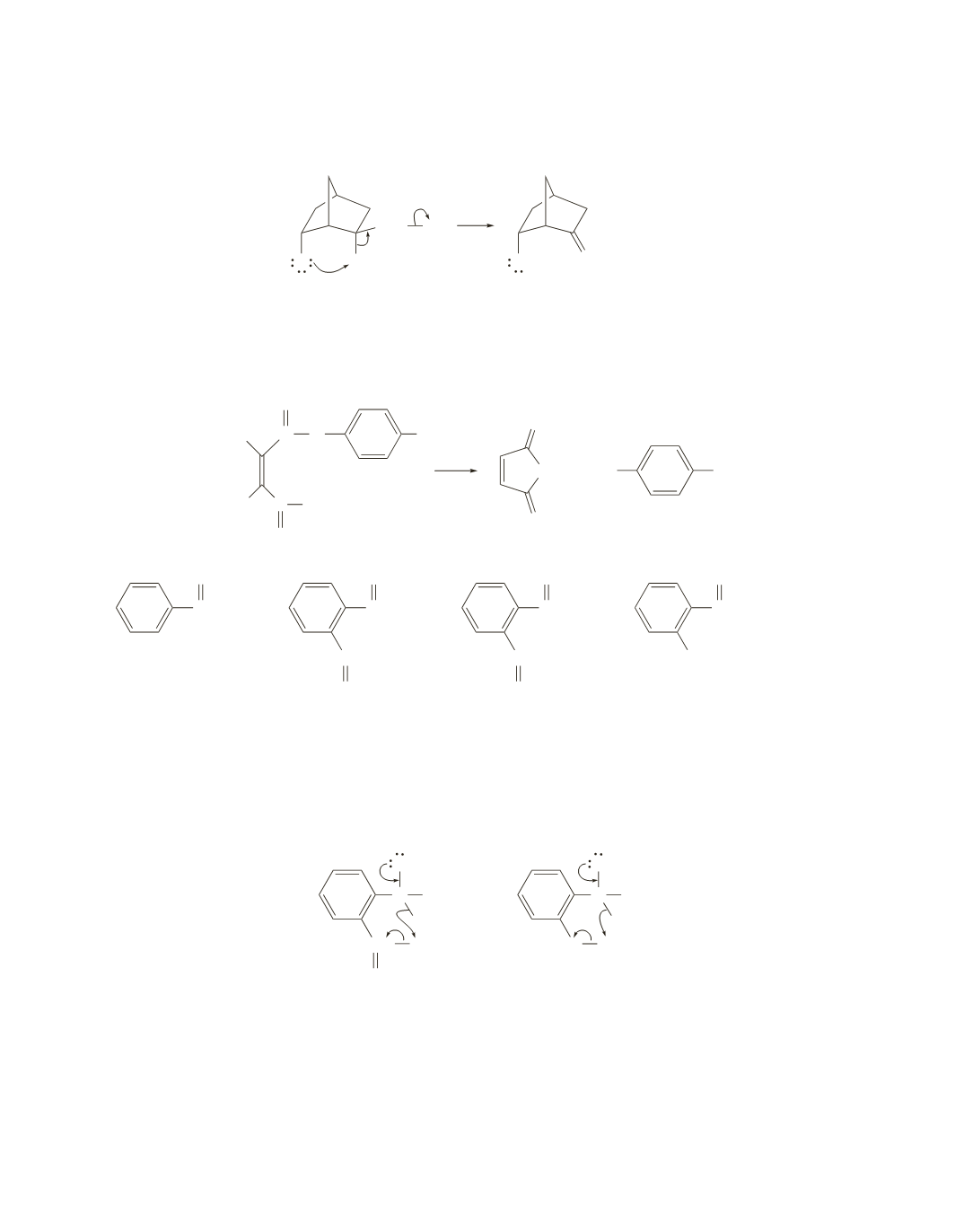
29.
The following compound eliminates HBr more rapidly because the negatively charged oxygen is in posi-
tion to act as an intramolecular general-base catalyst.
O H
CH
2
Br
CH
2
−
+
Br
−
OH
30.
The following compound will form an anhydride more rapidly because it forms a five-membered-ring anhy-
dride, which is less strained than the seven-membered-ring anhydride formed by the other compound. The
greater stability of the five-membered-ring product causes the transition state leading to its formation to be
more stable than the transition state leading to formation of the seven-membered-ring product.
H C O
C O
−
H
O
Br
O
O
O
O
−
O
Br
+
31.
CNH
2
O
CNH
2
O
COH
O
CNH
2
O
CH
O
CNH
2
O
OH
ortho
-carboxybenzamide
ortho
-hydroxybenzamide
In order to hydrolyze an amide, the NH
2
group in the tetrahedral intermediate has to leave in preference to
the less basic OH group. This can happen if the NH
2
group is protonated because
+
NH
3
is a weaker base
and, therefore, easier to eliminate than OH. Of the four compounds, two (
ortho
-carboxybenzamide and
ortho
-hydroxybenzamide) have substituents that can protonate the NH
2
by acting as acid catalysts in a hy-
drolysis reaction carried out at pH
=
3.5.
C
OH
C
O
OH
NH
2
C
OH
OH
NH
2
O H
O H
Because the carboxy group withdraws electrons from the ring by resonance and the OH group donates
electrons to the ring by resonance, formation of the tetrahedral intermediate will be faster for the carboxy-
substituted compound.
The carboxy group is a stronger acid than the OH group (and with a p
K
a
=
4.2, 83% will be in the acidic
form at pH
=
3.5). Therefore, a larger fraction of the tetrahedral intermediate will be protonated than in
the case of the hydroxy-substituted compound, so collapse of the tetrahedral intermediate will be faster.
Therefore, the
ortho
-carboxybenzamide has the faster rate of hydrolysis.