



 746 / 912

738 Chapter 22
Copyright © 2017 Pearson Education, Inc.
Mechanism for acid-catalyzed ester hydrolysis: second part
+
B
R
C
OH
O H
R C
OH
NHCH
3
OH
R C
OH
NHCH
3
OH
+
H
(4)
+
HB
+
R
C
OH
O
H B
+
OH
+
+
R
C
O
R C
OH
OCH
3
OH
H B
R C
OH
OCH
3
OH
+
H
HB
+
+
R
C
OH
CH
3
OH
+
CH
3
OH
+
CH
3
NH
2
O
+
H
B
R C
OH
H
OCH
3
R C
OH
H
OCH
3
+
H
R C
OCH
3
H
CH
3
OCH
3
+
R C
OCH
3
H
OCH
3
(3)
+
HB
+
+
R
C
H
OCH
3
H
H B
+
B
OH
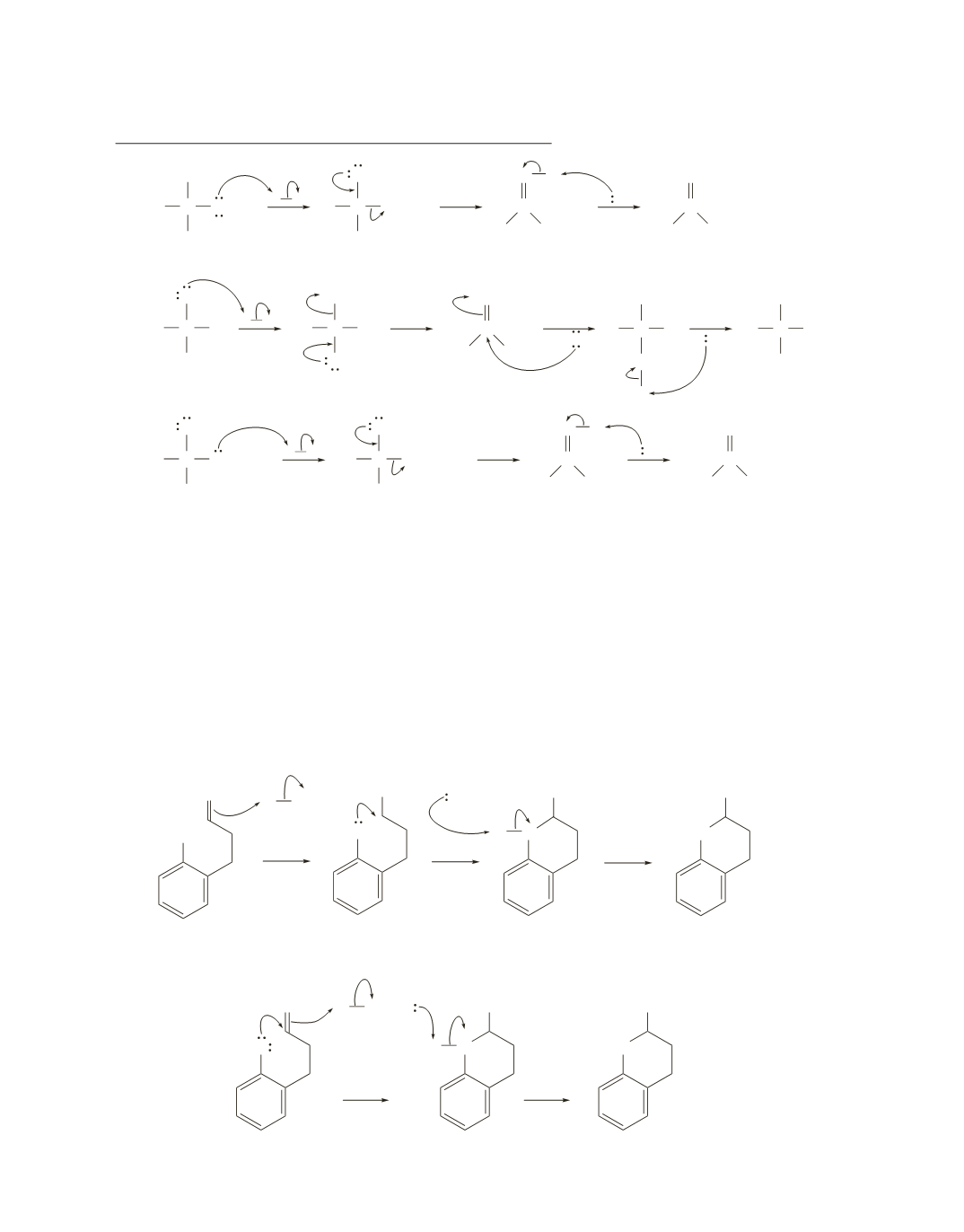
a. Similarities:
the first step is protonation of the tetrahedral intermediate, and the second step is elimi-
nation of a group from the tetrahedral intermediate. In two of the three reactions, the third step is loss
of a proton.
b. Differences:
the group that is protonated—O in the first two and N in the third—and the group that is
eliminated from the tetrahedral intermediate. The third step in acetal formation is not loss of a proton
because the intermediate does not have a proton to lose. Instead, the third step is addition of a nucleo-
phile, and the fourth step is loss of a proton.
3.
Both slow steps are specific-acid catalyzed; the compound is protonated before the slow step in each case.
4.
a.
In specific-acid catalysis, the proton is added to the reactant before the O
¬
C bond forms.
OH
CH
2
H B
+
OH
CH
3
+
O
CH
3
+
H
B
O
CH
3
HB
+
b.
In general-acid catalysis, the proton is added to the reactant and the O
¬
C bond forms in the same step.
HO
CH
2
O
CH
3
O
CH
3
H B
+
H
+
B
HB
+