



 731 / 912

Chapter 21 723
Copyright © 2017 Pearson Education, Inc.
c.
+
(CH
2
)
4
NH
3
NHCH
NHCH
CH
2
OH
H
2
NCH
NHCH
CH
2
SH
CH
2
COO
−
OH
NHCH
CH
2
NHCH
CH
2
O
−
N
NH
C
O
C
O
C
O
C
O
C
O
C
O
d.
(CH
2
)
4
NH
2
NHCH
NHCH
CH
2
OH
H
2
NCH
NHCH
CH
2
S
CH
2
COO
−
NHCH
CH
2
NHCH
CH
2
O
−
O
−
−
N
NH
C
O
C
O
C
O
C
O
C
O
C
O
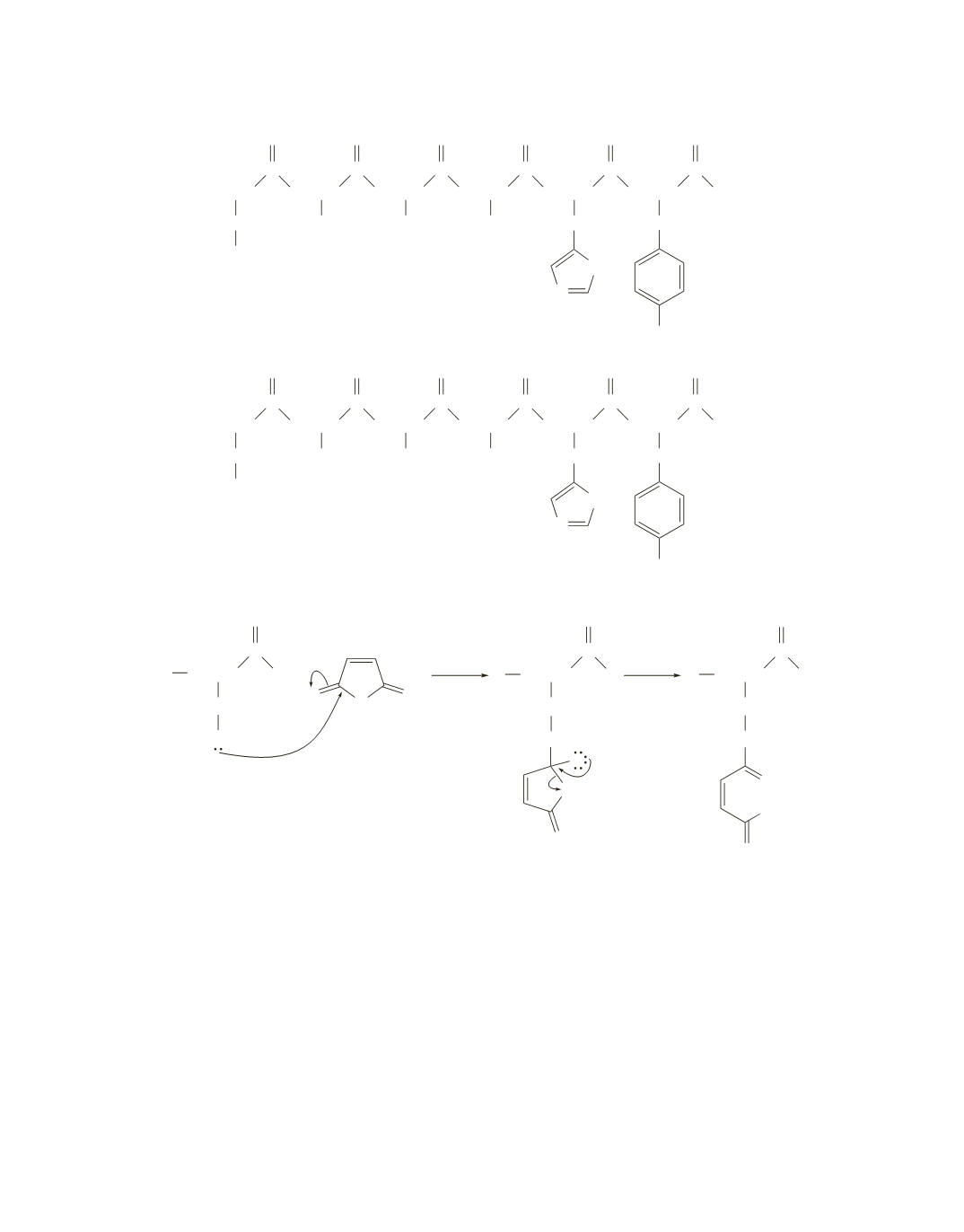
64.
NHCH
(CH
2
)
4
NH
2
+
O O
O
NHCH
O
O
O
O
O
NH
(CH
2
)
4
−
−
NHCH
(CH
2
)
4
NH
lysine
maleic
anhydride
C
O
C
O
C
O
O
65.
a.
When the polypeptide is treated with maleic anhydride, lysine reacts with maleic anhydride (see
Problem 64), but the amino group of arginine is not sufficiently nucleophilic to react with maleic anhy-
dride. Therefore, trypsin will cleave only at arginine residues because the enzyme no longer recognizes
lysine residues.
b.
Four fragments will be obtained from the polypetide. Remember that trypsin will not cleave the
Arg-Pro bond.
c.
The N-terminal end of each fragment will be positively charged because of the
+
NH
3
group.
The C-terminal end will be negatively charged because of the COO
-
group.
Arginine residues will be positively charged.
Aspartate and glutamate residues will be negatively charged.
Lysine residues will be negatively charged because they are attached to the maleic acid group.